171 posters, 10 topics, 5 sessions, 690 authors, 211 institutions
ePostersLive by SciGen Technologies S.A. All rights reserved.
American Association of Plastic Surgeons Meeting 2022
April 9 - 12 | San Diego, California

PC4
The Impact Of Breast Cancer Type, Staging, And Treatment On Free Flap Breast Reconstruction Complications
Poster Presenter
Part of Topic
Breast Reconstruction
The Impact Of Breast Cancer Type, Staging, And Treatment On Vascular Complications Of Free Flap Breast Reconstruction
Daniel Mazzaferro, MD, MBA1; Ankoor A. Talwar, MBA1; Martin P. Morris, MBE1; Harrison Davis, BS1;Jared Shulkin, BS1; Michaela Hitchner, BS1;
Jonathan Walsh, BS; Robyn B. Broach, PhD1; Ari Brooks, MD, MSEd;Joseph M. Serletti, MD1
INTRODUCTION
Patients with advanced cancer staging have a greater risk of developing venous thromboembolism (VTE) than no cancer alone. Approximately 1% of breast cancer patients experienced some form of VTE. The impact of breast cancer staging and treatment on clinical outcomes after autologous free-flap breast reconstruction (ABR) is not well-established. The objective of this retrospective study is to determine the impact of breast cancer characteristics, such as cancer staging, hormone receptor status, and history of VTE, on vascular complications of ABR.
OBJECTIVE
Identify cancer-level risk factors of vascular compromise following ABR
METHODS
A retrospective review was conducted examining patients who underwent ABR from 2009-2019. Breast cancer staging, cancer types, hormone receptor status, and treatments were collected in addition to demographic data. Intraoperative and postoperative complications related to vascular compromise, including intraoperative congestion, postoperative take back for flap concern, and flap loss, were analyzed using chi-squared test. Continuous variables were univariately analyzed with Student’s t-test. Factors with p<0.1 on univariate analysis were included in multivariate regression.
RESULTS
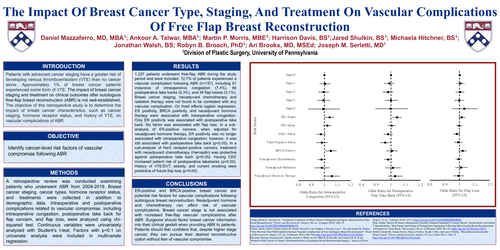
1,237 patients underwent free-flap ABR during the study period and were included. 12.7% of patients experienced a vascular complication following ABR (n=157), including 91 instances of intraoperative congestion (7.4%), 66 postoperative take backs (5.3%), and 38 flap losses (3.1%). Breast cancer staging, neoadjuvant chemotherapy and radiation therapy were not found to be correlated with any vascular complication. On fixed effects logistic regression, ER positivity, BRCA positivity, and neoadjuvant hormone therapy were associated with intraoperative congestion. Only ER positivity was associated with postoperative take back. No factor was associated with flap loss. In a sub-analysis of ER-positive cancers, when adjusted for neoadjuvant hormone therapy, ER positivity was no longer associated with intraoperative congestion; however, it was still associated with postoperative take back (p<0.05). In a sub-analysis of Her2 receptor-positive cancers, treatment with neoadjuvant chemotherapy (Herceptin) was protective against postoperative take back (p<0.05). Having CKD increased patient risk of postoperative takebacks (p<0.05). History of VTE/DVT, obesity, and current smoking were predictive of future flap loss (p<0.05).
CONCLUSIONS
ER-positive and BRCA-positive breast cancer are potential risk factors for vascular complications following autologous breast reconstruction. Neoadjuvant hormone and chemotherapy can affect risk of vascular complications. Breast cancer stage is not associated with increased free-flap vascular complications after ABR. Surgeons should factor breast cancer information into their clinical gestalt when providing ABR to patients. Patients should feel confident that, despite higher stage cancer, they can pursue their desired reconstructive option without fear of vascular compromise.