171 posters, 10 topics, 5 sessions, 690 authors, 211 institutions
ePostersLive by SciGen Technologies S.A. All rights reserved.
American Association of Plastic Surgeons Meeting 2022
April 9 - 12 | San Diego, California

PC28
Surgical And Patient-reported Outcomes Of 694 Two-stage Prepectoral Vs. Subpectoral Breast Reconstructions
Poster Presenter
Part of Topic
Breast Reconstruction
Background
•Over the past decade, there has been increasing interest in reviving use of the prepectoral plane for device placement
•
•The purpose of this study was to assess the differences in complication rates and patient satisfaction between patients who underwent prepectoral and subpectoral implant-based breast reconstruction (IBR).
Methods
•We conducted a retrospective cohort study of patients who underwent IBR at our institution from January 1, 2018, through December 31, 2019.
•
•Patients who underwent a two-stage approach (TE followed by implant placement) were included. W
•
•e excluded patients who underwent direct-to-implant or delayed-immediate reconstruction (TE followed by a free flap). Patients who underwent subpectoral TE followed by prepectoral implant or vice versa (site switches) were excluded.
•
•Device location was based on individual surgeon practice and was not related to differences in mastectomy flap thickness or viability.
•
•The study cohort was divided into those who underwent prepectoral TE (placed above the pectoralis muscle) and those who underwent subpectoral TE (dual plane).
Results
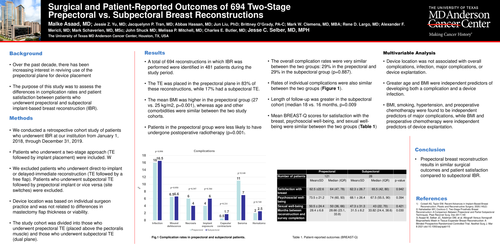
•A total of 694 reconstructions in which IBR was performed were identified in 481 patients during the study period.
•The TE was placed in the prepectoral plane in 83% of these reconstructions, while 17% had a subpectoral TE.
•The mean BMI was higher in the prepectoral group (27 vs. 25 kg/m2, p=0.001), whereas age and other comorbidities were similar between the two study cohorts.
•Patients in the prepectoral group were less likely to have undergone postoperative radiotherapy (p=0.001).
•The overall complication rates were very similar between the two groups: 29% in the prepectoral and 29% in the subpectoral group (p=0.887).
•Rates of individual complications were also similar between the two groups (Figure 1).
•Length of follow-up was greater in the subpectoral cohort (median 18 vs. 16 months, p=0.009
•Mean BREAST-Q scores for satisfaction with the breast, psychosocial well-being, and sexual well-being were similar between the two groups (Table 1)
Multivariable Analysis
•Device location was not associated with overall complications, infection, major complications, or device explantation.
•
•Greater age and BMI were independent predictors of developing both a complication and a device infection.
•
•BMI, smoking, hypertension, and preoperative chemotherapy were found to be independent predictors of major complications, while BMI and preoperative chemotherapy were independent predictors of device explantation.
•
•
Conclusion
•Prepectoral breast reconstruction results in similar surgical outcomes and patient satisfaction compared to subpectoral IBR.