171 posters, 10 topics, 5 sessions, 690 authors, 211 institutions
ePostersLive by SciGen Technologies S.A. All rights reserved.
American Association of Plastic Surgeons Meeting 2022
April 9 - 12 | San Diego, California

P154
Facial Surgery Scarring Impact On Quality-of-life: The Perspectives Of Asian And Caucasian Patients
Poster Presenter
Authors
Stuti Garg, Rou Wan, Joshua Weissman, Narainsai Reddy, Lin Lang, Marco Ellis, Gregory Dumanian, John Kim, Robert Galiano
Affiliations
Northwestern University Feinberg School of Medicine, Mayo Clinic, Division of Plastic and Reconstructive Surgery, Texas A&M Health Science Center College of Medicine, Engineering Medicine, Shanghai New Hongqiao Healthchoice Clinic
Part of Topic
Outcomes
Facial Surgery Impact on Quality-of-Life: The Perspectives of Asian and Caucasian Patients
Stuti Garg, BA1, Rou Wan, MD2, Joshua Weissman, BBA1, Narainsai Reddy, MS3, Lin Lang, MD4, Marco Ellis, MD, FACS1, Gregory Dumanian, MD, FACS1, John Kim, MD, FACS1, Robert Galiano, MD, FACS1
Background
Inappropriate scarring can result in significant morbidity that negatively impacts physical, functional, and psychosocial outcomes.1 Within plastic surgery, procedures of the face require especially careful treatment and management of subsequent scar formation. There are important differences between cutaneous scarring among different ethnic groups.2 Asian populations whose skin color ranges from type III to type V Fitzpatrick’s classification have a tendency to have hyperpigmented and overactive scarring, partly due to Asian skin having a thicker dermis, greater collagen density, and a larger number of sebaceous glands.3,4 In addition, Asian patients may experience more significant fibroblast proliferation and collagen deposition than White patients after surgical treatment.5
Thus, evaluating surgical scars postoperatively among Asian populations can help both surgeons and patients to achieve satisfactory outcomes and plan scar management accordingly. There remains a need to study the impact of facial scars on quality-of-life comparing Caucasian and Asian populations has not previously been reported. Patient-reported outcome measurements are used to understand the negative impact of scarring from the patient’s perspective.
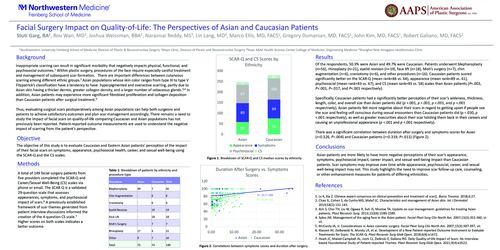
The objective of this study is to evaluate Caucasian and Eastern Asian patients' perception of the impact of their facial scars on symptoms, appearance, psychosocial health, career, and sexual well-being using the SCAR-Q and the CS scales.