171 posters, 10 topics, 5 sessions, 690 authors, 211 institutions
ePostersLive by SciGen Technologies S.A. All rights reserved.
American Association of Plastic Surgeons Meeting 2022
April 9 - 12 | San Diego, California

P153
Outcomes Of Abdominal Wall Reconstruction Using Acellular Dermal Matrix In High-risk CDC Class III And IV Defects
Poster Presenter
Authors
Abbas Hassan, Malke Asaad, Jun Liu, Anazae Offodile, Charles Butler
Affiliations
Part of Topic
Outcomes
Outcomes Of Abdominal Wall Reconstruction Using Acellular Dermal Matrix In High-risk CDC Class III And IV Defects
Abbas M Hassan, MD; Malke Asaad, MD; Anaeze C Offodile II, MD, MPH, FACS; Charles E Butler, MD, FACSDepartment of Plastic and Reconstructive Surgery, The University of Texas MD Anderson Cancer Center, Houston, TX.
Background
>400,000 operations
performed annually in the US alone.
Costs >$3 billion
AWR in the presence of bacterial contamination is challenging
Conclusion
Patients with class IV defects have a higher risk of SSOs, but not HR or SSIs
Safe and durable long-term outcomes are achievable in single-stage AWR using xenogeneic mesh for CDC class III/IV defects despite the high level of defect contamination
Contamination Level
Acellular Dermal Matrix (ADM)
Rapid revascularization
Fibroblast stimulation
Cellular
infiltration
Soft tissue
incorporation
Knowledge gap
Optimal mesh selection in class III/IV defects is controversial
Outcomes using ADM are lacking
Objective
Evaluate the long-term outcomes of AWR using Porcine ADM and bovine ADM in patients with CDC class III and IV defects
Methods
Retrospective cohort study
March 2005 to June 2019
The University of Texas MD Anderson Cancer Center
AWR of Class III and IV patients
Primary outcome: Hernia recurrence (HR)
Secondary outcomes: Surgical site occurrences (SSOs) and surgical site infections (SSIs)
Results
725 Patients
CDC Wound Classification
101
Class III/IV
322
Class II
302
Class I
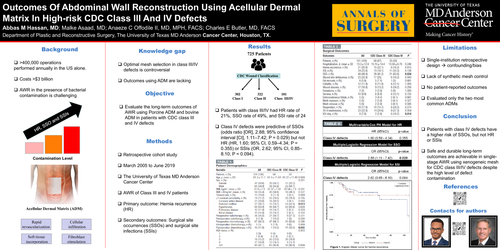
Patients with class III/IV had HR rate of 21%, SSO rate of 49%, and SSI rate of 24
Class IV defects were predictive of SSOs (odds ratio [OR], 2.88; 95% confidence interval [CI], 1.11–7.42; P = 0.029) but not HR (HR, 1.60; 95% CI, 0.59–4.34; P = 0.355) or SSIs (OR, 2.62; 95% CI, 0.85–8.10; P = 0.094).
Figure 1. Kaplan–Meier curve for hernia recurrence
Limitations
Single-institution retrospective design confounding/bias
Lack of synthetic mesh control
No patient-reported outcomes
Evaluated only the two most common ADMs
References
Contacts for authors