171 posters, 10 topics, 5 sessions, 690 authors, 211 institutions
ePostersLive by SciGen Technologies S.A. All rights reserved.
American Association of Plastic Surgeons Meeting 2022
April 9 - 12 | San Diego, California

P152
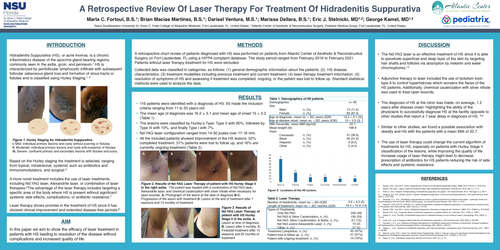
A Retrospective Review Of Laser Therapy For Treatment Of Hidradenitis Suppurativa
Poster Presenter
Authors
Marla C. Fortoul, Brian Macias Martinez, Darisel Ventura, Marissa Dallara, Eric J. Stelnicki, George Kamel
Affiliations
Nova Southeastern University Dr. Kiran C. Patel College of Allopathic Medicine, Atlantic Center of Aesthetic & Reconstructive Surgery, Pediatrix Medical Group, and Nova Southeastern University Dr. Kiran C. Patel College of Allopathic Medicine
Part of Topic
Outcomes
A Retrospective Review of Laser Therapy for Treatment Of Hidradenitis Suppurativa
Marla C. Fortoul, B.S.1; Brian Macias Martinez, B.S.1; Darisel Ventura, M.S.1; Marissa Dallara, B.S.1; Eric J. Stelnicki, MD1,2; George Kamel, MD1,2
1Nova Southeastern University Dr. Kiran C. Patel College of Allopathic Medicine, Fort Lauderdale, FL, United States; 2 Atlantic Center of Aesthetic & Reconstructive Surgery, Pediatrix Medical Group, Fort Lauderdale, FL, United States;
INTRODUCTION
Hidradenitis Suppurativa (HS), or acne inversa, is a chronic inflammatory disease of the apocrine gland-bearing regions, commonly seen in the axilla, groin, and perineum.1 HS is characterized by perifollicular lymphocytic infiltrate with subsequent follicular sebaceous gland loss and formation of sinus tracts or fistulae and is classified using Hurley Staging.1, 2
Based on the Hurley staging the treatment is selected, ranging from topical, intralesional, systemic such as antibiotics and immunomodulators, and surgical.4
A more novel treatment includes the use of laser treatments, including Nd:YAG laser, Alexandrite laser, or combination of laser therapies.6The advantage of the laser therapy includes targeting a specific area of the body where HS is present without significant systemic side effects, complications, or antibiotic resistance.7
Laser therapy shows promise in the treatment of HS since it has showed clinical improvement and extended disease-free periods.8
AIM
In this paper we aim to show the efficacy of laser treatment in patients with HS leading to resolution of the disease without complications and increased quality of life.
METHODS
A retrospective chart review of patients diagnosed with HS was performed on patients from Atlantic Center of Aesthetic & Reconstructive Surgery on Fort Lauderdale, FL using a HIPPA complaint database. The study period ranged from February 2016 to February 2021. Patients without laser therapy treatment for HS were excluded.
Collected data was classified in categories, as follows: (1) general demographic information about the patients; (2) HS disease characteristics; (3) treatment modalities including previous treatment and current treatment; (4) laser therapy treatment information; (5) resolution of symptoms of HS and assessing if treatment was completed, ongoing, or the patient was lost to follow up. Standard statistical methods were used to analyze the data.
RESULTS
• 116 patients were identified with a diagnosis of HS: 95 made the inclusion criteria ranging from 11 to 35 years old.
• The mean age of diagnosis was 16.2 ± 3.1 and mean age of onset 15 ± 3.3 (Table 1) .
• The lesions were classified by Hurley’s Type: Type II with 90%, followed by Type III with 10%, and finally Type I with 7%.
• Nd:YAG laser configuration ranged from 14-30 joules over 17-18 mm.
• All the included patients showed improvement of the HS lesions. 52% completed treatment, 31% patients were lost to follow up, and 16% are currently ongoing treatment (Table 2).
DISCUSSION
• The Nd:YAG laser is an effective treatment of HS since it is able to penetrate superficial and deep layer of the skin by targeting hair shafts and follicles via absorption by melanin and water chromophores.12
• Adjunctive therapy to laser included the use of botulism toxin type A to control hyperhidrosis which worsens the flares of the HS patients. Additionally, chemical cauterization with silver nitrate was used to treat open wounds.
• The diagnosis of HS at the clinic was made, on average, 1.2 years after disease onset. Highlighting the ability of the physicians to successfully diagnose HS at the facility opposite to other studies that report a 7-year delay in diagnosis of HS. 3,6
• Similar to other studies, we found a possible association with obesity and HS with the patients with a mean BMI of 32.7.
• The use of laser therapy could change the current algorithm of treatments for HS, especially on patients with Hurley Stage II classification of the lesions, while improving the quality of life. Increase usage of laser therapy might lead to decrease prescription of antibiotics for HS patients reducing the risk of side effects and systemic resistance.