171 posters, 10 topics, 5 sessions, 690 authors, 211 institutions
ePostersLive by SciGen Technologies S.A. All rights reserved.
American Association of Plastic Surgeons Meeting 2022
April 9 - 12 | San Diego, California

P112
Addressing The Grey Zone In Gender Affirming Mastectomy: Outcomes And Technique Choice In Fischer Grade 2 Patients
Poster Presenter
Authors
Darius Balumuka, Kelsi Krakauer, Ana Meza-Rochin, Juliana Hansen
Affiliations
Part of Topic
Gender Affirmation
Addressing the Grey Zone in Gender Affirming Mastectomy: Outcomes and Technique Choice in Fischer Grade 2 Patients
Background:
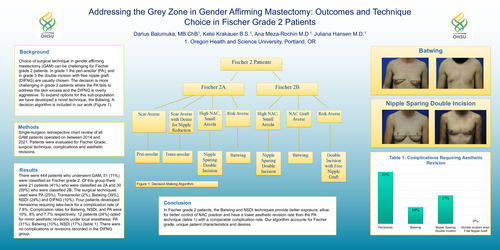
Choice of surgical technique in gender affirming mastectomy (GAM) can be challenging for Fischer grade 2 patients. In grade 1 the peri-areolar (PA), and in grade 3 the double incision with free nipple graft (DIFNG) are usually chosen. The decision is more challenging in grade 2 patients where the PA fails to address the skin excess and the DIFNG is overly aggressive. To expand options for this sub-population we have developed a novel technique, the Batwing. A decision algorithm is included in our work (Figure 1).
Methods:
Single-surgeon retrospective chart review of all GAM patients operated on between 2014 and 2021. Patients were evaluated for Fischer Grade, surgical technique, complications and aesthetic revisions.
Results:
There were 444 patients who underwent GAM, 51 (11%) were classified as Fischer grade 2. Of this group there were 21 patients (41%) who were classified as 2A and 30 (59%) who were classified 2B. The surgical techniques used were PA (25%), Transareolar (2%), Batwing (39%), NSDI (24%) and DIFNG (10%). Four patients developed hematoma requiring take-back for a complication rate of 7.8%. Complication rates for Batwing, NSDI, and PA were 10%, 8% and 7.7% respectively. 12 patients (24%) opted for minor aesthetic revisions under local anesthesia; PA (31%), Batwing (10%), NSDI (17%) (table 1). There were no complications or revisions recorded in the DIFNG group.
Conclusion:
In Fischer grade 2 patients, the Batwing and NSDI techniques provide better exposure, allow for better control of NAC position and have a lower aesthetic revision rate than the PA (table 1) technique with a comparable complication rate. Our algorithm accounts for Fischer grade, unique patient characteristics and desires.