171 posters, 10 topics, 5 sessions, 690 authors, 211 institutions
ePostersLive by SciGen Technologies S.A. All rights reserved.
American Association of Plastic Surgeons Meeting 2022
April 9 - 12 | San Diego, California

P102
Implementation Of An Enhanced Recovery After Surgery Protocol For Facial Feminization Surgery Reduces Pain, Opioid Usage, And Length Of Hospital Stay
Part of Topic
Gender Affirmation
Background:
Enhanced recovery after surgery (ERAS) protocols employ a multimodal approach to perioperative care, with aims to improve postoperative patient outcomes and optimize recovery.
Implementation of ERAS to reduce opioid use following gender-affirming surgery (GAS) is of particular interest due to disparities in prevalence of prescribed opioid abuse and psychiatric comorbidities in transgender persons, known risk factors for persistent opioid use after surgeries.
The purpose of this study was to evaluate the efficacy of ERAS protocol implementation after facial feminization surgery (FFS) in terms of total opioid use, postoperative pain scores, and length of hospital stay (LOS).
Methods:
Patients undergoing FFS by a single surgeon prior to ERAS implementation (March 2019 - January 2021) were compared to patients treated with ERAS protocol (January 2021 - January 2022) at a single institution (University of California Los Angeles IRB protocol 11-000925).
Exclusion criteria: history of chronic pain, prior FFS.
Retrospective chart review was performed to collect demographics, medical and surgical history, FFS characteristics, analgesic medication usage, pain scores, and LOS.
Pre-ERAS protocol: PRN analgesia, primarily oral oxycodone and acetaminophen with intravenous (IV) hydromorphone for severe pain, and oral oxycodone at discharge.
ERAS protocol: preoperative counseling/education, intraoperative and postoperative multimodal regimen including IV ketorolac, IV and oral acetaminophen, and oral tramadol for breakthrough pain. At discharge, oral acetaminophen and ibuprofen and a 5-day supply of tramadol.
Chi-square, Mann-Whitney U, and independent samples t tests were used to compare pre-ERAS and ERAS groups. Multivariable linear regressions were conducted to determine whether implementation of the ERAS protocol predicted total opioid use, pain scores, or LOS.
Results:
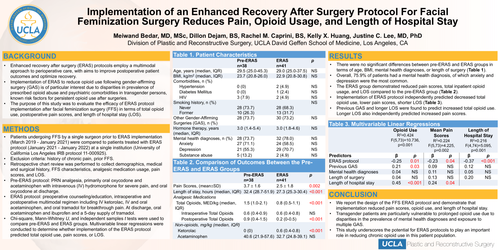
There were no significant differences between pre-ERAS and ERAS groups in terms of age, BMI, mental health diagnoses, or length of surgery (Table 1).
Overall, 75.9% of patients had a mental health diagnosis, of which anxiety and depression were the most common.
The ERAS group demonstrated reduced pain scores, total inpatient opioid usage, and LOS compared to the pre-ERAS group (Table 2).
Implementation of ERAS protocol independently predicted decreased total opioid use, lower pain scores, shorter LOS (Table 3).
Previous GAS and longer LOS were found to predict increased total opioid use. Longer LOS also independently predicted increased pain scores.
Conclusion:
We report the design of the FFS ERAS protocol and demonstrate that implementation reduced pain scores, opioid use, and length of hospital stay.
Transgender patients are particularly vulnerable to prolonged opioid use due to disparities in the prevalence of mental health diagnoses and exposure to multiple GAS.
This study underscores the potential for ERAS protocols to play an important role in reducing chronic opioid use in this patient population.