171 posters, 10 topics, 5 sessions, 690 authors, 211 institutions
ePostersLive by SciGen Technologies S.A. All rights reserved.
American Association of Plastic Surgeons Meeting 2022
April 9 - 12 | San Diego, California

P105
Blood Pressure Challenge Reduces Complications In Female To Male Gender-Affirming Chest Reconstruction: A Retrospective Chart Review
Poster Presenter
Authors
John Slate-Romano, Victoria Zeyl, Darden Beqiri, Joseph Crozier, Paul Liu, Daniel Kwan
Affiliations
Warren Alpert Medical School, Brown University, Providence, Rhode Island, 02903, Department of Plastic and Reconstructive Surgery, Rhode Island Hospital, Warren Alpert Medical School, Brown University, Providence, Rhode Island 02903
Part of Topic
Gender Affirmation
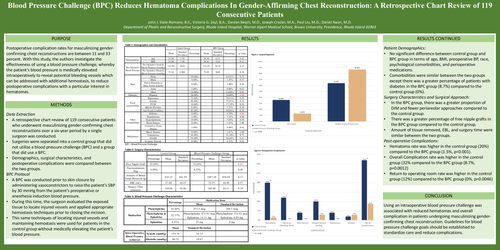
Blood Pressure Challenge (BPC) Reduces Hematoma Complications In Gender-Affirming Chest Reconstruction: A Retrospective Chart Review of 119 Consecutive Patients
John J. Slate-Romano, B.S., Victoria G. Zeyl, B.A., Dardan Beqiri, M.D., Joseph Crozier, M.A., Paul Liu, M.D., Daniel Kwan, M.D.
Department of Plastic and Reconstructive Surgery, Rhode Island Hospital, Warren Alpert Medical School, Brown University, Providence, Rhode Island 02903
PURPOSE
Postoperative complication rates for masculinizing gender-confirming chest reconstructions are between 11 and 33 percent. With this study, the authors investigate the effectiveness of using a blood pressure challenge, whereby the patient’s blood pressure is medically elevated intraoperatively to reveal potential bleeding vessels which can be addressed with additional hemostasis, to reduce postoperative complications with a particular interest in hematomas.
METHODS
Data Extraction
BPC Protocol
Patient Demographics:
Surgery Characteristics and Surgical Approach:
Post-operative Complications:
CONCLUSION
Using an intraoperative blood pressure challenge was associated with reduced hematomas and overall complication in patients undergoing masculinizing gender-confirming chest reconstruction. Guidelines for blood pressure challenge goals should be established to standardize care and reduce complications.