171 posters, 10 topics, 5 sessions, 690 authors, 211 institutions
ePostersLive by SciGen Technologies S.A. All rights reserved.
American Association of Plastic Surgeons Meeting 2022
April 9 - 12 | San Diego, California

P110
Facial Feminization In The United States From 2015-2017
Poster Presenter
Part of Topic
Gender Affirmation
Limited Access to Facial Feminization Geographically Despite Nationwide Expansion of Other Gender Affirming Surgeries
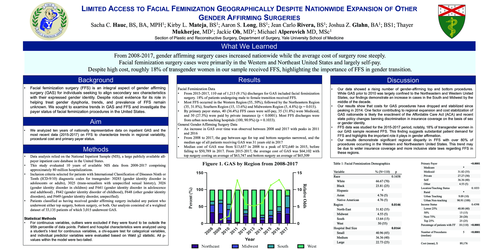
Facial feminization surgery (FFS) is an integral aspect of gender affirming surgery (GAS) for individuals seeking to align secondary sex characteristics with their expressed gender identity. Despite robust evidence for its role in helping treat gender dysphoria, trends, and prevalence of FFS remain unknown. We sought to examine trends in GAS and FFS and investigate the payer status of facial feminization procedures in the United States.
We analyzed ten years of nationally representative data on inpatient GAS and the most recent data (2015-2017) on FFS to characterize trends in regional variability, procedural cost and primary payer status.
Our data showed a rising number of gender-affirming top and bottom procedures. While GAS prior to 2010 was largely confined to the Northeastern and Western United States, our findings demonstrate an increase in cases in the South and Midwest by the middle of the decade.
Our results show that costs for GAS procedures have dropped and stabilized since peaking in 2014. One factor contributing to regional expansion and cost stabilization of GAS nationwide is likely the enactment of the Affordable Care Act (ACA) and recent state policy changes banning discrimination in insurance coverage on the basis of sex or gender identity.
FFS data was studied for the 2015-2017 period, notably, 18% of transgender women in our GAS sample received FFS. This finding suggests substantial patient demand for FFS and highlights the important role it plays in gender affirmation.
Our results demonstrate significant regional disparity in FFS with over 80% of procedures occurring in the Western and Northeastern United States. This trend may be due to wider insurance coverage and more inclusive state laws regarding FFS in these regions.