Loading...

171 posters, 10 topics, 5 sessions, 690 authors, 211 institutions

ePostersLive by SciGen Technologies S.A. All rights reserved.

American Association of Plastic Surgeons Meeting 2022

April 9 - 12 | San Diego, California

American Association of Plastic Surgeons Meeting 2022 banner

P109

Teaching and Training In Gender-Affirming Procedures In US Academic Plastic Surgery Residency Programs
Part of Topic

Gender Affirmation

Training in Transgender Surgery in
US Academic Plastic Surgery Residency Programs

M Ha1; LM Ngaage1,2; ER Finkelstein3; C Simon1; N Hricz1; K Zhu1; J Yoon4; F Liang4; R Bluebond-Langner5; J Berli6; YM Rasko1

1 - Division of Plastic Surgery, Department of Surgery, University of Maryland School of Medicine, Baltimore; 2 - Department of Plastic and Reconstructive Surgery, Johns Hopkins University, Baltimore; 3 - Ross University School of Medicine, Barbados, West Indies;

4 - Division of Plastic Surgery, R Adams Cowley Shock Trauma Center, University of Maryland School of Medicine, Baltimore; 5-Hansjörg Wyss Department of Plastic and Reconstructive Surgery, New York University Langone Health; 6 - Division of Plastic and Reconstructive Surgery, Oregon Health & Science University, Portland, Oregon

 Background

•Over 1.4 million adults in the US identifying as transgender, up to half seeking surgical transition.
•Access to a qualified provider is a primary reason for not receiving gender affirmation surgery.
•Plastic surgeons have stated feeling under-prepared in managing transgender surgical care after residency training.


AIM: To provide a thorough cross-sectional review of the current state of gender transition education in US Plastic Surgery Residency Programs  

Methods

•Accredited integrated and independent plastic surgery programs collected from ACAPS public database.
•Details of transgender training were extracted from program websites, and phone calls or emails to program coordinators, then categorized by:
•Geographic location
•Affiliation with a “Leader in LGBTQ Healthcare” center
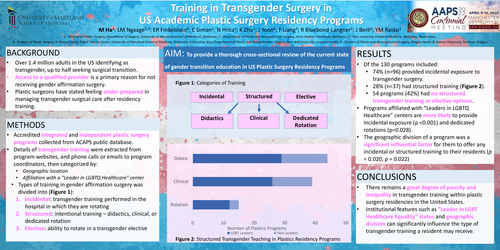
•Types of training in gender affirmation surgery was divided into (Figure 1):
1.Incidental: transgender training performed in the hospital in which they are rotating
2.Structured: intentional training – didactics, clinical, or dedicated rotation
3.Elective: ability to rotate in a transgender elective
 
Results
•Of the 130 programs included:
•74% (n=96) provided incidental exposure to transgender surgery.
•28% (n=37) had structured training (Figure 2).
•54 programs (42%) had no structured transgender training or elective options.
•Programs affiliated with “Leaders in LGBTQ Healthcare” centers are more likely to provide incidental exposure (p <0.001) and dedicated rotations (p=0.028). 
•The geographic division of a program was a significant influential factor for them to offer any incidental or structured training to their residents (p = 0.020, p = 0.022)
 
Conclusion
•There remains a great degree of paucity and inequality in transgender training within plastic surgery residencies in the United States.
•Institutional features such as “Leader in LGBT Healthcare Equality” status and geographic division can significantly influence the type of transgender training a resident may receive.  
 
American Association of Plastic Surgeons Meeting 2022 » banner
Copyright © 2015-2026, ePostersLive® SciGen is a registered trademark of SciGen Technologies S.A. Patent pending.

This website and third-party tools we use rely on cookies for the best user experience. By selecting "I agree", you agree to cookie usage as described in our Privacy Policy.