171 posters, 10 topics, 5 sessions, 690 authors, 211 institutions
ePostersLive by SciGen Technologies S.A. All rights reserved.
American Association of Plastic Surgeons Meeting 2022
April 9 - 12 | San Diego, California

P108
Enhancing Outcomes By Optimizing The Nasofrontal Angle: Surgical Decision Making In Gender Affirmation Surgery
Poster Presenter
Authors
Affiliations
Part of Topic
Gender Affirmation
Enhancing Outcomes by Optimizing the Nasofrontal Angle: Surgical Decision Making In Gender
Affirmation Surgery
Angela Rodriguez, MD1 Mark Constantian, MD2
1Align Surgical Associates San Francisco, CA
2University of Wisconsin school of Medicine, Madison, WI
Email: angela@alignsurgical.com
PURPOSE
•Precise preoperative planning around the nasofrontal area correlate with better aesthetic outcomes.
• Forehead remodeling and frontal sinus setback can be performed with or without rhinoplasty in the setting of facial feminization surgery.
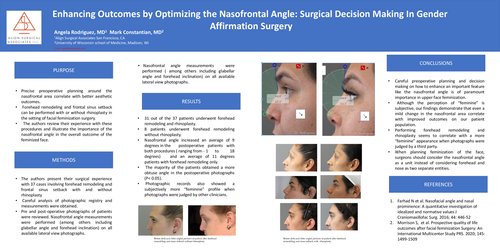
• The authors review their experience with these procedures and illustrate the importance of the nasofrontal angle in the overall outcome of the feminized face.
METHODS
•The authors present their surgical experience with 37 cases involving forehead remodeling and frontal sinus setback with and without rhinoplasty
• Careful analysis of photographic registry and measurements were obtained.
•Pre and post-operative photographs of patients were reviewed. Nasofrontal angle measurements were performed (among others including glabellar angle and forehead inclination) on all available lateral view photographs.
• Nasofrontal angle measurements were performed ( among others including glabellar angle and forehead inclination) on all available lateral view photographs.
RESULTS
•31 out of the 37 patients underwent forehead remodeling and rhinoplasty.
•8 patients underwent forehead remodeling without rhinoplasty.
•Nasofrontal angle increased an average of 9 degrees in the postoperative patients with both procedures ( ranging from - 1 to 18 degrees) and an average of 11 degrees patients with forehead remodeling only.
• The majority of the patients obtained a more obtuse angle in the postoperative photographs (P< 0.05).
• Photographic records also showed a subjectively more “feminine” profile when photographs were judged by other clinicians.
CONCLUSIONS
•Careful preoperative planning and decision making on how to enhance an important feature like the nasofrontal angle is of paramount importance in upper face feminization.
• Although the perception of “feminine” is subjective, our findings demonstrate that even a mild change in the nasofrontal area correlate with improved outcomes on our patient population.
•Performing forehead remodeling and rhinoplasty seems to correlate with a more “feminine” appearance when photographs were judged by a third party.
•When planning feminization of the face, surgeons should consider the nasofrontal angle as a unit instead of considering forehead and nose as two separate entities.