171 posters, 10 topics, 5 sessions, 690 authors, 211 institutions
ePostersLive by SciGen Technologies S.A. All rights reserved.
American Association of Plastic Surgeons Meeting 2022
April 9 - 12 | San Diego, California

P107
Comparison Of Chest Femininity Of Transgender Women With Hormone Treatment Vs. Surgically Augmented With Breast Implants
Poster Presenter
Part of Topic
Gender Affirmation
COMPARISON OF CHEST FEMININITY OF TRANSGENDER WOMEN WITH HORMONE TREATMENT VS. SURGICALLY AUGMENTED WITH BREAST IMPLANTS
Objectives
Background and Need:
•For male-to-female transgender patients, there is often the innate assumption that surgical breast augmentation will increase perceived chest femininity beyond hormone therapy alone.
•However, there are few studies that compare the outcomes of breast augmentation and hormone therapy in terms of chest femininity in this patient population.
Future Implementation:
•Study results may be incorporated in pre-surgical counseling to help inform patient decision-making regarding breast augmentation in terms of its impact on perceived femininity.
•Future studies will examine other subjective procedures to assess the objective change in perceived femininity.
Methods
Image Collection and Alteration:
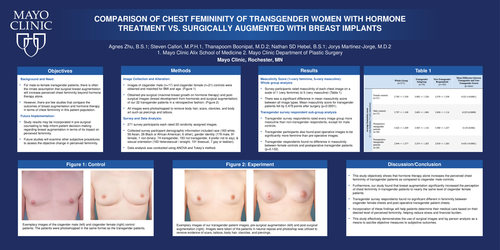
•Images of cisgender male (n=17) and cisgender female (n=21) controls were obtained and matched for BMI and age (Figure 1).
•Obtained pre-surgical (maximal breast growth on hormone therapy) and post-surgical images (breast development from hormones and surgical augmentation) of our 22 transgender patients in a retrospective fashion. (Figure 2)
•All images were photoshopped to remove body hair, scars, clavicles, and body art such as piercings and tattoos.
Survey and Data Analysis:
•271 survey participants each rated 20 randomly assigned images.
•Collected survey participant demographic information included race (183 white, 56 Asian, 26 Black or African American, 6 other), gender identity (179 male, 91 female, 1 non-binary; 74 transgender, 193 not transgender, 4 prefer not to say), & sexual orientation (163 heterosexual / straight, 101 bisexual, 7 gay or lesbian).
•Data analysis was conducted using ANOVA and Tukey’s method.
Results
Masculinity Score (1=very feminine, 5=very masculine):
Whole group analysis
•Survey participants rated masculinity of each chest image on a scale of 1 (very feminine) to 5 (very masculine) (Table 1).
•There was a significant difference in mean masculinity score between all image types. Mean masculinity score for transgender patients fell by 0.478 points after surgery (p<0.0001).
Transgender survey respondent sub-group analysis
•Transgender survey respondents rated every image group more masculine than non-transgender respondents, except for male controls.
•Transgender participants also found post-operative images to be significantly more feminine than pre-operative images.
•Transgender respondents found no difference in masculinity between female controls and postoperative transgender patients (p=0.132).
Discussion/Conclusion
•This study objectively shows that hormone therapy alone increases the perceived chest femininity of transgender patients as compared to cisgender male controls.
•Furthermore, our study found that breast augmentation significantly increased the perception of chest femininity in transgender patients to nearly the same level of cisgender female patients.
•Transgender survey respondents found no significant different in femininity between cisgender female chests and post-operative transgender patient chests.
•Incorporation of these findings will help patients determine their medical care based on their desired level of perceived femininity, helping reduce stress and financial burden.
•This study effectively demonstrates the use of surgical images and lay person analysis as a means to ascribe objective measures to subjective outcomes.