171 posters, 10 topics, 5 sessions, 690 authors, 211 institutions
ePostersLive by SciGen Technologies S.A. All rights reserved.
American Association of Plastic Surgeons Meeting 2022
April 9 - 12 | San Diego, California

P106
Gender Affirming Top Surgery In Transmale Vs. Gender Nonconforming Patients - Does Gender Identity Affect Patient-reported Outcomes?
Poster Presenter
Authors
Emmeline Jia, Sivana Barron, Christine Kang, Monica Morgenstern, Valeria Bustos, Carolina Torres, Brianna Slatnick, Amy Maselli, Bernard Lee, Adam Tobias, Ryan Cauley
Affiliations
Beth Israel Deaconess Medical Center, Beth Israel Deaconess Medical Center/Rutgers Robert Wood Johnson Medical School
Part of Topic
Gender Affirmation
Gender Affirming Top Surgery in Transmale vs. Gender Nonconforming Patients – Does Gender Identity Affect Patient-Reported Outcomes?
Emmeline Jia, MS.1 Sivana Barron, BA.1 Christine O. Kang, MD, MHS, MS.1 Monica Morgenstern, MS.1 Valeria Bustos, MD, MSc.1 Carolina Torres, MD.1 Brianna L. Slatnick, MD.1,2 Amy Maselli, MD.1 Bernard Lee, MD, MBA, MPH, FACS.1 Adam M. Tobias, MD.1 Ryan P. Cauley MD, MPH.1
1Division of Plastic and Reconstructive Surgery. Beth Israel Deaconess Medical Center. Harvard Medical School. Boston, MA
2Department of Surgery. Rutgers Robert Wood Johnson Medical School. New Brunswick, NJ
Purpose:
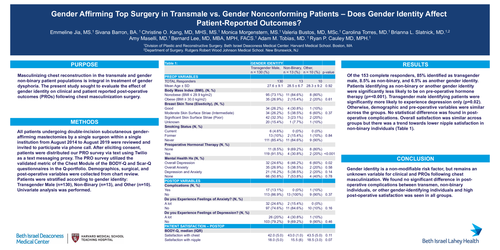
Masculinizing chest reconstruction in the transmale and gender non-binary patient populations is integral in treatment of gender dysphoria. The present study sought to evaluate the effect of gender identity on clinical and patient reported post-operative outcomes (PROs) following chest masculinization surgery.
Methods:
All patients undergoing double-incision subcutaneous gender-affirming mastectomies by a single surgeon within a single institution from August 2014 to August 2019 were reviewed and invited to participate via phone call. After eliciting consent, patients were distributed our PRO survey via text using Twilio as a text messaging proxy. The PRO survey utilized the validated metric of the Chest Module of the BODY-Q and Scar-Q questionnaires in the Q-portfolio. Demographics, surgical, and post-operative variables were collected from chart review. Patients were stratified according to gender identity: Transgender Male (n=130), Non-Binary (n=13), and Other (n=10). Univariate analysis was performed.
Results:
Of the 153 complete responders, 85% identified as transgender male, 8.5% as non-binary, and 6.5% as another gender identity. Patients identifying as non-binary or another gender identity were significantly less likely to be on pre-operative hormone therapy (p=<0.001). Transgender male identifying patients were significantly more likely to experience depression only (p=0.02). Otherwise, demographic and pre-operative variables were similar across the groups. No statistical difference was found in post-operative complications. Overall satisfaction was similar across groups but there was a trend towards lower nipple satisfaction in non-binary individuals (Table 1).
Conclusion:
Gender identity is a non-modifiable risk factor, but remains an unknown variable for clinical and PROs following chest masculinization. We found no significant difference in post-operative complications between transmen, non-binary individuals, or other gender-identifying individuals and high post-operative satisfaction was seen in all groups.