4,068 posters, 219 videos, 101 topics, 69 sessions, 14,365 authors, 6,128 institutions
ePostersLive by SciGen Technologies S.A. All rights reserved.
Alzheimer's Association International Conference 2026
July 12-15, 2026 | London, United Kingdom, and Online

13858
Apoe-e4 Disrupts Cell-type-specific Clinicopathological Coupling In The Human Dlpfc Via Regulon Reprogramming And Xist Inversion
Poster Presenter
Authors
Affiliations
Part of Topic
Basic Science and Pathogenesis -> Genetics -> Genetic factors of Alzheimer’s disease
Hello, I am Dr. Yiyang Wu from the Vanderbilt Memory and Alzheimer’s Center at Vanderbilt Health from the USA.
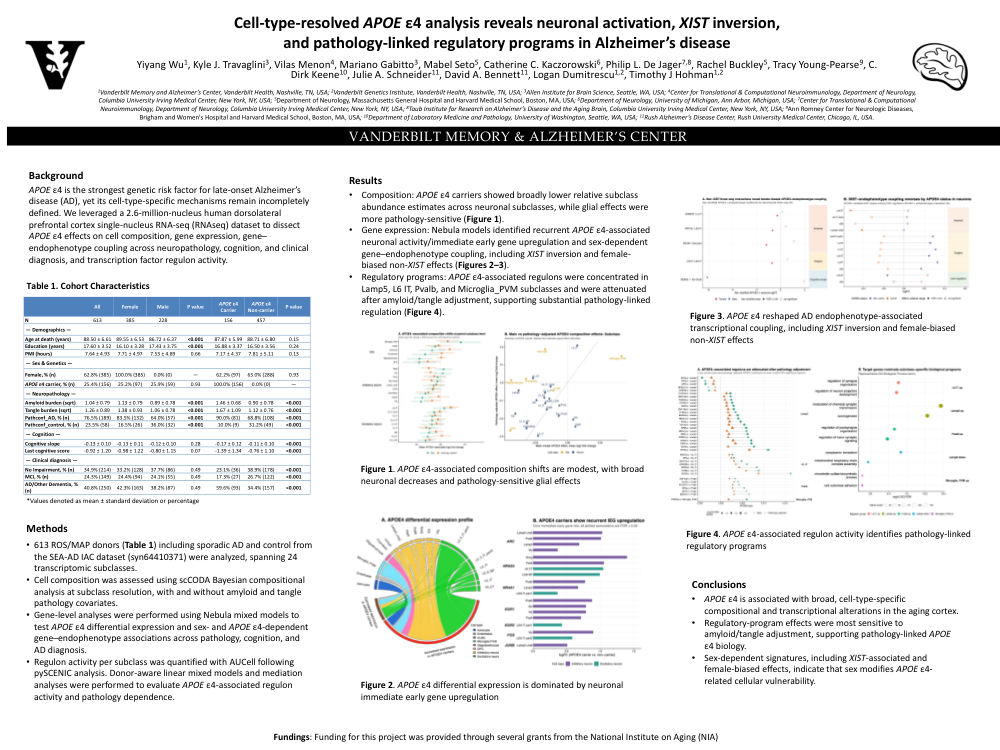
APOE epsilon 4 is the strongest common genetic risk factor for late-onset Alzheimer’s disease, but its cell-type-specific mechanisms remain incompletely understood. In this study, we used a large human single-nucleus RNA-sequencing dataset to examine how APOE epsilon 4 influences cell composition, gene expression, pathology- and cognition-related transcriptional coupling, and transcriptional regulatory programs.
We analyzed dorsolateral prefrontal cortex tissue from 613 ROS/MAP participants in the SEA-AD Integrative Analysis Center dataset, comprising approximately 2.6 million nuclei across 24 transcriptomic subclasses. We applied scCODA to evaluate cellular composition, Nebula mixed models for gene-level analyses, and pySCENIC with AUCell to quantify transcription factor regulon activity.
First, at the composition level, APOE epsilon 4 carriers showed broadly lower relative abundance estimates across neuronal subclasses. In contrast, glial composition estimates were more sensitive to adjustment for amyloid and tangle pathology. This indicates that APOE epsilon 4-associated compositional differences are modest and that their interpretation depends partly on whether neuropathology is modeled.
Second, gene-level analysis identified recurrent APOE epsilon 4-associated upregulation of neuronal activity and immediate early gene programs. These findings were concentrated in neuronal subclasses and suggest altered activity-responsive transcriptional states in APOE epsilon 4 carriers.
We also found that APOE epsilon 4 reshaped transcriptional coupling with Alzheimer’s disease endophenotypes in a sex-dependent manner. XIST showed an APOE epsilon 4-dependent inversion of its associations with pathology and cognition. In addition, several non-XIST genes showed predominantly female-biased APOE epsilon 4-by-endophenotype interactions. Together, these results suggest that sex modifies how APOE epsilon 4 influences cell-type-specific transcriptional responses to disease-related processes.
Finally, APOE epsilon 4-associated regulatory programs were concentrated in Lamp5, L6 IT, Pvalb, and Microglia_PVM subclasses. Many of these regulon associations were attenuated after amyloid and tangle adjustment, supporting substantial pathology-linked regulation. This included a microglial PPARG regulon associated with FLT1, as well as neuronal regulatory programs related to synaptic and neurite biology.
In conclusion, APOE epsilon 4 is associated with broad but cell-type-specific compositional and transcriptional alterations in the aging cortex. Our findings highlight pathology-linked regulatory programs and sex-dependent transcriptional signatures as important components of APOE epsilon 4-related cellular vulnerability in Alzheimer’s disease.
Thank you for your interest! If you have any questions, please feel free to send me an email at yiyang.wu@vumc.org.
Comments
Email is required but is not shown publicly.
Loading comments...