4,068 posters, 219 videos, 101 topics, 69 sessions, 14,365 authors, 6,128 institutions
ePostersLive by SciGen Technologies S.A. All rights reserved.
Alzheimer's Association International Conference 2026
July 12-15, 2026 | London, United Kingdom, and Online

11856
Mtor Dysregulation Disrupts Cerebrovascular Rna Processing Networks In Alzheimer’S Disease
Poster Presenter
Authors
Affiliations
Part of Topic
Basic Science and Pathogenesis -> Human Neuropathology -> Vascular
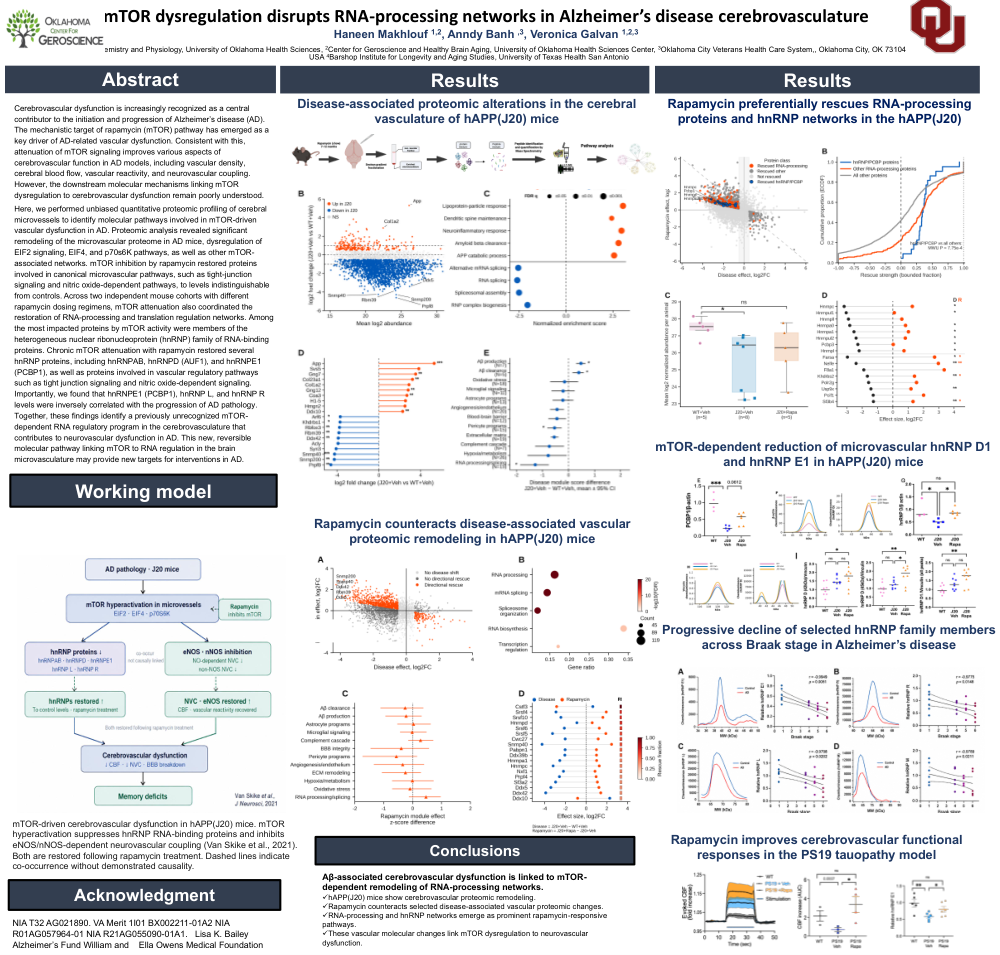
mTOR drives hnRNP family remodeling in Alzheimer’s disease
Haneen Makhlouf 1,2, Andy Banh3, Veronica Galvan1,2,4
1Department of Biochemistry and Molecular Biology, 2Center for Geroscience and Healthy Brain Aging, University of Oklahoma Health Campus
3Department of Neurology, Washington University in St Louis
4Oklahoma City Veterans Health Care System
Cerebrovascular dysfunction is central to Alzheimer’s disease (AD) initiation and progression. We and others have identified the mechanistic/mammalian target of rapamycin (mTOR) as a central driver of cerebrovascular dysregulation in AD. Consistent with this, mTOR attenuation prevents and reverses AD-like vascular deficits by restoring multiple aspects of brain vascular function, including brain vascular density, cerebral blood flow, vascular reactivity, and neurovascular coupling. However, the mechanisms by which mTOR drives cerebrovascular dysfunction in AD remain unclear.
Here, we present the first global proteome map of mTOR-driven cerebrovascular deficits in AD-like disease and examine how chronic mTOR attenuation with rapamycin blocks and reverses these alterations. We found significant changes in the microvascular proteome of AD mice as compared to non-diseased littermates, including dysregulation of EIF2 signaling, EIF4 and p70s6K pathways, and other mTOR-associated networks. mTOR inhibition by rapamycin restored proteins involved in canonical microvascular pathways, such as tight-junction signaling and nitric oxide-dependent pathways, to levels indistinguishable from controls. Across two independent mouse cohorts with different rapamycin dosing regimes mTOR attenuation also restored multiple heterogeneous ribonucleoproteins (hnRNPs), including, but not limited to hnRNPAB, hnRNPD (AUF1), and hnRNPE1 (PCBP1). Notably, we found that PCBP1 levels negatively correlate with AD progression in humans. Given recent evidence suggests that aberrant RNA processing may have a central role in the activation of cellular senescence and the progression of neurodegeneration, our studies suggest that mTOR drives amyloid-induced downregulation of large sets of RNA-regulating proteins, thereby revealing a central role of mTOR-dependent hnRNP dysregulation in the pathogenesis of AD.
Comments
Email is required but is not shown publicly.
Loading comments...