4,068 posters, 219 videos, 101 topics, 69 sessions, 14,365 authors, 6,128 institutions
ePostersLive by SciGen Technologies S.A. All rights reserved.
Alzheimer's Association International Conference 2026
July 12-15, 2026 | London, United Kingdom, and Online

11843
Altered Polyubiquitin Positioning Modifies Tau Filament Architecture
Poster Presenter
Authors
Ryohei Watanabe, Benjamin Creekmore, Nabil Darwich, Hong Xu, Lakshmi Changolkar, Kevt’her Hoxha, Bin Zhang, Caroline O’Rourke, George Burslem, Virginia Lee, Yi-Wei Chang, Edward Lee
Affiliations
Department of Pathology and Laboratory Medicine, Perelman School of Medicine at the University of Pennsylvania, Department of Biochemistry and Biophysics, Perelman School of Medicine at the University of Pennsylvania
Part of Topic
Basic Science and Pathogenesis -> Molecular and Cell Biology -> Tau
Background:
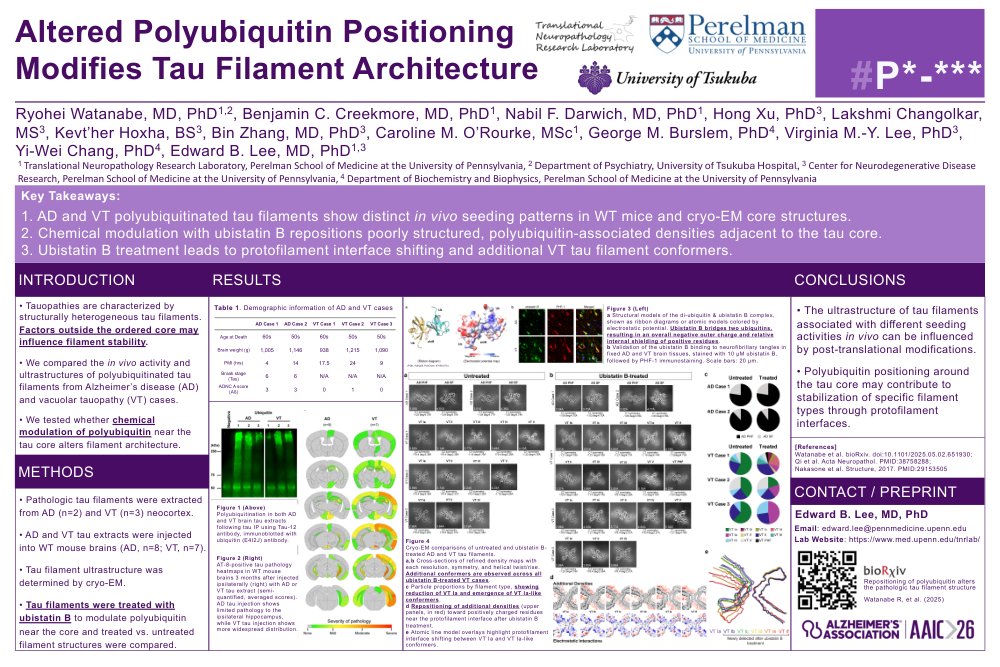
Structurally diverse tau filaments form proteinaceous aggregates in a heterogeneous group of neurodegenerative diseases called tauopathies. The factors extrinsic to the highly ordered core structure that influence tau filament stability are not well understood. Here, we investigated whether polyubiquitinated tau filaments from Alzheimer’s disease (AD) and vacuolar tauopathy (VT) human brain tissue exhibit distinct biological and structural properties, and whether chemical modulation of polyubiquitin adjacent to the tau core alters tau filament architecture.
Methods:
Polyubiquitinated tau filaments were extracted from the neocortex of AD (n=2) and VT (n=3) cases. Seeding patterns were examined after intracerebral injection of extracted tau from a subset of cases into 15 WT mouse brains (AD, n=8; VT, n=7), and tau filament ultrastructure was determined by cryo-electron microscopy. Chemical modulation of the polarity of polyubiquitin adjacent to the tau core was performed with the small molecule ubistatin B (ubiB), and untreated and ubiB-treated filament structures were compared across all five cases, including an additional VT case (n=3 total) not previously reported.
Results:
Polyubiquitinated tau filaments from AD and VT human brain tissue exhibited distinct seeding patterns in WT mice, in association with differences in tau core structures determined by cryo-electron microscopy, including detection of up to five distinct filament cores in VT. Chemical modulation of the polarity of polyubiquitin adjacent to the tau core with ubiB resulted in repositioning of poorly structured densities towards positively charged residues on the highly structured core filament. In ubiB-treated AD filaments, the major PHF and SF core backbones were retained. In contrast, in certain VT tau filaments, ubiB treatment resulted in prominent additional densities near the protofilament interface, leading to shifting of the protofilament interface and the appearance of additional filament conformers not detected in untreated preparations (Figure 1). Similar treatment-associated interface shifting was identified in all three VT cases.
Conclusions:
Our findings suggest that the structure of tau filaments associated with different seeding activities in vivo can be influenced by post-translational modifications. Polyubiquitin positioning around the tau core may contribute to stabilization of specific filament types through protofilament interfaces.
Comments
Email is required but is not shown publicly.
Loading comments...