4,068 posters, 219 videos, 101 topics, 69 sessions, 14,365 authors, 6,128 institutions
ePostersLive by SciGen Technologies S.A. All rights reserved.
Alzheimer's Association International Conference 2026
July 12-15, 2026 | London, United Kingdom, and Online

13560
Comparative Performance Of Externally Validated Dementia Risk Prediction Models In General Populations: A Systematic Review
Poster Presenter
Authors
Zain Hussain, Dominic Ng, Amina Hussain, Nathan Ng, Samuel Leighton, Sarah Gregory, Fani Deligianni, Craig Ritchie, Jonathan Cavanagh
Affiliations
University of Edinburgh, Scottish Brain Sciences; University of St Andrews, University of Glasgow, University Hospital Crosshouse, Northern Hospital Epping
Part of Topic
Public Health -> Epidemiology -> Risk, Reserve and Resilience
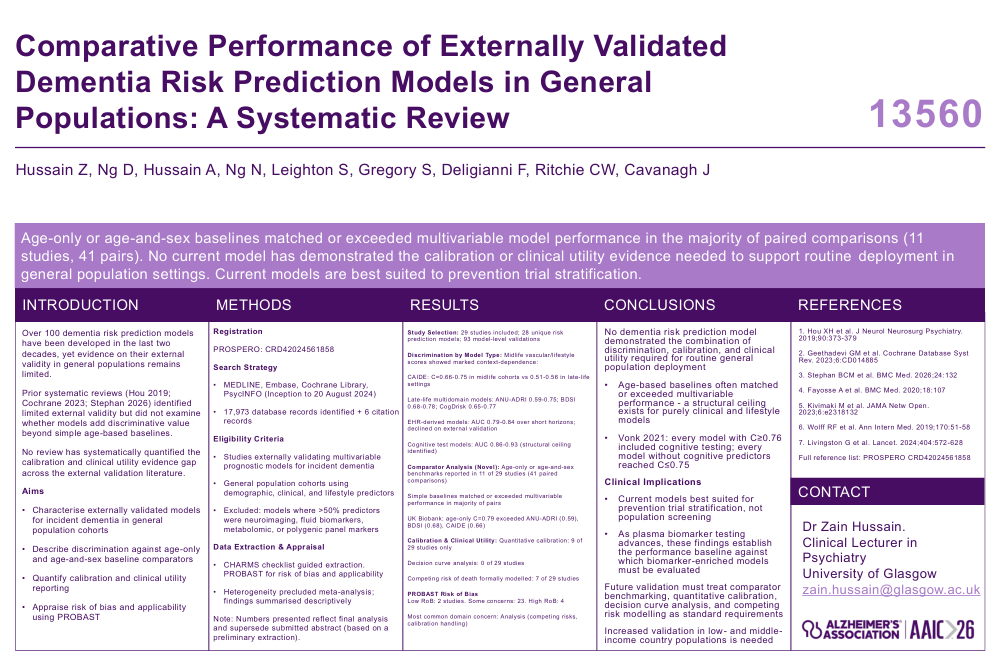
Comparative Performance of Externally Validated Dementia Risk Prediction Models in General Populations: A Systematic Review
Age-only or age-and-sex baselines matched or exceeded multivariable model performance in the majority of paired comparisons (11 studies, 41 pairs). No current model has demonstrated the calibration or clinical utility evidence needed to support routine deployment in general population settings. Current models are best suited to prevention trial stratification.
Introduction:
Over 100 dementia risk prediction models have been developed in the last two decades, yet evidence on their external validity in general populations remains limited.
Prior systematic reviews (Hou 2019; Cochrane 2023; Stephan 2026) identified limited external validity but did not examine whether models add discriminative value beyond simple age-based baselines.
No review has systematically quantified the calibration and clinical utility evidence gap across the external validation literature.
Aims
Methods:
Registration
PROSPERO: CRD42024561858
Search Strategy
Eligibility Criteria
Data Extraction & Appraisal
Note: Numbers presented reflect final analysis and supersede submitted abstract (based on a preliminary extraction).
Results:
Study Selection: 29 studies included; 28 unique risk prediction models; 93 model-level validations
Discrimination by Model Type: Midlife vascular/lifestyle scores showed marked context-dependence:
CAIDE: C=0.66-0.75 in midlife cohorts vs 0.51-0.56 in late-life settings
Late-life multidomain models: ANU-ADRI 0.59-0.75; BDSI 0.68-0.78; CogDrisk 0.65-0.77
EHR-derived models: AUC 0.79-0.84 over short horizons; declined on external validation
Cognitive test models: AUC 0.86-0.93 (structural ceiling identified)
Comparator Analysis (Novel): Age-only or age-and-sex benchmarks reported in 11 of 29 studies (41 paired comparisons)
Simple baselines matched or exceeded multivariable performance in majority of pairs
UK Biobank: age-only C=0.79 exceeded ANU-ADRI (0.59), BDSI (0.68), CAIDE (0.66)
Calibration & Clinical Utility: Quantitative calibration: 9 of 29 studies only
Decision curve analysis: 0 of 29 studies
Competing risk of death formally modelled: 7 of 29 studies
PROBAST Risk of Bias
Low RoB: 2 studies. Some concerns: 23. High RoB: 4
Most common domain concern: Analysis (competing risks, calibration handling)
Conclusions:
No dementia risk prediction model demonstrated the combination of discrimination, calibration, and clinical utility required for routine general population deployment
Clinical Implications
Future validation must treat comparator benchmarking, quantitative calibration, decision curve analysis, and competing risk modelling as standard requirements
Increased validation in low- and middle-income country populations is needed
Comments
Email is required but is not shown publicly.
Loading comments...