4,068 posters, 219 videos, 101 topics, 69 sessions, 14,365 authors, 6,128 institutions
ePostersLive by SciGen Technologies S.A. All rights reserved.
Alzheimer's Association International Conference 2026
July 12-15, 2026 | London, United Kingdom, and Online

11784
Intersectional Inequality Of Individual And Area-level Disadvantage On Cognitive Ageing In The Uk
Poster Presenter
Authors
Affiliations
Part of Topic
Public Health -> Epidemiology -> Risk, Reserve and Resilience
Abstract:
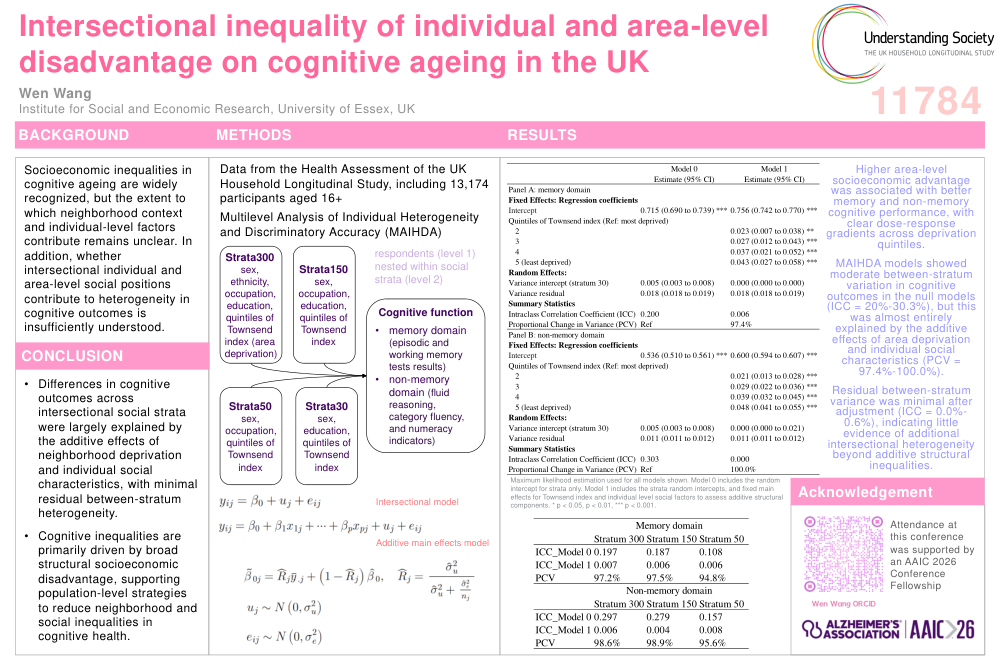
Background: Socioeconomic inequalities in cognitive ageing are widely recognised, but the extent to which neighbourhood context and individual-level factors contribute remains unclear. In addition, whether intersectional individual and area-level social positions contribute to heterogeneity in cognitive outcomes is insufficiently understood.
Methods: We used data from the Health Assessment of the UK Household Longitudinal Study, including 13,174 participants aged 16+ in Great Britain. Cognitive function was assessed using memory (episodic and working memory tests results) and non-memory domains (fluid reasoning, category fluency, and numeracy indicators) derived from standardised cognitive tests. Area deprivation was measured using the quintiles of the Townsend index. We first estimated associations between area deprivation and cognition using linear regression models and tested the effect modification of each individual-level sociodemographic factor (sex, age groups, education, occupation, income quintiles, urbanity, partnership status, and ethnicity). Multilevel Analysis of Individual Heterogeneity and Discriminatory Accuracy (MAIHDA) was applied to model intersectional strata defined by combinations of individual sociodemographic characteristics (sex with education/occupation) and area deprivation index, with sensitivity analyses incorporating cross-classified random effects for neighbourhoods.
Results: Higher area deprivation was consistently associated with people's poorer cognitive performance, with clear graded patterns. Interaction analyses indicated largely uniform effects across subgroups, with some evidence of effect modification by education and occupation. MAIHDA models showed that between-strata variance in cognitive outcomes was moderate in unadjusted models but largely explained by individual social disadvantage and area deprivation fixed effects (>90%). Residual variance across intersectional strata was small (<1%), and inclusion of area-level random effects contributed minimal additional variance.
Conclusion: Area-level socioeconomic disadvantage is associated with worse cognition across adulthood, independent of individual characteristics. However, most variation in cognitive outcomes is explained by compositional characteristics, with limited residual intersectional heterogeneity. These findings suggest that contextual effects operate broadly across populations, and highlight the importance to support population-level approaches to reducing cognitive health inequalities.
Comments
Email is required but is not shown publicly.
Loading comments...