4,068 posters, 219 videos, 101 topics, 69 sessions, 14,365 authors, 6,128 institutions
ePostersLive by SciGen Technologies S.A. All rights reserved.
Alzheimer's Association International Conference 2026
July 12-15, 2026 | London, United Kingdom, and Online

11991
Three Decades Of Global And Regional Trends In Tobacco-attributable Alzheimer’s Disease And Other Dementia Burden
Poster Presenter
Authors
Part of Topic
Public Health -> Epidemiology -> Risk, Reserve and Resilience
Introduction:
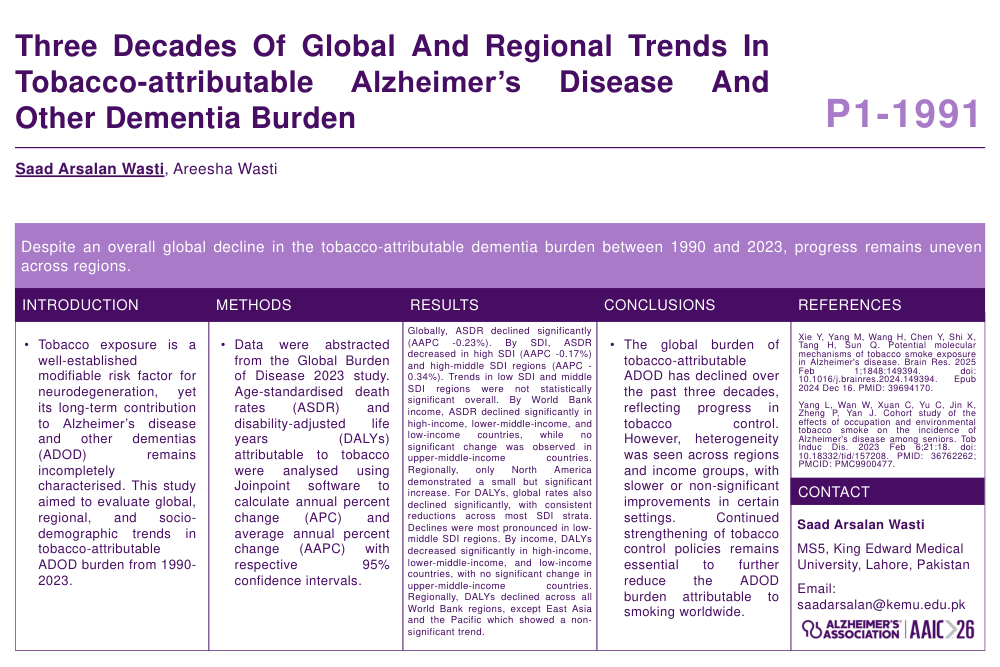
Tobacco exposure is a well-established modifiable risk factor for neurodegeneration, yet its long-term contribution to Alzheimer’s disease and other dementias (ADOD) remains incompletely characterised. This study aimed to evaluate global, regional, and socio-demographic trends in tobacco-attributable ADOD burden from 1990-2023.
Methods:
Data were abstracted from the Global Burden of Disease 2023 study. Age-standardised death rates (ASDR) and disability-adjusted life years (DALYs) attributable to tobacco were analysed using Joinpoint software to calculate annual percent change (APC) and average annual percent change (AAPC) with respective 95% confidence intervals.
Results:
Globally, ASDR declined significantly (AAPC -0.23%). By SDI, ASDR decreased in high SDI (AAPC -0.17%) and high-middle SDI regions (AAPC -0.34%). Trends in low SDI and middle SDI regions were not statistically significant overall. By World Bank income, ASDR declined significantly in high-income, lower-middle-income, and low-income countries, while no significant change was observed in upper-middle-income countries. Regionally, only North America demonstrated a small but significant increase. For DALYs, global rates also declined significantly, with consistent reductions across most SDI strata. Declines were most pronounced in low-middle SDI regions. By income, DALYs decreased significantly in high-income, lower-middle-income, and low-income countries, with no significant change in upper-middle-income countries. Regionally, DALYs declined across all World Bank regions, except East Asia and the Pacific which showed a non-significant trend.
Conclusions:
The global burden of tobacco-attributable ADOD has declined over the past three decades, reflecting progress in tobacco control. However, heterogeneity was seen across regions and income groups, with slower or non-significant improvements in certain settings. Continued strengthening of tobacco control policies remains essential to further reduce the ADOD burden attributable to smoking worldwide.
Comments
Email is required but is not shown publicly.
Loading comments...