4,068 posters, 219 videos, 101 topics, 69 sessions, 14,365 authors, 6,128 institutions
ePostersLive by SciGen Technologies S.A. All rights reserved.
Alzheimer's Association International Conference 2026
July 12-15, 2026 | London, United Kingdom, and Online

13534
Zombosomes As Active Vectors Of Neurodegeneration: A Review Of Astrocytic-mediated Alpha-synuclein Spread
Poster Presenter
Part of Topic
Basic Science and Pathogenesis -> Human Neuropathology -> Alpha-synuclein
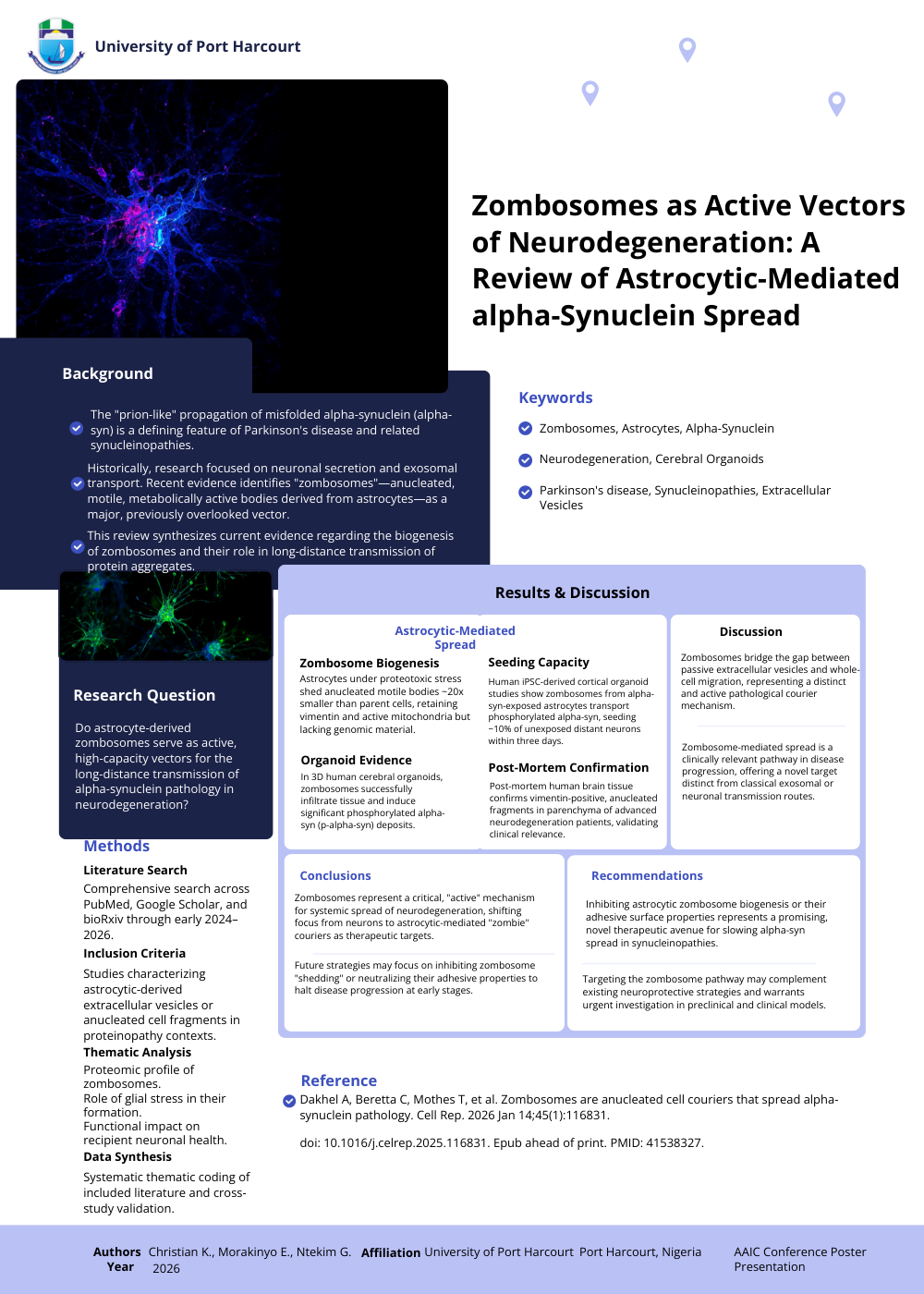
Zombosomes as Active Vectors of Neurodegeneration: A Review of Astrocytic-Mediated alpha-Synuclein Spread
Christian K.1, Morakinyo E.1, Ntekim G.1Ikechukwu E.1
1. University of Port Harcourt, Port Harcourt, Nigeria
Background: The "prion-like" propagation of misfolded alpha-synuclein (alpha-syn) is a defining feature of Parkinson’s disease and related synucleinopathies. Historically, research has focused on neuronal secretion and exosomal transport. However, recent evidence identifies "zombosomes"—anucleated, motile, and metabolically active bodies derived from astrocytes—as a major, previously overlooked vector. This review synthesizes current evidence regarding the biogenesis of zombosomes and their role in the long-distance transmission of protein aggregates.
Methods: A comprehensive literature search was conducted across PubMed, Google Scholar, and bioRxiv through early 2024—2026. Studies were included if they characterized astrocytic-derived extracellular vesicles or anucleated cell fragments in the context of proteinopathy. Thematic analysis was performed to reveal the proteomic profile of these vehicles, the role of glial stress in their formation, and their functional impact on recipient neuronal health.
Results: Synthesis of recent literature (2024—2026) reveals that astrocytes under proteotoxic stress undergo a process of "shedding" anucleated, motile bodies, ~20 times smaller than parent astrocytes, termed zombosomes; which serve as couriers that bridge the gap between passive extracellular vehicle and whole-cell migration. These structures are characterized by the retention of vimentin and active mitochondria but lack genomic material. Crucially, studies in human iPSC-derived cortical organoids demonstrate that zombosomes released from alpha-syn-exposed astrocytes act as high-capacity vectors, transporting phosphorylated alpha-synuclein across the extracellular matrix to "seed" approximately 10% of unexposed acceptor distant neuronal cells within three days. In 3D human cerebral organoids, zombosomes successfully infiltrates tissue and induce significant phosphorylated alpha-syn (p-alpha-syn) deposits. Evidence from post-mortem human brain tissue further confirms the presence of these vimentin-positive, anucleated fragments in the parenchyma of patients with advanced neurodegeneration, suggesting that zombosome-mediated spread is a clinically relevant pathway in disease progression.
Conclusions: This review highlights zombosomes as a critical, "active" mechanism for the systemic spread of neurodegeneration. By shifting the focus from neurons to astrocytic-mediated "zombie" couriers, this sets a pace for a new therapeutic target. Future strategies may focus on inhibiting the "shedding" of zombosomes or neutralizing their adhesive properties to halt disease progression in its early stages.
Keywords: Zombosomes, Astrocytes, Alpha-Synuclein, Neurodegeneration, Cerebral Organoids.
Reference
Dakhel A, Beretta C, Mothes T, Hakhverdyan S, Michno W, Rostami J, Erlandsson A. Zombosomes are anucleated cell couriers that spread α-synuclein pathology. Cell Rep. 2026 Jan 14;45(1):116831. doi: 10.1016/j.celrep.2025.116831. Epub ahead of print. PMID: 41538327.
Comments
Email is required but is not shown publicly.
Loading comments...