4,068 posters, 219 videos, 101 topics, 69 sessions, 14,365 authors, 6,128 institutions
ePostersLive by SciGen Technologies S.A. All rights reserved.
Alzheimer's Association International Conference 2026
July 12-15, 2026 | London, United Kingdom, and Online

13134
BDNF Val66Met genetic polymorphism modulates cognition across the menopausal transition
Part of Topic
Basic Science and Pathogenesis -> Genetics -> Genetics of cognitive aging
BDNF Val66Met genetic polymorphism modulates cognition across the menopausal transition
Background
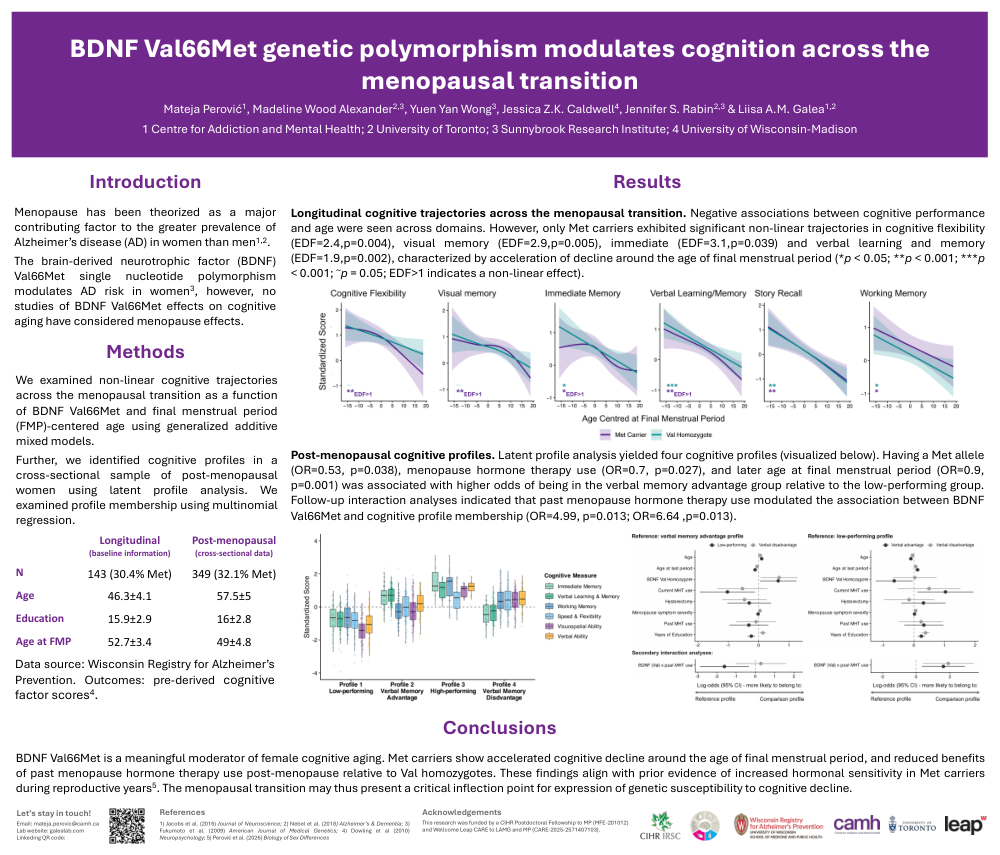
The brain-derived neurotrophic factor (BDNF) Val66Met single nucleotide polymorphism modulates Alzheimer’s disease (AD) risk in women, the sex at higher risk of AD. However, no studies of BDNF Val66Met effects on cognitive aging have considered the effects of menopause, a key inflection point for women’s cognitive aging which coincides with preclinical AD development.
Methods
We leveraged data from the Wisconsin Registry for Alzheimer’s Prevention to examine non-linear cognitive trajectories across the menopausal transition as a function of BDNF Val66Met and final menstrual period (FMP)-centered age using generalized additive mixed models (N=143, Met=30.4%; baseline age=46.3±4.1; years of education=15.9±2.9; FMP=52.7±3.4). Further, we identified cognitive profiles in a cross-sectional sample of post-menopausal women using latent profile analysis, and examined profile membership using multinomial regression (N=349, Met=32.1%; baseline age=57.5±5; years of education=16±2.8; FMP=49±4.8).
Results
Analyses of cognitive change across the menopausal transition indicated that Met carriers exhibited significant non-linear trajectories in immediate (EDF=3.1,p=0.039) and verbal memory (EDF=1.9,p=0.002), visual learning (EDF=2.9,p=0.005), and cognitive speed/flexibility (EDF=2.4,p=0.004), characterized by acceleration of decline around the age of FMP (Figure 1). Latent profile analysis of cognitive performance in post-menopausal women yielded four profiles: low-performing, high-performing, moderate with verbal memory advantage, moderate with verbal memory disadvantage (based on cognitive factor scores from Dowling et al. 2010. including immediate, verbal and working memory, visuospatial and verbal ability, and cognitive flexibility). Having a Met allele (OR=0.53,p=0.038), using menopause hormone therapy (OR=0.7,p=0.027), and having a later age at FMP (OR=0.9,p=0.001) was associated with higher odds of being in the verbal memory advantage group relative to the low-performing group. A follow-up analysis examining the interaction between BDNF Val66Met and past use of menopause hormone therapy (MHT) indicated a protective effect of MHT use for Val homozygotes (reduced likelihood of belonging to the low-performing group; OR=0.2,p=0.013) but not Met carriers.
Conclusions
Met carriers showed accelerated cognitive decline around the age of FMP, and reduced benefits of MHT use post-menopause relative to Val homozygotes. These findings highlight the importance of considering female-specific variables when assessing the impacts of Val66Met on cognitive aging, and identify Val66Met as a potentially important moderator of female cognitive aging.
Comments
Email is required but is not shown publicly.
Loading comments...