4,068 posters, 219 videos, 101 topics, 69 sessions, 14,365 authors, 6,128 institutions
ePostersLive by SciGen Technologies S.A. All rights reserved.
Alzheimer's Association International Conference 2026
July 12-15, 2026 | London, United Kingdom, and Online

12827
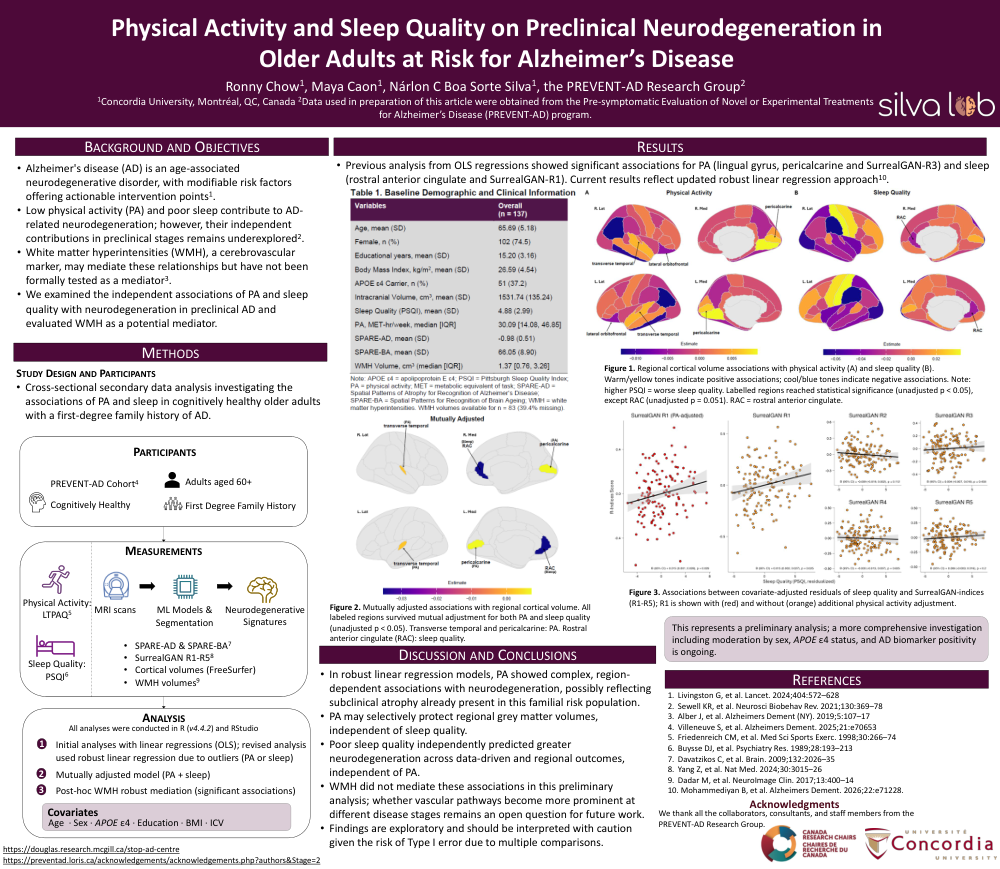
Physical Activity And Sleep Quality On Preclinical Neurodegeneration In Older Adults At Risk For Alzheimer’s Disease
Part of Topic
Public Health -> Epidemiology -> Risk, Reserve and Resilience
Background and Objectives
•Alzheimer's disease (AD) is an age-associated neurodegenerative disorder, with modifiable risk factors offering actionable intervention points1.
•Low physical activity (PA) and poor sleep contribute to AD-related neurodegeneration; however, their independent contributions in preclinical stages remains underexplored2.
•White matter hyperintensities (WMH), a cerebrovascular marker, may mediate these relationships but have not been formally tested as a mediator3.
•We examined the independent associations of PA and sleep quality with neurodegeneration in preclinical AD and evaluated WMH as a potential mediator.
Methods
•Cross-sectional secondary data analysis investigating the associations of PA and sleep in cognitively healthy older adults with a first-degree family history of AD.
Results
•Previous analysis from OLS regressions showed significant associations for PA (lingual gyrus, pericalcarine and SurrealGAN-R3) and sleep (rostral anterior cingulate and SurrealGAN-R1). Current results reflect updated robust linear regression approach10.
Discussion and Conclusions
•In robust linear regression models, PA showed complex, region-dependent associations with neurodegeneration, possibly reflecting subclinical atrophy already present in this familial risk population.
•PA may selectively protect regional grey matter volumes, independent of sleep quality.
•Poor sleep quality independently predicted greater neurodegeneration across data-driven and regional outcomes, independent of PA.
•WMH did not mediate these associations in this preliminary analysis; whether vascular pathways become more prominent at different disease stages remains an open question for future work.
•Findings are exploratory and should be interpreted with caution given the risk of Type I error due to multiple comparisons.
References
1.Livingston G, et al. Lancet. 2024;404:572–628
2.Sewell KR, et al. Neurosci Biobehav Rev. 2021;130:369–78
3.Alber J, et al. Alzheimers Dement (NY). 2019;5:107–17
4.Villeneuve S, et al. Alzheimers Dement. 2025;21:e70653
5.Friedenreich CM, et al. Med Sci Sports Exerc. 1998;30:266–74
6.Buysse DJ, et al. Psychiatry Res. 1989;28:193–213
7.Davatzikos C, et al. Brain. 2009;132:2026–35
8.Yang Z, et al. Nat Med. 2024;30:3015–26
9.Dadar M, et al. NeuroImage Clin. 2017;13:400–14
10. Mohammediyan B, et al. Alzheimers Dement. 2026;22:e71228.
Acknowledgments
We thank all the collaborators, consultants, and staff members from the PREVENT-AD Research Group.
Comments
Email is required but is not shown publicly.
Loading comments...