4,068 posters, 219 videos, 101 topics, 69 sessions, 14,365 authors, 6,128 institutions
ePostersLive by SciGen Technologies S.A. All rights reserved.
Alzheimer's Association International Conference 2026
July 12-15, 2026 | London, United Kingdom, and Online

12793
The Link Between Sleep Duration And Severity Of Cognitive Impairment Differs By APOE-e4 Carrier Status In Non-Hispanic Black African Adults
Poster Presenter
Authors
Brittany Larsen, Farid Rajabli, Joshua Akinyemi, Susan Blanton, Debbie Chung, Michael Cuccaro, Giuseppe Tosto, Scott Williams, African Dementia Consortium, William Bush, Brian Kunkle, Jeffrey Vance, Jonathan Haines, Goldie Byrd, Christiane Reitz, Adesola Ogunniyi, Margaret Pericak-Vance, Rufus Akinyemi, Azizi Seixas
Affiliations
, Department of Psychiatry and Behavioral Sciences, University of Miami Miller School of Medicine, Miami, FL, USA, John P. Hussman Institute for Human Genomics, University of Miami Miller School of Medicine, Miami, FL, USA; Dr. John T. Macdonald Foundation Department of Human Genetics, University of Miami Miller School of Medicine, Miami, FL, USA, Department of Epidemiology and Medical Statistics, College of Medicine, University of Ibadan, Ibadan, Nigeria, Gertrude H. Sergievsky Center, Taub Institute for Research on the Aging Brain, Departments of Neurology, Psychiatry, and Epidemiology, College of Physicians and Surgeons, Columbia University, New York, NY, USA, Cleveland Institute for Computational Biology, Department of Population & Quantitative Health Sciences, School of Medicine, Case Western Reserve University, Cleveland, OH, USA, John P. Hussman Institute for Human Genomics, University of Miami Miller School of Medicine, Miami, FL, USA; Dr. John T. Macdonald Foundation Department of Human Genetics, University of Miami Miller School of Medicine, Miami, FL, USA; Department of Neurology, University of Miami Miller School of Medicine, Miami, FL, USA, Maya Angelou Center for Health Equity, Wake Forest University School of Medicine, Winston-Salem, NC, USA, Institute for Advanced Medical Research and Training, College of Medicine, University of Ibadan, Ibadan, Nigeria, Department of Psychiatry and Behavioral Sciences, University of Miami Miller School of Medicine, Miami, FL, USA; Department of Informatics and Health Data Science, University of Miami Miller School of Medicine, Miami, FL, USA
Part of Topic
Basic Science and Pathogenesis -> Genetics -> Epigenetics
TITLE: The Relationship Between Sleep Duration and Severity of Cognitive/Functional Impairments Differ by APOE-ε4 Carrier Status in Middle-aged and Elderly Indigenous Africans
OVERALL TAKE-AWAY:
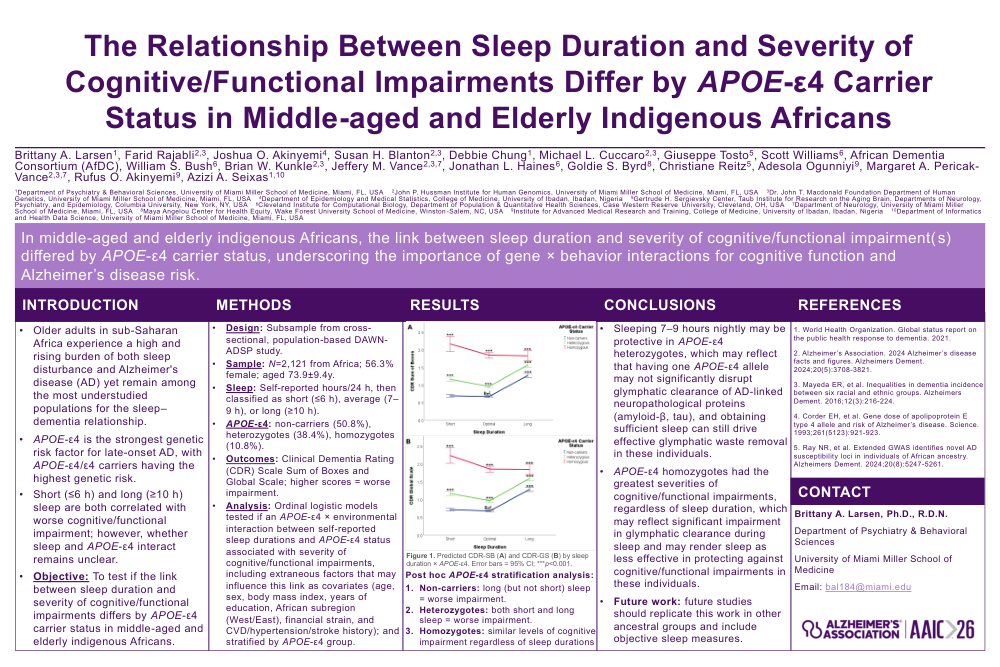
In middle-aged and elderly indigenous Africans, the link between sleep duration and severity of cognitive/functional impairment(s) differed by APOE-ε4 carrier status, underscoring the importance of gene × behavior interactions for cognitive function and Alzheimer’s disease risk.
INTRODUCTION:
METHODS:
RESULTS:
Post hoc APOE-ε4 stratification analysis:
CONCLUSIONS:
CONTACT:
Brittany A. Larsen, Ph.D., R.D.N.
Department of Psychiatry & Behavioral Sciences
University of Miami Miller School of Medicine
Email: bal184@miami.edu
Comments
Email is required but is not shown publicly.
Loading comments...