4,068 posters, 219 videos, 101 topics, 69 sessions, 14,365 authors, 6,128 institutions
ePostersLive by SciGen Technologies S.A. All rights reserved.
Alzheimer's Association International Conference 2026
July 12-15, 2026 | London, United Kingdom, and Online

12022
Long Term Validation Of Neuronal Density With A Mathematical Model Of Brain Health
Poster Presenter
Authors
Affiliations
Part of Topic
Basic Science and Pathogenesis -> Molecular and Cell Biology -> Neurodegeneration and neuroprotection
BACKGROUND
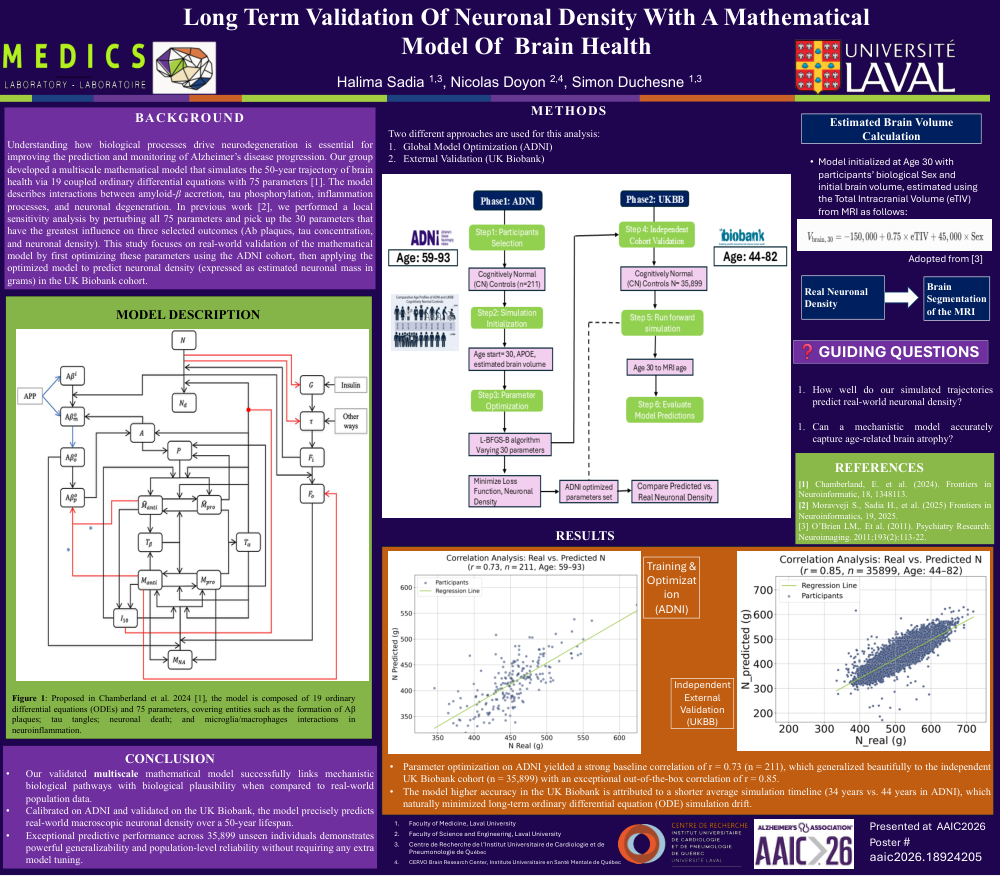
Understanding how biological processes drive neurodegeneration is essential for improving the prediction and monitoring of Alzheimer’s disease progression. Our group developed a multiscale mathematical model that simulates the 50-year trajectory of brain health via 19 coupled ordinary differential equations with 75 parameters [1]. The model describes interactions between amyloid-β accretion, tau phosphorylation, inflammation processes, and neuronal degeneration. In previous work [2], we performed a local sensitivity analysis by perturbing all 75 parameters and pick up the 30 parameters that have the greatest influence on three selected outcomes (Ab plaques, tau concentration, and neuronal density). This study focuses on real-world validation of the mathematical model by first optimizing these parameters using the ADNI cohort, then applying the optimized model to predict neuronal density (expressed as estimated neuronal mass in grams) in the UK Biobank cohort.
MODEL DESCRIPTION
Figure 1: Proposed in Chamberland et al. 2024 [1], the model is composed of 19 ordinary differential equations (ODEs) and 75 parameters, covering entities such as the formation of Aβ plaques; tau tangles; neuronal death; and microglia/macrophages interactions in neuroinflammation.
METHODS
Two different approaches are used for this analysis:
GUIDING QUESTIONS
RESULTS
CONCLUSION
•Our validated multiscale mathematical model successfully links mechanistic biological pathways with biological plausibility when compared to real-world population data.
•Calibrated on ADNI and validated on the UK Biobank, the model precisely predicts real-world macroscopic neuronal density over a 50-year lifespan.
•Exceptional predictive performance across 35,899 unseen individuals demonstrates powerful generalizability and population-level reliability without requiring any extra model tuning.
REFERENCES
[1] Chamberland, E. et al. (2024). Frontiers in Neuroinformatic, 18, 1348113.
[2] Moravveji S., Sadia H., et al. (2025) Frontiers in Neuroinformatics, 19, 2025.
[3] O’Brien LM,. Et al. (2011). Psychiatry Research: Neuroimaging. 2011;193(2):113-22.
Comments
Email is required but is not shown publicly.
Loading comments...