4,068 posters, 219 videos, 101 topics, 69 sessions, 14,365 authors, 6,128 institutions
ePostersLive by SciGen Technologies S.A. All rights reserved.
Alzheimer's Association International Conference 2026
July 12-15, 2026 | London, United Kingdom, and Online

11900
The Impact Of Gingipain From Porphyromonas Gingivalis On Microglia: Connecting Chronic Periodontitis And Alzheimer's Disease Risk
Poster Presenter
Authors
Part of Topic
Basic Science and Pathogenesis -> Molecular and Cell Biology -> Innate immunity
The Impact Of Gingipain From P. gingivalis On Microglia: Connecting Chronic Periodontitis And Alzheimer's Disease Risk
Mika Fujii, Aoi Ikedo, Kaito Mizuno, Akira Hasebe, Jiwon Lee. Hokkaido University, Sapporo, Japan.
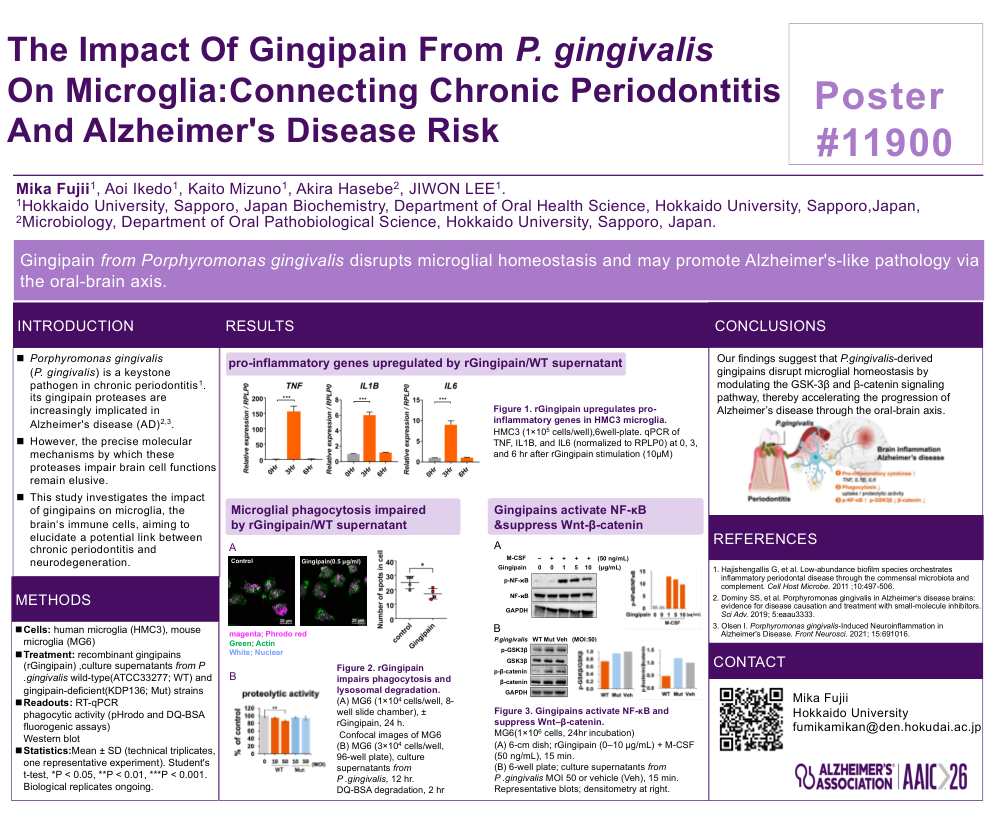
Gingipain from Porphyromonas gingivalis disrupts microglial homeostasis and may promote Alzheimer's-like pathology via the oral-brain axis.
INTRODUCTION: Porphyromonas gingivalis (P. gingivalis) is a keystone pathogen in chronic periodontitis. Its gingipain proteases are increasingly implicated in Alzheimer's disease (AD). However, the precise molecular mechanisms by which these proteases impair brain cell functions remain elusive. This study investigates the impact of gingipains on microglia, the brain's immune cells, aiming to elucidate a potential link between chronic periodontitis and neurodegeneration.
METHODS: Cells: human microglia (HMC3), mouse microglia (MG6). Treatment: recombinant gingipains (rGingipain), culture supernatants from P. gingivalis wild-type (ATCC33277; WT) and gingipain-deficient (KDP136; Mut) strains. Readouts: RT-qPCR, phagocytic activity (pHrodo and DQ-BSA fluorogenic assays), Western blot.
RESULTS: rGingipain upregulates pro-inflammatory genes (TNF, IL1B, IL6) in HMC3 microglia. rGingipain impairs phagocytosis and lysosomal degradation in MG6 microglia. Gingipains activate NF-κB and suppress Wnt–β-catenin signaling.
CONCLUSIONS: Our findings suggest that P. gingivalis-derived gingipains disrupt microglial homeostasis by modulating the GSK-3β and β-catenin signaling pathway, thereby accelerating the progression of Alzheimer's disease through the oral-brain axis.
Comments
Email is required but is not shown publicly.
Loading comments...