4,068 posters, 219 videos, 101 topics, 69 sessions, 14,365 authors, 6,128 institutions
ePostersLive by SciGen Technologies S.A. All rights reserved.
Alzheimer's Association International Conference 2026
July 12-15, 2026 | London, United Kingdom, and Online

1766
Quantifying Full-length Circular RNAs In Alzheimer’s Disease Using Cutting Edge Long-read Sequencing
Poster Presenter
Authors
Affiliations
Department of Clinical and Biomedical Sciences, Faculty of Health and Life Sciences, University of Exeter, Exeter, UK., Department of Psychiatry and Neuropsychology, School for Mental Health and Neuroscience (MHeNs), Faculty of Health, Medicine and Life Sciences (FHML), Maastricht University, Maastricht, The Netherlands.
Part of Topic
Basic Science and Pathogenesis -> Human Neuropathology -> Other
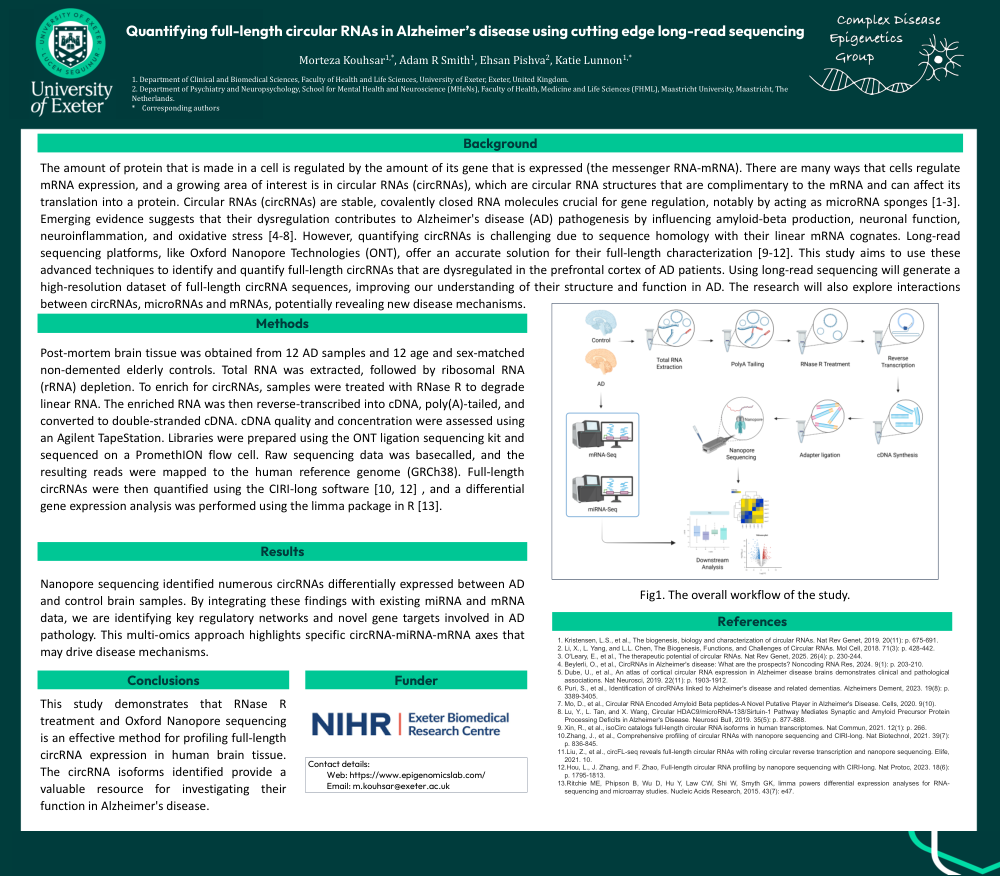
The amount of protein that is made in a cell is regulated by the amount of its gene that is expressed (the messenger RNA-mRNA). There are many ways that cells regulate mRNA expression, and a growing area of interest is in circular RNAs (circRNAs), which are circular RNA structures that are complimentary to the mRNA and can affect its translation into a protein. Circular RNAs (circRNAs) are stable, covalently closed RNA molecules crucial for gene regulation, notably by acting as microRNA sponges. Emerging evidence suggests that their dysregulation contributes to Alzheimer's disease (AD) pathogenesis by influencing amyloid-beta production, neuronal function, neuroinflammation, and oxidative stress. However, quantifying circRNAs is challenging due to sequence homology with their linear mRNA cognates. Long-read sequencing platforms, like Oxford Nanopore Technologies (ONT), offer an accurate solution for their full-length characterization. This study aims to use these advanced techniques to identify and quantify full-length circRNAs that are dysregulated in the prefrontal cortex of AD patients. Using long-read sequencing will generate a high-resolution dataset of full-length circRNA sequences, improving our understanding of their structure and function in AD. The research will also explore interactions between circRNAs, microRNAs and mRNAs, potentially revealing new disease mechanisms.
Comments
Email is required but is not shown publicly.
Loading comments...