4,068 posters, 219 videos, 101 topics, 69 sessions, 14,365 authors, 6,128 institutions
ePostersLive by SciGen Technologies S.A. All rights reserved.
Alzheimer's Association International Conference 2026
July 12-15, 2026 | London, United Kingdom, and Online

13876
Subjective Cognitive Concerns And Risk For Cognitive Impairment In Longitudinal Electronic Health Records
Poster Presenter
Part of Topic
Public Health -> Epidemiology -> Prevalence, incidence and clinical outcomes of MCI and dementia
Background:
Subjective cognitive concerns (SCC), reported by patients, informants, or clinicians despite normal objective cognitive testing, may represent an early clinical marker of Alzheimer's disease and related dementias (ADRD).
In routine clinical care, SCC are typically documented only in free-text clinical notes rather than standardized diagnostic codes, limiting large-scale research and clinical applications.
Although SCC has been associated with future cognitive decline in research cohorts, its prognostic value in real-world electronic health records (EHRs) remains largely unknown.
Study Aims:
Study design: Retrospective cohort study using longitudinal EHR data from a large academic healthcare system (Mass General Brigham).
Population: Adults ≥65 years with a first documented normal cognitive test (MMSE, MoCA, Mini-Cog, SLUMS, or AD8) between January 1, 2010, and December 31, 2020. Cognitive test score and date were extracted using GPT-OSS 120B; extraction agreement on 200 manually annotated cases: κ = 0.911 and 0.903, respectively.
Exposure: Patient-, informant-, or clinician-documented SCC within 1 year prior to the index cognitive test, extracted from free-text clinical notes using GPT-OSS 120B (sensitivity 88.9%, PPV 84.2%, F1 86.5%).
Outcome: Incident MCI or dementia at least one year after the index date, identified using ICD diagnosis codes.
Statistical analysis:
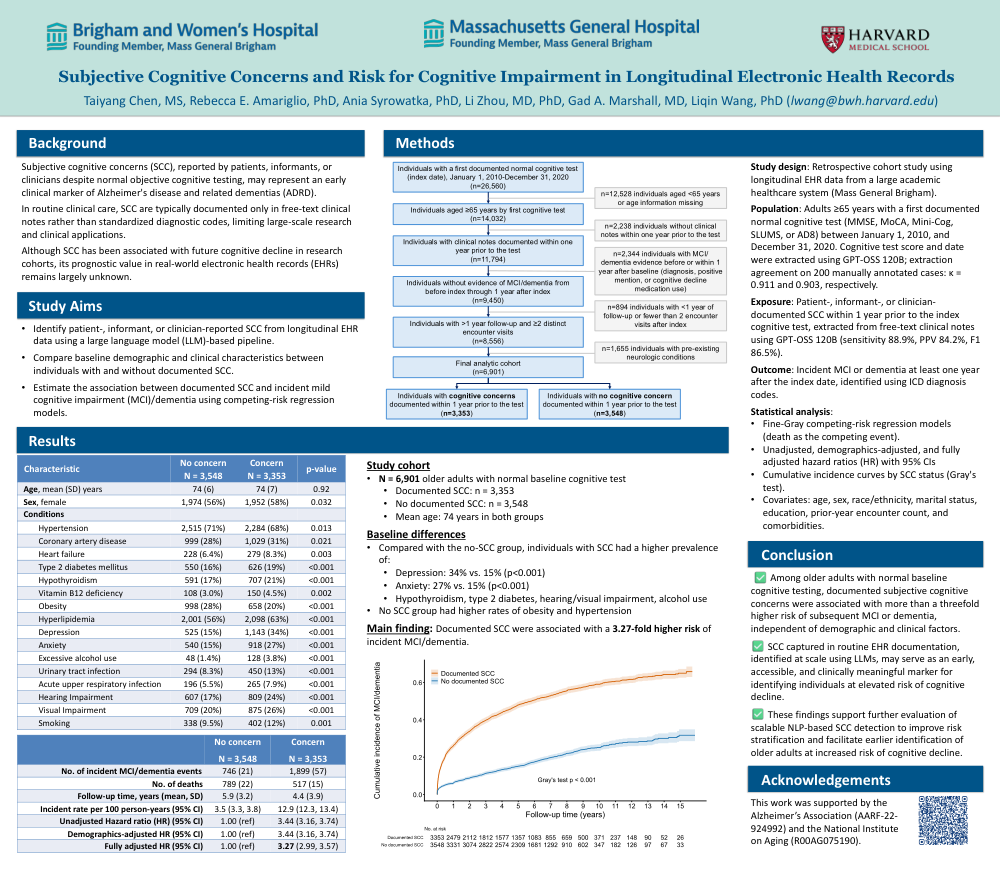
Study cohort
Baseline differences
Main finding: Documented SCC were associated with a 3.27-fold higher risk of incident MCI/dementia.
✅ Among older adults with normal baseline cognitive testing, documented subjective cognitive concerns were associated with more than a threefold higher risk of subsequent MCI or dementia, independent of demographic and clinical factors.
✅ SCC captured in routine EHR documentation, identified at scale using LLMs, may serve as an early, accessible, and clinically meaningful marker for identifying individuals at elevated risk of cognitive decline.
✅ These findings support further evaluation of scalable NLP-based SCC detection to improve risk stratification and facilitate earlier identification of older adults at increased risk of cognitive decline.
Comments
Email is required but is not shown publicly.
Loading comments...