4,068 posters, 219 videos, 101 topics, 69 sessions, 14,365 authors, 6,128 institutions
ePostersLive by SciGen Technologies S.A. All rights reserved.
Alzheimer's Association International Conference 2026
July 12-15, 2026 | London, United Kingdom, and Online

13646
Short Remote Cognitive Screening For Early Identification Of Alzheimer’S Disease In The Population Without Dementia
Poster Presenter
Authors
Part of Topic
Public Health -> Population Health Prevention Strategies -> Early Detection and Diagnosis
Short remote cognitive screening for early identification of Alzheimer’s disease in the population without dementia
Karin Lohi1, Aino Aaltonen1, Sanna-Kaisa Herukka2,3, Tarja Kokkola2, Sari Kärkkäinen2, Aarno Palotie1,4,5, Heiko Runz1,6, Jaakko Kaprio1, Valtteri Julkunen2,3, Toni Saari1, Eero Vuoksimaa1
1 Institute for Molecular Medicine Finland (FIMM), HiLIFE, University of Helsinki, Finland
2 Department of Neurology, Institute of Clinical Medicine, University of Eastern Finland, Kuopio, Finland
3 Department of Neurology, NeuroCenter, Kuopio University Hospital, Kuopio, Finland
4 Analytic and Translational Genetics Unit, Department of Medicine, Department of Neurology and Department of Psychiatry, Massachusetts General Hospital, Boston, Massachusetts, USA
5 The Stanley Center for Psychiatric Research and Program in Medical and Population Genetics, The Broad Institute of MIT and Harvard, Cambridge, Massachusetts, USA
6 European Molecular Biological Laboratories (EMBL), Heidelberg, Germany
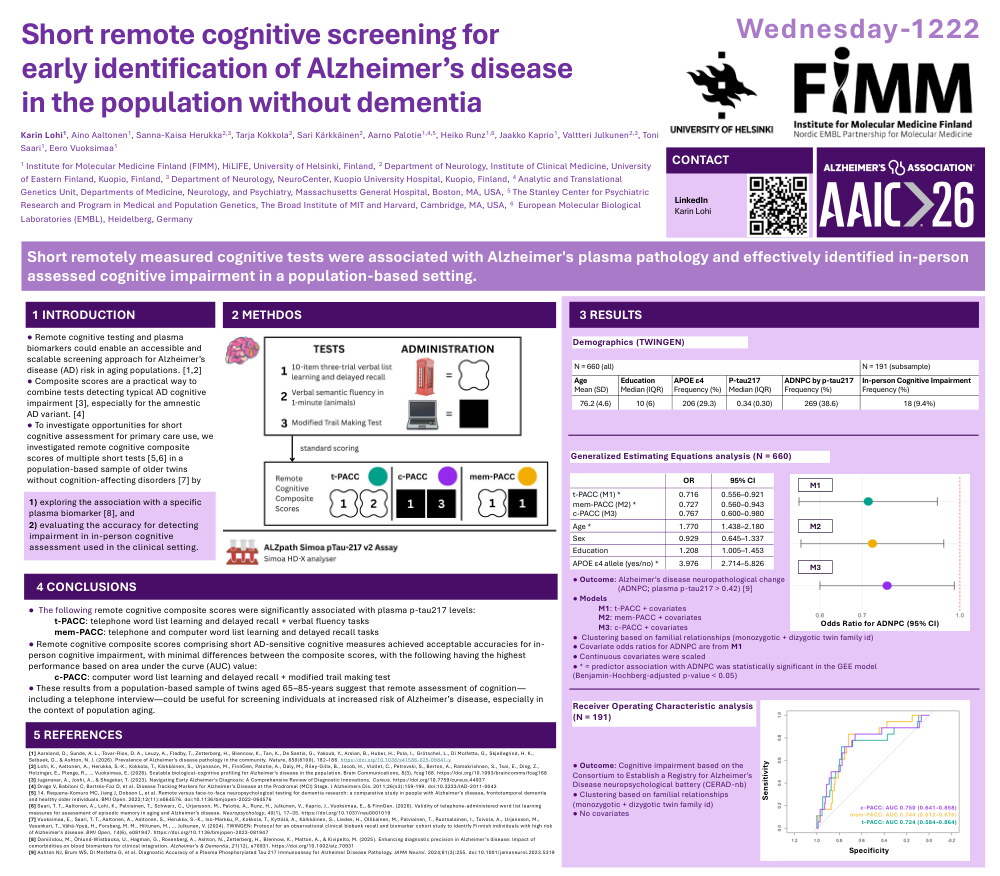
Background: Remote cognitive testing and plasma biomarkers could enable an accessible, scalable screening approach for Alzheimer’s disease (AD) risk in aging populations. We assessed the accuracy of telephone- and computer-administered cognitive composite scores in predicting AD-related cognitive impairment and investigated their association with plasma phosphorylated tau 217 (p-tau217).
Methods: Using a population-based TWINGEN sample (n = 191, 65–85-year-olds) of individuals without cognition-affecting diseases, including AD, cognitive performance was measured using a self-administered computerised battery (cCOG) and telephone tests. Based on the literature on AD cognitive impairment, three composite scores were calculated from scaled means of individual test scores of 1) telephone-administered three-trial word list learning and delayed recall tasks, and verbal fluency (t-PACC), 2) computer-administered three-trial word list learning and delayed recall tasks, and modified Trail Making Test (c-PACC), and 3) telephone- and computer-administered three-trial word list learning and delayed recall tasks (mem-PACC). The accuracy for detecting early AD cognitive impairment was evaluated using receiver operating characteristic (ROC) analysis against the Consortium to Establish a Registry for Alzheimer’s Disease neuropsychological battery (CERAD-nb) total score. Associations with early AD pathology were examined in Generalized Estimating Equations models predicting plasma p-tau217 levels measured with the ALZpath Simoa pTau-217 v2 Assay kit, using PACC scores and controlling for age, sex, and education.
Results: A total of 18 (9.4%) participants had cognitive impairment based on the CERAD-nb total score. The accuracies for predicting CERAD-nb impairment were 0.72 (95%CI: 0.58;0.87) for t-PACC, 0.75 (95%CI: 0.64;0.86) for c-PACC, and 0.74 (95%CI: 0.61;0.88) for mem-PACC. Lower t-PACC (β= -0.23; 95%CI: -0.39; -0.06) and mem-PAC (β= -0.23; 95%CI: -0.42;-0.04) scores were associated with higher plasma p-tau217 levels.
Conclusions: Remote cognitive composite scores comprising AD-sensitive measures achieved acceptable accuracies for in-person cognitive impairment, with minimal differences between the composite scores. The combinations of telephone word list recall and verbal fluency task, as well as telephone- and computer-administered word list recall tasks, were also associated with plasma p-tau217 levels. These results suggest that remote assessment of cognition—including a telephone interview—could be useful for screening individuals at increased risk of Alzheimer’s disease.
Theme: Public Health
Topic: Population Health Prevention Strategies
Subtopic: Early Detection and Diagnosis
Poster number: Wed-1222
Comments
Email is required but is not shown publicly.
Loading comments...