4,068 posters, 219 videos, 101 topics, 69 sessions, 14,365 authors, 6,128 institutions
ePostersLive by SciGen Technologies S.A. All rights reserved.
Alzheimer's Association International Conference 2026
July 12-15, 2026 | London, United Kingdom, and Online

13332
Recruitment To Randomisation: Assessing Recruitment Efficiency & Participant Access In Alzheimer’s Disease Trials
Poster Presenter
Authors
Affiliations
Part of Topic
Public Health -> Epidemiology -> Innovative methods in epidemiology (i.e. assessment methods, design, recruitment strategies, statistical methods, etc.)
RECRUITMENT TO RANDOMISATION: ASSESSING RECRUITMENT EFFICIENCY & PARTICIPANT ACCESS IN ALZHEIMER'S DISEASE TRIALS
Lucianne Dobson, Thomas W. Noteman, Lauren Devaney, Jessica Jiang, Catherine J. Mummery
ABSTRACT
Background: The recruitment of well-phenotyped, diverse participant cohorts remains a bottleneck in the successful delivery of Alzheimer’s Disease (AD) clinical trials. We evaluated longitudinal recruitment data across a portfolio of 13 AD trials (phases I-III) at University College London Hospitals to quantify rates of pre-screening attrition, formal screen failure, and successful randomisation. This analysis aims to identify the drivers preventing trial involvement and reasons for ineligibility among potential participants.
Methods: At our site, a dedicated recruitment team maintains a site-specific registry of research interested patients derived from multiple sources. Protocol specific pre-screening assessments are performed to check each patient’s suitability for currently active trials. We reviewed retrospective data recorded in our site recruitment database for the most recent 13 trials which have completed recruitment. Patient demographics, trial eligibility assessment outcome and reason for non-progression was recorded in cases of pre-screen or screen failure.
Results: 1,667 trial eligibility assessments were conducted for 606 unique patients, representing an average of 2.75 trial eligibility assessments per participant. Of 606 individuals, 103 (17%) progressed to formal screening for at least one trial and 67 (11%) were ultimately randomised on a trial during the period evaluated. The primary attrition occurred at pre-screening (n=1222 events), while numbers of formal screen failure were relatively low (n=51) representing a screen failure rate of 43%. Leading causes for pre-screen failure were participant decline (37%), cognitive deficit too advanced for participation (19%), medical/safety exclusions (14%), and failure to meet AD diagnostic criteria (7%).
Conclusions: Managing recruitment for a multi-trial portfolio via a centralised pathway enhances recruitment efficiency by considering participants for multiple protocols simultaneously, reducing the need for constant new-lead generation and maximising value of referrals. Participant decline at pre-screening is the primary source of attrition in our experience – highlighting the importance of careful protocol design and site level logistical planning to reduce burden, alleviate concerns and maximise opportunities for trial participation. Demographic analysis indicates an under-representation of ethnically diverse populations within the current recruitment pool; ongoing work will focus on improving collection of ethnicity data in our participant registry, and on implementing strategies to increase recruitment from underrepresented groups.
KEY POINTS
1: Multi-trial recruitment & detailed pre-screening protocols improved efficiency and reduced screen failures over time.
2: “Declined to participate” was the major driver of attrition in pre-screening
3: Enhanced ethnicity data collection is required to evaluate recruitment equity.
INTRODUCTION
Recruitment of well-phenotyped, diverse participant cohorts remains a bottleneck in the delivery of Alzheimer’s Disease (AD) clinical trials of investigational medicinal products (CTIMPs).1
At our site, a dedicated recruitment team maintains a site-specific registry of research-interested patients derived from multiple sources. Protocol specific pre-screening assessments are performed to check each patient’s suitability for currently active trials.
This project was conducted as a service evaluation of recruitment performance at our site. Here we have reviewed retrospective data for the most recent 12 trials which have completed recruitment at our site. Trial eligibility assessment outcomes and reasons for non-progression have been examined to improve understanding of the reasons for attrition during the eligibility assessment process among our population of potential trial participants.
We also sought to explore information on patient demographics, as improving access to trials for participants of diverse ethnic and socioeconomic backgrounds is a known challenge in recruitment.2
This project aims to identify the drivers preventing trial involvement and reasons for ineligibility among potential participants.
METHODS
We evaluated longitudinal recruitment data across a portfolio of the most recent 12 AD CTIMPs (phases I-III) at University College London Hospitals recruited though our registry.
Demographics, trial eligibility assessment outcome and reasons for non-progression were recorded. Index of innovation and growth by local authority was calculated from post code data to provide an estimate of individuals’ socioeconomic status.
Attrition reasons were categorised and analysed descriptively to identify common barriers to recruitment and progression through the trial pathway.
RESULTS
SCREEN FAILURE AND ATTRITION RATES
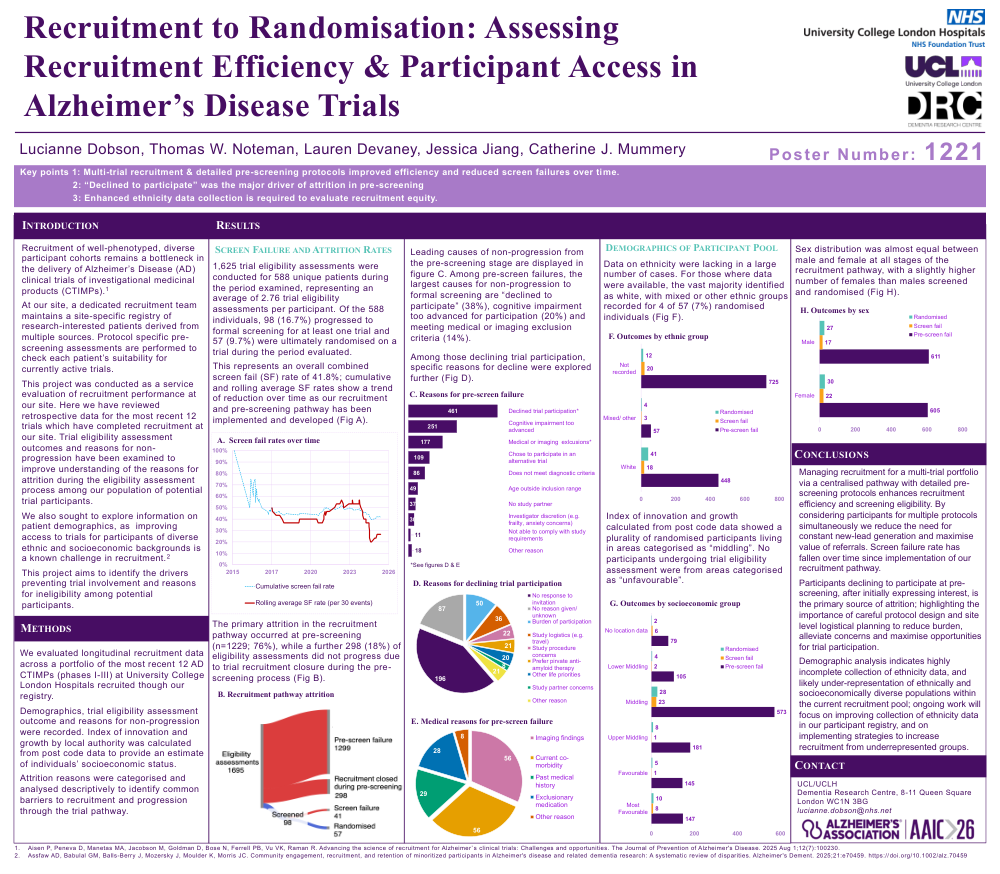
1,625 trial eligibility assessments were conducted for 588 unique patients during the period examined, representing an average of 2.76 trial eligibility assessments per participant. Of the 588 individuals, 98 (16.7%) progressed to formal screening for at least one trial and 57 (9.7%) were ultimately randomised on a trial during the period evaluated.
This represents an overall combined screen fail (SF) rate of 41.8%; cumulative and rolling average SF rates show a trend of reduction over time as our recruitment and pre-screening pathway has been implemented and developed (Fig A).
The primary attrition in the recruitment pathway occurred at pre-screening (n=1229; 76%), while a further 298 (18%) of eligibility assessments did not progress due to trial recruitment closure during the pre-screening process (Fig B).
Leading causes of non-progression from the pre-screening stage are displayed in figure C. Among pre-screen failures, the largest causes for non-progression to formal screening are “declined to participate” (38%), cognitive impairment too advanced for participation (20%) and meeting medical or imaging exclusion criteria (14%).
Among those declining trial participation, specific reasons for decline were explored further (Fig D).
DEMOGRAPHICS OF PARTICIPANT POOL
Data on ethnicity were lacking in a large number of cases. For those where data were available, the vast majority identified as white, with mixed or other ethnic groups recorded for 4 of 57 (7%) randomised individuals (Fig F).
Index of innovation and growth calculated from post code data showed a plurality of randomised participants living in areas categorised as “middling”. No participants undergoing trial eligibility assessment were from areas categorised as “unfavourable”.
Sex distribution was almost equal between male and female at all stages of the recruitment pathway, with a slightly higher number of females than males screened and randomised (Fig H).
CONCLUSIONS
Managing recruitment for a multi-trial portfolio via a centralised pathway with detailed pre-screening protocols enhances recruitment efficiency and screening eligibility. By considering participants for multiple protocols simultaneously we reduce the need for constant new-lead generation and maximise value of referrals. Screen failure rate has fallen over time since implementation of our recruitment pathway.
Participants declining to participate at pre-screening, after initially expressing interest, is the primary source of attrition; highlighting the importance of careful protocol design and site level logistical planning to reduce burden, alleviate concerns and maximise opportunities for trial participation.
Demographic analysis indicates highly incomplete collection of ethnicity data, and likely under-representation of ethnically and socioeconomically diverse populations within the current recruitment pool; ongoing work will focus on improving collection of ethnicity data in our participant registry, and on implementing strategies to increase recruitment from underrepresented groups.
CONTACT
UCL/UCLH
Dementia Research Centre, 8-11 Queen Square
London WC1N 3BG
lucianne.dobson@nhs.net
REFERENCES
1. Aisen P, Peneva D, Manetas MA, Jacobson M, Goldman D, Bose N, Ferrell PB, Vu VK, Raman R. Advancing the science of recruitment for Alzheimer’s clinical trials: Challenges and opportunities. The Journal of Prevention of Alzheimer's Disease. 2025 Aug 1;12(7):100230.
2. Assfaw AD, Babulal GM, Balls-Berry J, Mozersky J, Moulder K, Morris JC. Community engagement, recruitment, and retention of minoritized participants in Alzheimer's disease and related dementia research: A systematic review of disparities. Alzheimer's Dement. 2025;21:e70459. https://doi.org/10.1002/alz.70459
Comments
Email is required but is not shown publicly.
Loading comments...