4,068 posters, 219 videos, 101 topics, 69 sessions, 14,365 authors, 6,128 institutions
ePostersLive by SciGen Technologies S.A. All rights reserved.
Alzheimer's Association International Conference 2026
July 12-15, 2026 | London, United Kingdom, and Online

12963
Pharmacological Treatment For Reducing The Risk Of Cognitive Decline And Dementia After Stroke/TIA: A Systematic Review
Part of Topic
Public Health -> Population Health Prevention Strategies -> Risk Reduction
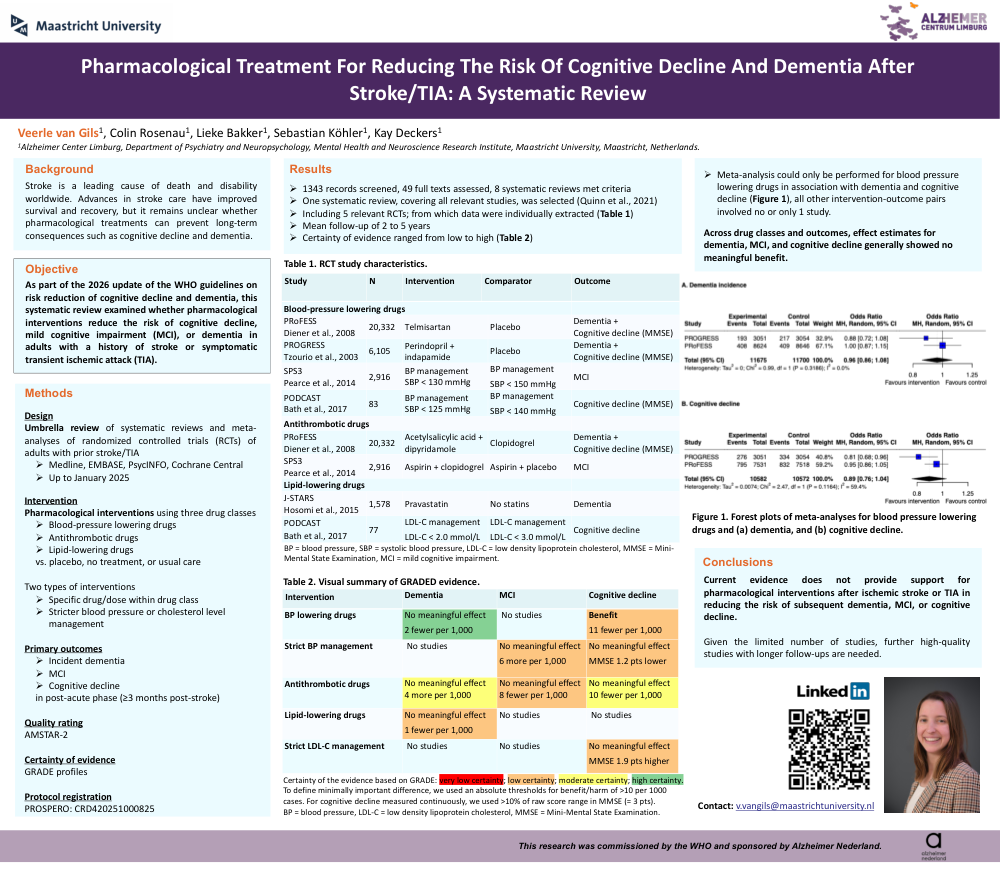
Background: Stroke is a leading cause of death and disability worldwide. Advances in stroke care have improved survival and recovery, but it remains unclear whether pharmacological treatments can prevent long-term consequences such as cognitive decline and dementia. As part of the 2026 update of the WHO guidelines on risk reduction of cognitive decline and dementia, this systematic review examined whether pharmacological interventions reduce the risk of cognitive decline, mild cognitive impairment (MCI), or dementia in adults with a history of stroke or symptomatic transient ischemic attack (TIA).
Methods: We conducted an umbrella review of systematic reviews and meta-analyses published up to January 23, 2025 including randomized controlled trials (RCTs) of adults with prior stroke or symptomatic TIA. Pharmacological interventions (including blood pressure-lowering, antithrombotic, and lipid-lowering drugs) were compared to placebo, no treatment, or usual care. Primary outcomes included incident dementia, MCI, and cognitive decline assessed in the post-acute phase (≥3 months post-event). Literature searches (Medline, EMBASE, PsycINFO, Cochrane Central) were conducted without language restrictions. Methodological quality was assessed with AMSTAR 2, and certainty of evidence with GRADE. The protocol was registered in PROSPERO (CRD420251000825).
Results: Of 1343 records screened, 49 full texts were assessed and 8 systematic reviews met inclusion criteria. The most comprehensive systematic review covering all relevant RCTs was selected, including five relevant RCTs from which data were individually extracted. Certainty of evidence ranged from low to high, further specified per comparison in Table 1. Across drug classes and outcomes, effect estimates for dementia, MCI, and cognitive decline generally showed no meaningful benefit over a mean follow-up of 2.0-4.9 years.
Conclusion: Current evidence does not provide support for pharmacological interventions after ischemic stroke or TIA in reducing the risk of subsequent dementia, MCI, or cognitive decline. Given the limited number of studies, further high-quality studies with longer follow-ups are needed.
Comments
Email is required but is not shown publicly.
Loading comments...