4,068 posters, 219 videos, 101 topics, 69 sessions, 14,365 authors, 6,128 institutions
ePostersLive by SciGen Technologies S.A. All rights reserved.
Alzheimer's Association International Conference 2026
July 12-15, 2026 | London, United Kingdom, and Online

12958
Objective Sleep And Alzheimer’s Disease Plasma Biomarker Trajectories In The Population-based Rotterdam Study
Poster Presenter
Authors
Affiliations
Part of Topic
Public Health -> Epidemiology -> Risk, Reserve and Resilience
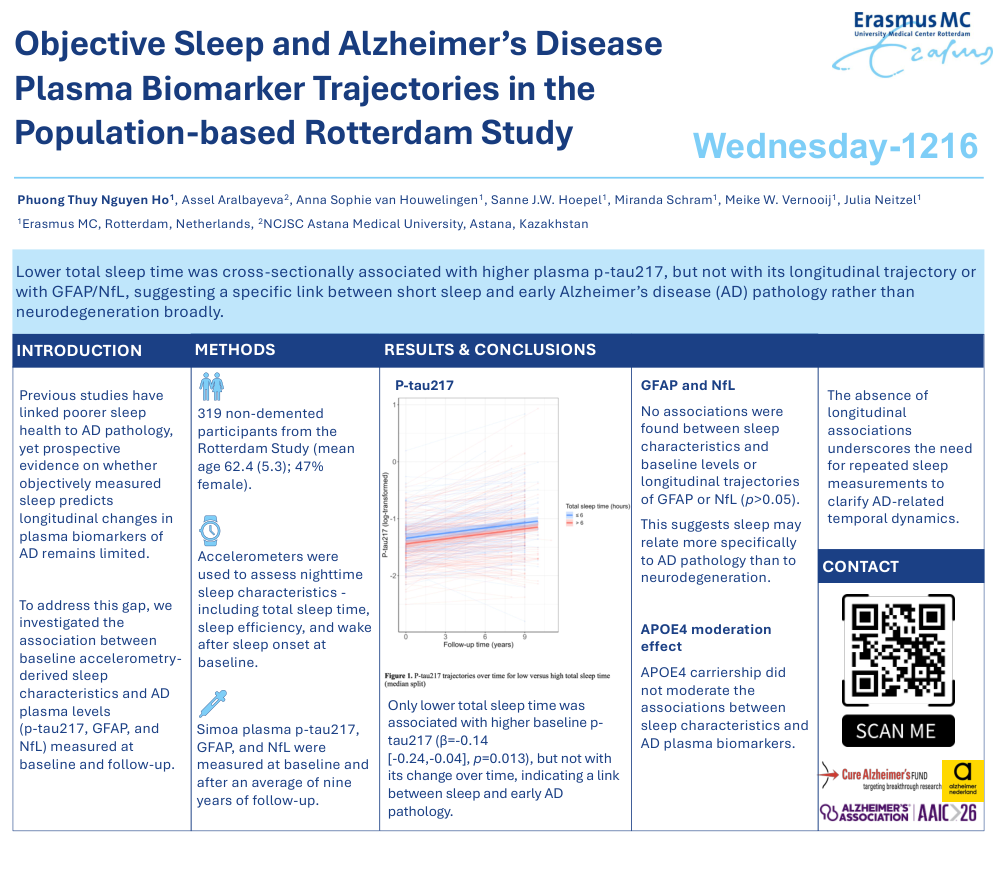
Background: Previous studies have linked poorer sleep health to Alzheimer's disease (AD) pathology, yet prospective evidence on whether objectively measured sleep predicts longitudinal changes in plasma biomarkers of AD remains limited. To address this gap, we investigated the association between baseline accelerometry-derived sleep characteristics and AD plasma levels (p-tau217, GFAP, and NfL) measured at baseline and follow-up.
Methods: We included 319 non-demented participants from the prospective, population-based Rotterdam Study (mean age 62.4 (5.3); 47% female). At baseline, wrist-worn accelerometers were used to assess nighttime sleep characteristics - including total sleep time, sleep efficiency, and wake after sleep onset. Simoa plasma p-tau217, GFAP, and NfL were measured at baseline and after an average of nine years of follow-up. Linear mixed models were used to estimate the associations between sleep and AD plasma biomarkers, adjusting for age, sex, APOE4, estimated GFR, accelerometer device, follow-up time, and time between sleep and baseline plasma measures.
Results: Shorter total sleep time (per SD) was associated with higher baseline p-tau217 levels (β=-0.14 [-0.24, -0.04], p=0.013), but sleep duration was not associated with change in p-tau217 levels over time. No associations were found between other sleep characteristics and p-tau217, or between sleep and baseline levels or longitudinal trajectories of GFAP and NfL (p>0.05). APOE4 carriership did not moderate the associations between sleep characteristics and AD plasma biomarkers.
Conclusion: Shorter sleep duration was associated with higher plasma p-tau217 levels, suggesting a link between sleep and early AD pathology. No associations were observed between sleep and longitudinal plasma biomarker trajectories, highlighting the need for studies with repeated sleep measurements to clarify the temporal dynamics of sleep in AD. The absence of associations between actigraphy-measured sleep and NfL or GFAP suggests that sleep may be more specifically linked to AD-related pathology than to neurodegeneration more broadly, which is consistent with the findings for NfL in a non-overlapping Rotterdam Study subgroup.
Comments
Email is required but is not shown publicly.
Loading comments...