4,068 posters, 219 videos, 101 topics, 69 sessions, 14,365 authors, 6,128 institutions
ePostersLive by SciGen Technologies S.A. All rights reserved.
Alzheimer's Association International Conference 2026
July 12-15, 2026 | London, United Kingdom, and Online

13539
Investigating Temporal Relationships Between Psychiatric Disorders And Subsequent Dementia: A Swedish Population-based Cohort Study
Poster Presenter
Authors
Jean Stafford, Praveetha Patalay, James B. Kirkbride, Marcus Richards, Robert Howard
Affiliations
Part of Topic
Public Health -> Epidemiology -> Risk, Reserve and Resilience
Temporal relationships between psychiatric disorders and dementia
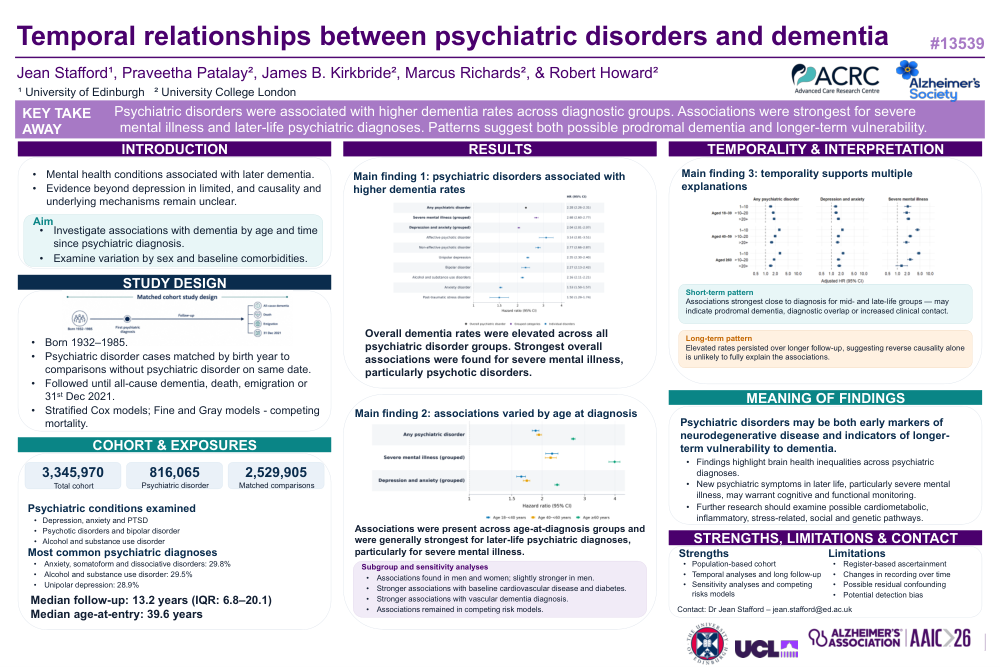
Key takeaways: Psychiatric disorders were associated with higher dementia rates across diagnostic groups. Associations were strongest for severe mental illness and later-life psychiatric diagnoses. Patterns suggest both possible prodromal dementia and longer-term vulnerability.
INTRODUCTION
•Investigate associations with dementia by age and time since psychiatric diagnosis.
STUDY DESIGN
COHORT & EXPOSURES
Total cohort n=3,345,970; psychiatric disorder n=816,065; matched comparison n=2,529,905
Psychiatric conditions examined
Most common psychiatric diagnoses
Median follow-up: 13.2 years (IQR: 6.8–20.1) Median age-at-entry: 39.6 years
RESULTS
Main finding 1: psychiatric disorders associated with higher dementia rates
Overall dementia rates were elevated across all psychiatric disorder groups. Strongest overall associations were found for severe mental illness, particularly psychotic disorders.
Main finding 2: associations varied by age at diagnosis
Associations were present across age-at-diagnosis groups and were generally strongest for later-life psychiatric diagnoses, particularly for severe mental illness.
Subgroup and sensitivity analyses
TEMPORALITY & INTERPRETATION
Short-term pattern
Associations strongest close to diagnosis for mid- and late-life groups — may indicate prodromal dementia, diagnostic overlap or increased clinical contact.
Long-term pattern
Elevated rates persisted over longer follow-up, suggesting reverse causality alone is unlikely to fully explain the associations.
MEANING OF FINDINGS
Psychiatric disorders may be both early markers of neurodegenerative disease and indicators of longer-term vulnerability to dementia.
STRENGTHS, LIMITATIONS & CONTACT
Strengths
Limitations
Comments
Email is required but is not shown publicly.
Loading comments...