4,068 posters, 219 videos, 101 topics, 69 sessions, 14,365 authors, 6,128 institutions
ePostersLive by SciGen Technologies S.A. All rights reserved.
Alzheimer's Association International Conference 2026
July 12-15, 2026 | London, United Kingdom, and Online

12812
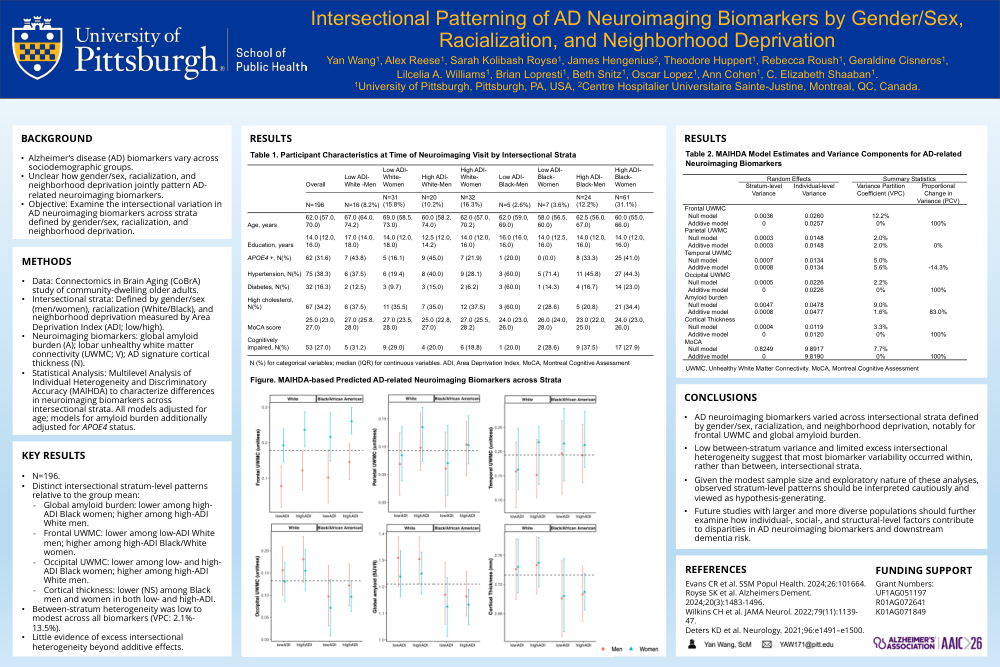
Intersectional Patterning Of AD Neuroimaging Biomarkers By Gender/Sex, Racialization, And Neighborhood Deprivation
Poster Presenter
Part of Topic
Public Health -> Epidemiology -> Innovative methods in epidemiology (i.e. assessment methods, design, recruitment strategies, statistical methods, etc.)
Background:
Prior research suggests that Alzheimer’s disease (AD) biomarkers vary across sociodemographic groups (e.g., gender/sex, racialization, neighborhood deprivation); however, it remains unclear how they jointly pattern AD-related neuroimaging biomarkers. We examined the intersectional variation in AD neuroimaging biomarkers across strata defined by gender/sex, racialization, and neighborhood deprivation.
Methods:
We used data from the Connectomics in Brain Aging (CoBrA) study of community-dwelling older adults. Eight intersectional strata were defined by gender/sex (men/women), racialization (White/Black), and neighborhood deprivation measured by Area Deprivation Index (ADI; low/high). Neuroimaging biomarkers included global amyloid SUVR (A); lobar unhealthy white matter connectivity (UWMC), a vascular (V) measure; and AD signature cortical thickness for neurodegeneration (N). We used Multilevel Analysis of Individual Heterogeneity and Discriminatory Accuracy (MAIHDA) to characterize differences in neuroimaging biomarkers across intersectional strata. All models adjusted for age; models for A additionally adjusted for APOE4 status.
Results:
Among 196 participants (Table 1), MAIHDA-predicted biomarkers showed distinct stratum-level patterns relative to the group mean (Figure). For global amyloid burden, high-ADI Black women had significantly lower burden, whereas White men had higher burden (low-ADI: non-significant (ns), high-ADI: significant). For frontal UWMC, high-ADI Black and White women had significantly higher values, whereas low-ADI White men had significantly lower values. For occipital UWMC, high-ADI White men had ns higher values, while low-ADI Black women had ns lower values. No significant differences were observed across strata for parietal or temporal UWMC. For cortical thickness, Black participants tended to have ns lower values overall. Between-stratum heterogeneity was low to modest (variance partition coefficients: 2.1%-13.5%) across all biomarkers (Table 2). There was little evidence of excess intersectional heterogeneity beyond additive effects of gender/sex, racialization, and ADI.
Conclusions:
AD neuroimaging biomarkers varied across strata defined by gender/sex, racialization, and neighborhood deprivation, notably frontal V and global A measures. Low between-stratum variance and intersectional effects indicate that these strata explained only a small proportion of total variability, highlighting substantial within-stratum heterogeneity and the likely importance of other factors. Findings suggest neuroimaging biomarker disparities arise through multiple jointly operating sociodemographic and other dimensions, with implications for understanding downstream inequalities in cognitive impairment and dementia.
Comments
Email is required but is not shown publicly.
Loading comments...