4,068 posters, 219 videos, 101 topics, 69 sessions, 14,365 authors, 6,128 institutions
ePostersLive by SciGen Technologies S.A. All rights reserved.
Alzheimer's Association International Conference 2026
July 12-15, 2026 | London, United Kingdom, and Online

13701
Genetic Liability To Alzheimer's Disease And Susceptibility To Childhood Infections
Poster Presenter
Part of Topic
Public Health -> Epidemiology -> Risk, Reserve and Resilience
No strong evidence was found for an association between genetic liability to Alzheimer's disease and common childhood infections.
INTRODUCTION
Accumulating evidence suggests microbial infections may play a role in the aetiology of Alzheimer's disease (AD)1,2. A number of pathogens have been implicated, with the most studied being herpesviruses. However, the role of polygenic liability to AD or APOE ε4 status has not been comprehensively studied against a broad range of infections.
This study aims to examine the association between genetic liability to AD and risk of common childhood infections.
METHODS
Sample: A subsample of 8,056 children with genetic and infections data available was selected from the Avon Longitudinal Study of Parents and Children (ALSPAC)3,4, a population-based pregnancy cohort based in and around Bristol, United Kingdom.
Exposures: We calculated polygenic risk scores for Alzheimer's disease including and excluding the APOE region (PRSAD and PRSAD_noAPOE) and extracted APOE ε4 carrier status.
Outcomes: Variables for "ever infection", "number of infection episodes" and "overall infection burden" were derived from data on 16 infections from parent-completed questionnaires collected between the ages of 18 months and 13 years.
Analysis: We performed logistic, Poisson and zero-inflated negative binomial regressions, adjusting for sex and first 10 genetic principal components, and controlled the false discovery rate at 5% using the Benjamini-Hochberg procedure.
RESULTS
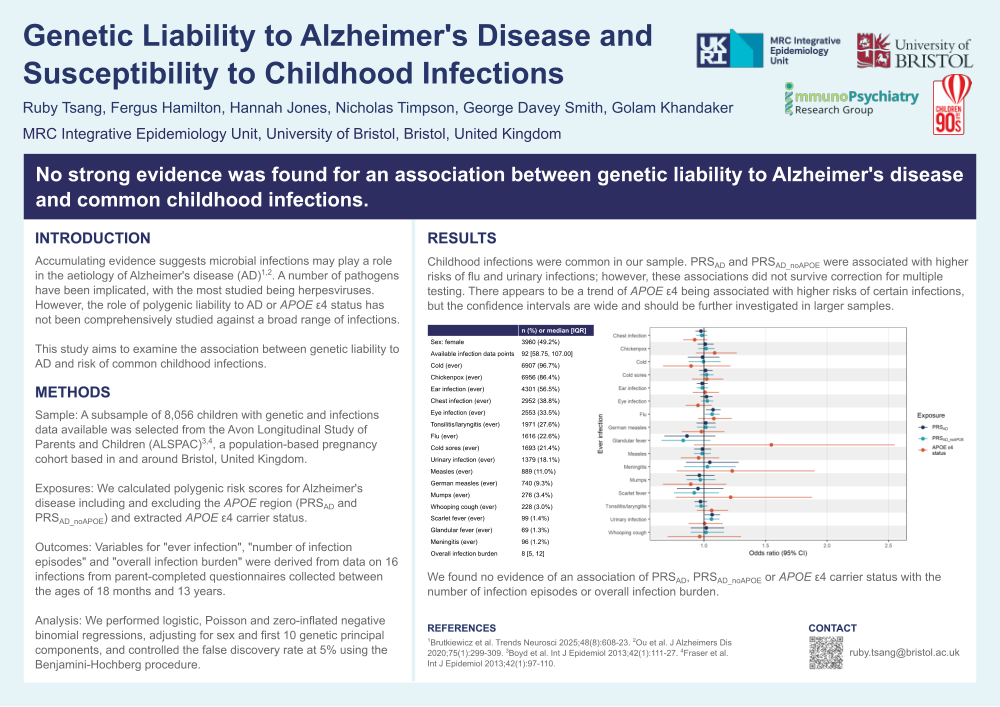
Childhood infections were common in our sample. PRSAD and PRSAD_noAPOE were associated with higher risks of flu and urinary infections; however, these associations did not survive correction for multiple testing. There appears to be a trend of APOE ε4 being associated with higher risks of certain infections, but the confidence intervals are wide and should be further investigated in larger samples.
We found no evidence of an association of PRSAD, PRSAD_noAPOE or APOE ε4 carrier status with the number of infection episodes or overall infection burden.
REFERENCES
1Brutkiewicz et al. Trends Neurosci 2025;48(8):608-23.
2Ou et al. J Alzheimers Dis 2020;75(1):299-309.
3Boyd et al. Int J Epidemiol 2013;42(1):111-27.
4Fraser et al. Int J Epidemiol 2013;42(1):97-110.
Comments
Email is required but is not shown publicly.
Loading comments...