4,068 posters, 219 videos, 101 topics, 69 sessions, 14,365 authors, 6,128 institutions
ePostersLive by SciGen Technologies S.A. All rights reserved.
Alzheimer's Association International Conference 2026
July 12-15, 2026 | London, United Kingdom, and Online

13657
Cognitive Change During Midlife In Diverse Populations: A Pooled Cohort Study In The United States
Poster Presenter
Authors
Jiawen Chen, Kristine Yaffe, Richard Jones, Seo‐Eun Choi, Sid O’Bryant, Lisa Bratzke, Jessica Caldwell, Xiaqing Jiang
Affiliations
Department of Psychiatry and Behavioral Sciences, University of California San Francisco, Department of Psychiatry and Behavioral Sciences, Neurology, and Epidemiology and Biostatistics, University of California San Francisco, Department of Psychiatry and Human Behavior, Warren Alpert Medical School, Brown University, Division of General Internal Medicine, Department of Medicine, University of Washington, Institute for Translational Research, University of North Texas Health Science Center, School of Nursing, University of Wisconsin-Madison, School of Medicine and Public Health, University of Wisconsin-Madison, Department of Psychiatry and Behavioral Sciences, University of California San Francisco; Department of Population Health, New York University Grossman School of Medicine
Part of Topic
Public Health -> Epidemiology -> Risk, Reserve and Resilience
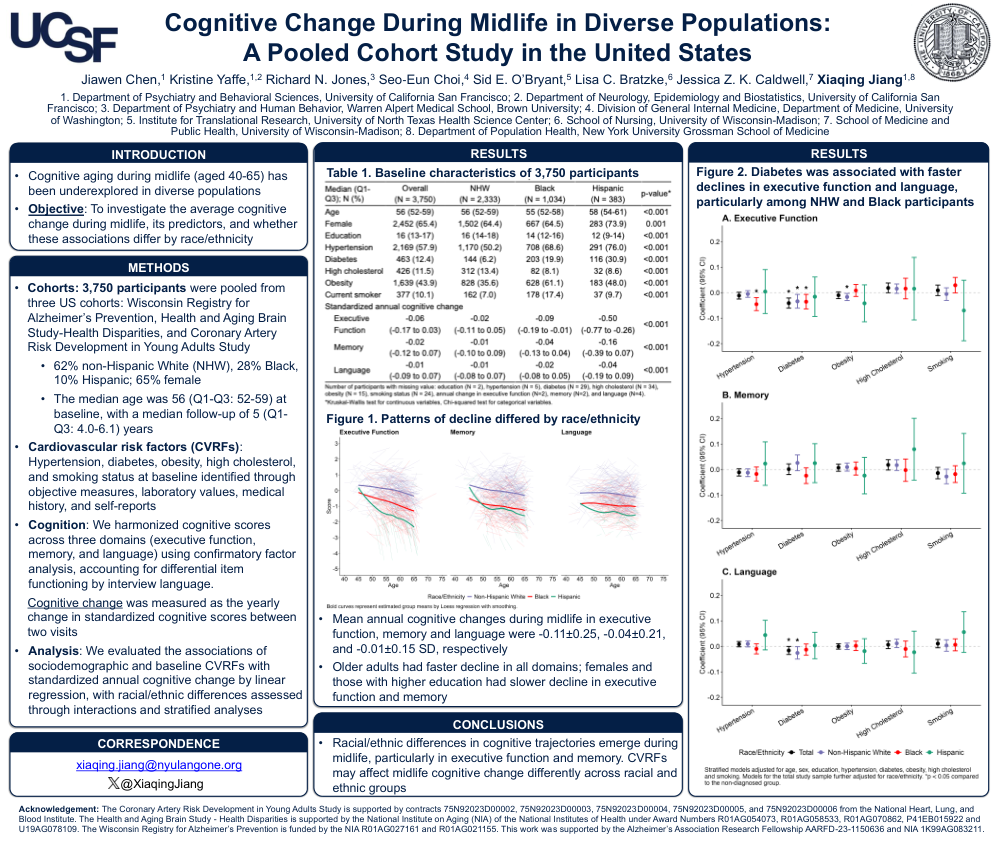
Background: Cognitive aging has been underexplored in midlife across diverse populations. We investigated average cognitive change during midlife (aged 40-65), its predictors and whether these associations differ by race/ethnicity.
Methods: We conducted a pooled analysis of 3,750 participants (62% non-Hispanic White [NHW], 28% Black, 10% Hispanic; 65% female) from three US cohorts: Wisconsin Registry for Alzheimer’s Prevention, Health and Aging Brain Study-Health Disparities, and Coronary Artery Risk Development in Young Adults Study. The median age was 56 (Q1-Q3: 52-59) at baseline, with a median follow-up of 5 (Q1-Q3: 4.0-6.1) years. We harmonized cognitive scores across three domains (executive function, memory, and language) using confirmatory factor analysis, accounting for differential item functioning by interview language. Associations of sociodemographics and baseline cardiovascular risk factors (CVRFs: hypertension, diabetes, obesity, high cholesterol, and smoking) with standardized annual cognitive change were evaluated using linear regression, with racial/ethnic differences assessed through interactions and stratified analyses.
Results: Mean annual cognitive changes during midlife in executive function, memory and language were -0.11±0.25, -0.04±0.21, and -0.01±0.15 SD, respectively. Older adults had faster decline in all domains, while female participants and those with higher education had slower decline in executive function and memory. The patterns of decline differed across race/ethnicity (Figure 1). Compared with NHW participants, Hispanic participants declined faster in executive function (-0.38, 95%CI -0.40 to -0.36), memory (-0.12, 95%CI -0.15 to -0.10) and language (-0.04, 95%CI -0.06 to -0.02); Black participants declined faster in executive function (-0.04, 95%CI -0.06 to -0.03) and memory (-0.04, 95%CI -0.05 to -0.02), and these differences were not explained by education and CVRFs. Among all participants, diabetes was associated with faster decline in executive function (-0.04, 95%CI -0.06 to -0.02) and language (-0.02, 95%CI: -0.03 to -0.0004). Among racial/ethnic groups, diabetes was associated with faster decline in NHW (executive function: -0.03, 95% CI -0.06 to -0.01; language: -0.03, 95% CI -0.05 to -0.001) and Black participants (executive function: -0.04, 95%CI: -0.06 to -0.01; Figure 2).
Conclusion: Racial/ethnic differences in cognitive trajectories emerge during midlife, particularly in executive function and memory. CVRFs may affect midlife cognitive change differently across racial and ethnic groups.
Comments
Email is required but is not shown publicly.
Loading comments...