4,068 posters, 219 videos, 101 topics, 69 sessions, 14,365 authors, 6,128 institutions
ePostersLive by SciGen Technologies S.A. All rights reserved.
Alzheimer's Association International Conference 2026
July 12-15, 2026 | London, United Kingdom, and Online

13572
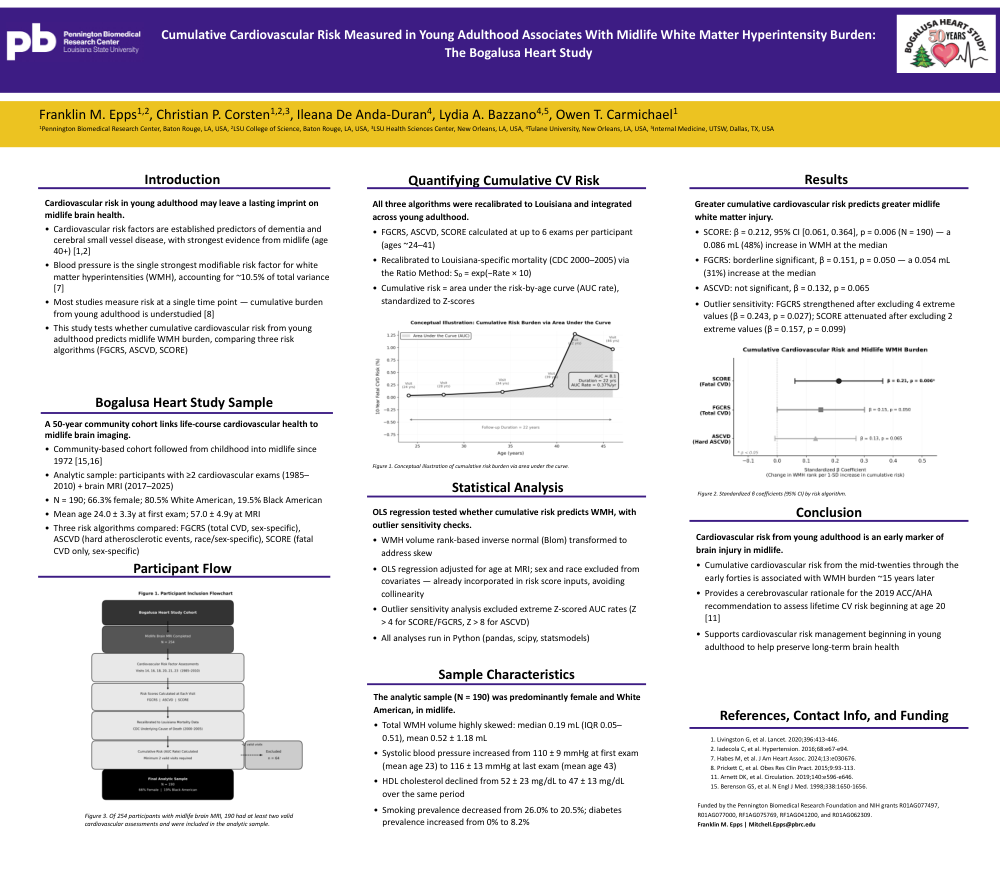
Cardiovascular Risk Scores From Young Adulthood To Midlife Predict White Matter Hyperintensity Burden: The Bogalusa Heart Study
Poster Presenter
Authors
Affiliations
null,
Part of Topic
Public Health -> Epidemiology -> Risk, Reserve and Resilience
Cumulative Cardiovascular Risk Measured in Young Adulthood Associates With Midlife White Matter Hyperintensity Burden: The Bogalusa Heart Study
Authors:
Franklin M. Epps¹˒², Christian P. Corsten¹˒²˒³, Ileana De Anda-Duran⁴, Lydia A. Bazzano⁴˒⁵, Owen T. Carmichael¹
Affiliations:
¹Pennington Biomedical Research Center, Baton Rouge, LA, USA
²LSU College of Science, Baton Rouge, LA, USA
³LSU Health Sciences Center, New Orleans, LA, USA
⁴Tulane University, New Orleans, LA, USA
⁵Internal Medicine, UTSW, Dallas, TX, USA
Introduction
Cardiovascular risk in young adulthood may leave a lasting imprint on midlife brain health.
- Cardiovascular risk factors are established predictors of dementia and cerebral small vessel disease, with strongest evidence from midlife (age 40+) [1,2]
- Blood pressure is the single strongest modifiable risk factor for white matter hyperintensities (WMH), accounting for ~10.5% of total variance [7]
- Most studies measure risk at a single time point — cumulative burden from young adulthood is understudied [8]
- This study tests whether cumulative cardiovascular risk from young adulthood predicts midlife WMH burden, comparing three risk algorithms (FGCRS, ASCVD, SCORE)
Bogalusa Heart Study Sample
A 50-year community cohort links life-course cardiovascular health to midlife brain imaging.
- Community-based cohort followed from childhood into midlife since 1972 [15,16]
- Analytic sample: participants with ≥2 cardiovascular exams (1985–2010) + brain MRI (2017–2025)
- N = 190; 66.3% female; 80.5% White American, 19.5% Black American
- Mean age 24.0 ± 3.3y at first exam; 57.0 ± 4.9y at MRI
- Three risk algorithms compared: FGCRS (total CVD, sex-specific), ASCVD (hard atherosclerotic events, race/sex-specific), SCORE (fatal CVD only, sex-specific)
Participant Flow
Figure 3. Of 254 participants with midlife brain MRI, 190 had at least two valid cardiovascular assessments and were included in the analytic sample.
Quantifying Cumulative CV Risk
All three algorithms were recalibrated to Louisiana and integrated across young adulthood.
- FGCRS, ASCVD, SCORE calculated at up to 6 exams per participant (ages ~24–41)
- Recalibrated to Louisiana-specific mortality (CDC 2000–2005) via the Ratio Method: S₀ = exp(−Rate × 10)
- Cumulative risk = area under the risk-by-age curve (AUC rate), standardized to Z-scores
Figure 1. Conceptual illustration of cumulative risk burden via area under the curve.
Statistical Analysis
OLS regression tested whether cumulative risk predicts WMH, with outlier sensitivity checks.
- WMH volume rank-based inverse normal (Blom) transformed to address skew
- OLS regression adjusted for age at MRI; sex and race excluded from covariates — already incorporated in risk score inputs, avoiding collinearity
- Outlier sensitivity analysis excluded extreme Z-scored AUC rates (Z > 4 for SCORE/FGCRS, Z > 8 for ASCVD)
- All analyses run in Python (pandas, scipy, statsmodels)
Sample Characteristics
The analytic sample (N = 190) was predominantly female and White American, in midlife.
- Total WMH volume highly skewed: median 0.19 mL (IQR 0.05–0.51), mean 0.52 ± 1.18 mL
- Systolic blood pressure increased from 110 ± 9 mmHg at first exam (mean age 23) to 116 ± 13 mmHg at last exam (mean age 43)
- HDL cholesterol declined from 52 ± 23 mg/dL to 47 ± 13 mg/dL over the same period
- Smoking prevalence decreased from 26.0% to 20.5%; diabetes prevalence increased from 0% to 8.2%
Results
Greater cumulative cardiovascular risk predicts greater midlife white matter injury.
- SCORE: β = 0.212, 95% CI [0.061, 0.364], p = 0.006 (N = 190) — a 0.086 mL (48%) increase in WMH at the median
- FGCRS: borderline significant, β = 0.151, p = 0.050 — a 0.054 mL (31%) increase at the median
- ASCVD: not significant, β = 0.132, p = 0.065
- Outlier sensitivity: FGCRS strengthened after excluding 4 extreme values (β = 0.243, p = 0.027); SCORE attenuated after excluding 2 extreme values (β = 0.157, p = 0.099)
Figure 2. Standardized β coefficients (95% CI) by risk algorithm.
Conclusion
Cardiovascular risk from young adulthood is an early marker of brain injury in midlife.
- Cumulative cardiovascular risk from the mid-twenties through the early forties is associated with WMH burden ~15 years later
- Provides a cerebrovascular rationale for the 2019 ACC/AHA recommendation to assess lifetime CV risk beginning at age 20 [11]
- Supports cardiovascular risk management beginning in young adulthood to help preserve long-term brain health
References, Contact Info, and Funding
- Livingston G, et al. Lancet. 2020;396:413-446.
- Iadecola C, et al. Hypertension. 2016;68:e67-e94.
- Habes M, et al. J Am Heart Assoc. 2024;13:e030676.
- Prickett C, et al. Obes Res Clin Pract. 2015;9:93-113.
- Arnett DK, et al. Circulation. 2019;140:e596-e646.
- Berenson GS, et al. N Engl J Med. 1998;338:1650-1656.
Funded by the Pennington Biomedical Research Foundation and NIH grants R01AG077497, R01AG077000, RF1AG075769, RF1AG041200, and R01AG062309.
Franklin M. Epps | Mitchell.Epps@pbrc.edu
Comments
Email is required but is not shown publicly.
Loading comments...