4,068 posters, 219 videos, 101 topics, 69 sessions, 14,365 authors, 6,128 institutions
ePostersLive by SciGen Technologies S.A. All rights reserved.
Alzheimer's Association International Conference 2026
July 12-15, 2026 | London, United Kingdom, and Online

13125
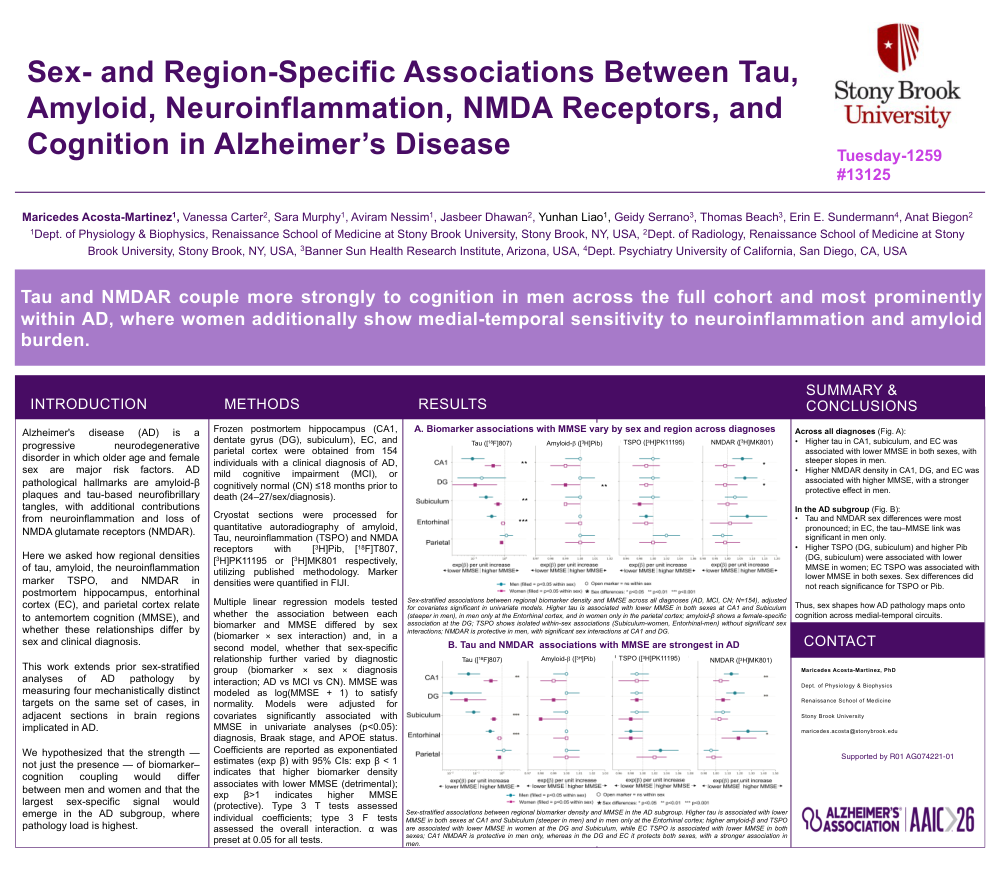
Sex- And Diagnosis-specific Associations Between Regional Tau, Amyloid, Neuroinflammation, NMDARs And Cognition In Alzheimer’s Disease
Poster Presenter
Authors
Part of Topic
Basic Science and Pathogenesis -> Human Neuropathology -> Clinico-pathologic correlations
Video
Alzheimer's disease (AD) is a progressive neurodegenerative disorder in which older age and female sex are major risk factors. AD pathological hallmarks are amyloid-β plaques and tau-based neurofibrillary tangles, with additional contributions from neuroinflammation and loss of NMDA glutamate receptors (NMDAR).Here we asked how regional densities of tau, amyloid, the neuroinflammation marker TSPO, and NMDAR in postmortem hippocampus, entorhinal cortex (EC), and parietal cortex relate to antemortem cognition (MMSE), and whether these relationships differ by sex and clinical diagnosis.This work extends prior sex-stratified analyses of AD pathology by measuring four mechanistically distinct targets on the same set of cases, in adjacent sections in brain regions implicated in AD. We hypothesized that the strength — not just the presence — of biomarker–cognition coupling would differ between men and women and that the largest sex-specific signal would emerge in the AD subgroup, where pathology load is highest.
Methods: Frozen postmortem hippocampus (CA1, dentate gyrus (DG), subiculum), EC, and parietal cortex were obtained from 154 individuals with a clinical diagnosis of AD, mild cognitive impairment (MCI), or cognitively normal (CN) ≤18 months prior to death (24–27/sex/diagnosis).Cryostat sections were processed for quantitative autoradiography of amyloid, Tau, neuroinflammation (TSPO) and NMDA receptors with [3H]Pib, [18F]T807, [3H]PK11195 or [3H]MK801 respectively, utilizing published methodology. Marker densities were quantified in FIJI. Multiple linear regression models tested whether the association between each biomarker and MMSE differed by sex (biomarker × sex interaction) and, in a second model, whether that sex-specific relationship further varied by diagnostic group (biomarker × sex × diagnosis interaction; AD vs MCI vs CN). MMSE was modeled as log(MMSE + 1) to satisfy normality. Models were adjusted for covariates significantly associated with MMSE in univariate analyses (p<0.05): diagnosis, Braak stage, and APOE status. Coefficients are reported as exponentiated estimates (exp β) with 95% CIs: exp β < 1 indicates that higher biomarker density associates with lower MMSE (detrimental); exp β>1 indicates higher MMSE (protective). Type 3 T tests assessed individual coefficients; type 3 F tests assessed the overall interaction. α was preset at 0.05 for all tests.
Results:Sex-stratified associations between regional biomarker density and MMSE across all diagnoses (AD, MCI, CN; N=154), adjusted for covariates significant in univariate models. Higher tau is associated with lower MMSE in both sexes at CA1 and Subiculum (steeper in men), in men only at the Entorhinal cortex, and in women only in the parietal cortex; amyloid-β shows a female-specific association at the DG; TSPO shows isolated within-sex associations (Subiculum-women, Entorhinal-men) without significant sex interactions; NMDAR is protective in men, with significant sex interactions at CA1 and DG.
Sex-stratified associations between regional biomarker density and MMSE in the AD subgroup. Higher tau is associated with lower MMSE in both sexes at CA1 and Subiculum (steeper in men) and in men only at the Entorhinal cortex; higher amyloid-β and TSPO are associated with lower MMSE in women at the DG and Subiculum, while EC TSPO is associated with lower MMSE in both sexes; CA1 NMDAR is protective in men only, whereas in the DG and EC it protects both sexes, with a stronger association in men.
In conclusion, sex shapes how AD pathology maps onto cognition across medial-temporal circuits.
Comments
Email is required but is not shown publicly.
Loading comments...