4,068 posters, 219 videos, 101 topics, 69 sessions, 14,365 authors, 6,128 institutions
ePostersLive by SciGen Technologies S.A. All rights reserved.
Alzheimer's Association International Conference 2026
July 12-15, 2026 | London, United Kingdom, and Online

12035
Sex Differences In The Gut Microbiota Are Associated With Distinct Neuropathological Responses In The 5xFAD Model Of Alzheimer’s Disease
Poster Presenter
Part of Topic
Basic Science and Pathogenesis -> Molecular and Cell Biology -> APP/Abeta/Amyloid
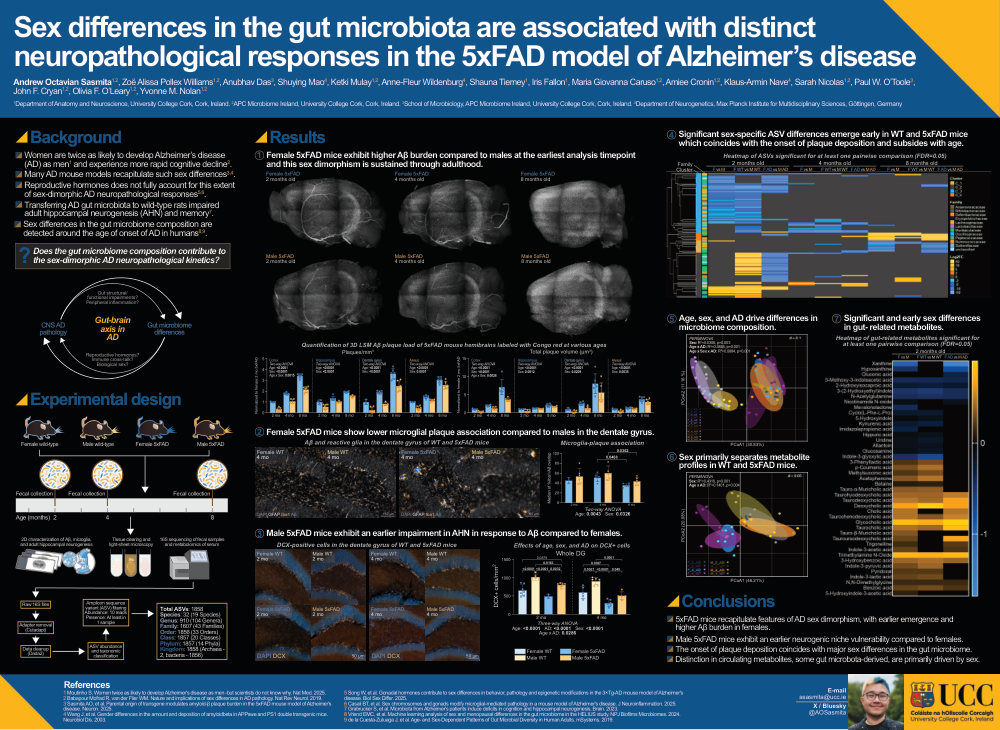
Women make up two-thirds of all Alzheimer’s disease (AD) cases and although reproductive hormones may explain some of these differences, supporting evidence suggests that other biological factors may contribute to this phenomenon. The gut microbiome has emerged as a key regulator of brain and behaviour with reported sex differences. We showed that transferring gut microbiota from AD patients to naïve rats induced deficits in adult hippocampal neurogenesis (AHN)—a process in the dentate gyrus increasingly relevant in AD—and associated behaviour. However, it remains unknown whether sex differences in the gut microbiome composition are associated with sex-dimorphic neuropathological effects of AD, including AHN impairments which may drive deficits in learning and memory.
Male and female wild-type (WT) and 5xFAD mice were utilized in this study at 2, 4, and 8 months old. Hemibrains were processed for 3D light-sheet microscopy of amyloid-β (Aβ) plaques in the cortex, hippocampus, dentate gyrus, and the white matter. 2D imaging characterisation of microglia (Iba1) and astrocytes (GFAP) in the hippocampus as well as AHN (DCX-positive cells) in the dentate gyrus was performed. Faecal samples and blood serum were collected for 16S rRNA sequencing and untargeted metabolomics, respectively.
Female 5xFAD mice displayed higher Aβ burden—even at 2 months—suggesting early emergence of sex-dependent Aβ-related kinetics. Microglia in male 5xFAD mice significantly contact plaques more than in female 5xFAD mice. Furthermore, 2-month-old male but not female 5xFAD mice had fewer DCX-positive cells in the dentate gyrus compared to WT mice, indicating an earlier Aβ-mediated vulnerability in the male neurogenic niche. Analysis of gut microbiota composition revealed significant differences in α- and β-diversities between male and female WT and 5xFAD mice as well as amplicon sequence variant (ASV) differences especially at 2 months. Circulating metabolites, some gut microbiota-derived, were also differentially abundant in male compared to female mice with some AD-specific signatures.
Our preclinical findings suggest that the sex dimorphic neuropathology in 5xFAD mice emerge early, including higher Aβ-related pathologies and a resistance to early AHN impairments in females. These are accompanied by sex-, age- and AD-dependent distinctions in the gut microbiota and circulating metabolites. Further research is warranted to uncover the regulatory role of gut microbiota and metabolites in sex dimorphic neuropathology and function in AD.
Comments
Email is required but is not shown publicly.
Loading comments...