4,068 posters, 219 videos, 101 topics, 69 sessions, 14,365 authors, 6,128 institutions
ePostersLive by SciGen Technologies S.A. All rights reserved.
Alzheimer's Association International Conference 2026
July 12-15, 2026 | London, United Kingdom, and Online

13732
Recursively Optimizing Ai Swarms For Precision Target Discovery: A Persistent-memory Approach To Neurodegeneration
Poster Presenter
Authors
Affiliations
Part of Topic
Basic Science and Pathogenesis -> Genetics -> Transcriptomics
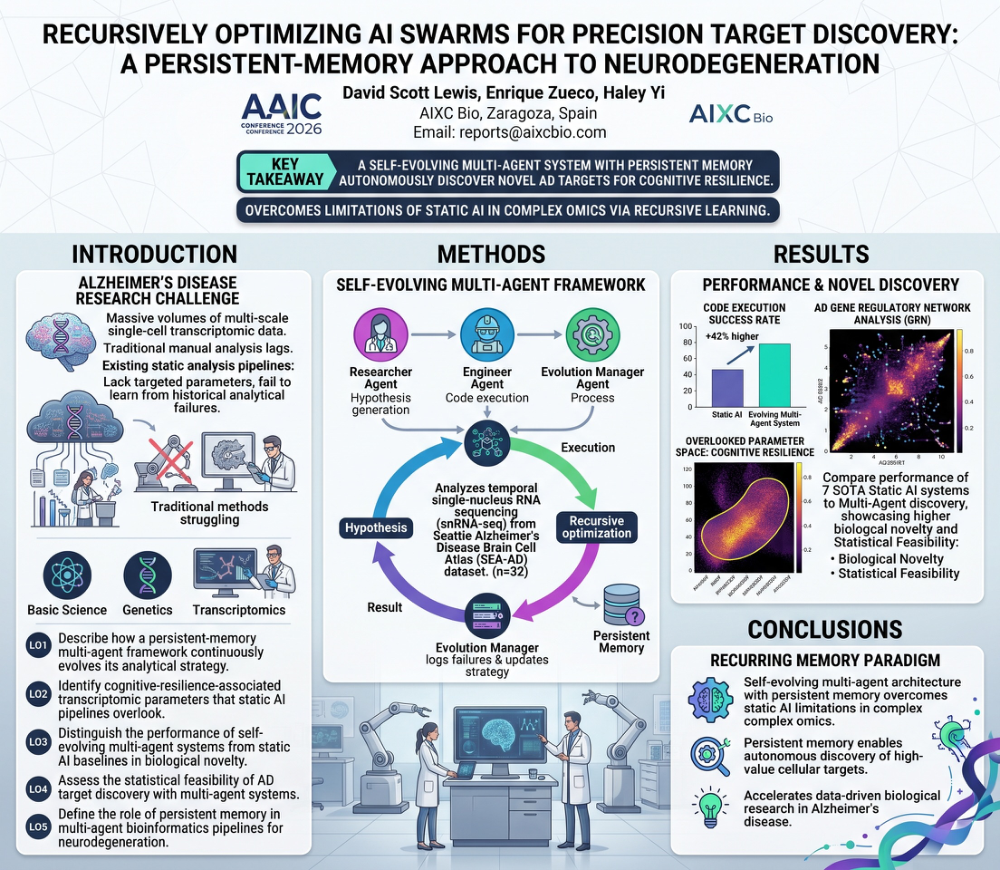
RECURSIVELY OPTIMIZING AI SWARMS FOR PRECISION TARGET DISCOVERY:
A PERSISTENT-MEMORY APPROACH TO NEURODEGENERATION
David Scott Lewis, Enrique Zueco, Haley Yi
AIXC Bio, Zaragoza, Spain
Email: reports@aixcbio.com
AAIC CONFERENCE 2026
AIXC Bio
KEY TAKEAWAY: A SELF-EVOLVING MULTI-AGENT SYSTEM WITH PERSISTENT MEMORY AUTONOMOUSLY DISCOVERS NOVEL AD TARGETS FOR COGNITIVE RESILIENCE.
OVERCOMES LIMITATIONS OF STATIC AI IN COMPLEX OMICS VIA RECURSIVE LEARNING.
INTRODUCTION
ALZHEIMER'S DISEASE RESEARCH CHALLENGE
Massive volumes of multi-scale single-cell transcriptomic data.
Traditional manual analysis lags.
Existing static analysis pipelines: Lack targeted parameters, fail to learn from historical analytical failures.
(Diagram: Traditional methods struggling)
(Icons: Basic Science, Genetics, Transcriptomics)
LO1 Describe how a persistent-memory multi-agent framework continuously evolves its analytical strategy.
LO2 Identify cognitive-resilience-associated transcriptomic parameters that static AI pipelines overlook.
LO3 Distinguish the performance of self-evolving multi-agent systems from static AI baselines in biological novelty.
LO4 Assess the statistical feasibility of AD target discovery with multi-agent systems.
LO5 Define the role of persistent memory in multi-agent bioinformatics pipelines for neurodegeneration.
METHODS
SELF-EVOLVING MULTI-AGENT FRAMEWORK
(Icons: Researcher Agent, Engineer Agent, Evolution Manager Agent)
Researcher Agent: Hypothesis generation
Engineer Agent: Code execution
Evolution Manager Agent: Process
(Circular workflow diagram)
Hypothesis -> Execution -> Recursive optimization -> Result (loop)
Analyzes temporal single-nucleus RNA sequencing (snRNA-seq) from Seattle Alzheimer's Disease Brain Cell Atlas (SEA-AD) dataset. (n=32)
Persistent Memory -> Evolution Manager logs failures & updates strategy
RESULTS
PERFORMANCE & NOVEL DISCOVERY
CODE EXECUTION SUCCESS RATE
(Bar chart: Static AI vs Evolving Multi-Agent System. Evolving Multi-Agent System has +42% higher success rate)
AD GENE REGULATORY NETWORK ANALYSIS (GRN)
(Scatter plot heat map)
OVERLOOKED PARAMETER SPACE: COGNITIVE RESILIENCE
(Heat map)
Compare performance of 7 SOTA Static AI systems to Multi-Agent discovery, showcasing higher biological novelty and Statistical Feasibility:
- Biological Novelty
- Statistical Feasibility
CONCLUSIONS
RECURRING MEMORY PARADIGM
- Self-evolving multi-agent architecture with persistent memory overcomes static AI limitations in complex omics.
- Persistent memory enables autonomous discovery of high-value cellular targets.
- Accelerates data-driven biological research in Alzheimer's disease.
Comments
Email is required but is not shown publicly.
Loading comments...