4,068 posters, 219 videos, 101 topics, 69 sessions, 14,365 authors, 6,128 institutions
ePostersLive by SciGen Technologies S.A. All rights reserved.
Alzheimer's Association International Conference 2026
July 12-15, 2026 | London, United Kingdom, and Online

13776
Protein Disulfide Isomerase A3 Modulates PKCζ and Cdk5 Gene Expression in Primary Cortical Neuron Cultures
Part of Topic
Basic Science and Pathogenesis -> Molecular and Cell Biology -> Other
Protein Disulfide Isomerase A3 Modulates PKCζ and Cdk5 Gene Expression in Primary Cortical Neuron Cultures
Bariscan Unal1, Bilge Nur Bilge1, Erdinc Dursun1, Duygu Gezen Ak1
1Istanbul University-Cerrahpasa, Brain and Neurodegenerative Disorders Research Laboratories, Department of Neuroscience, Institute of Neurological Sciences, Istanbul, Türkiye
Introduction: Protein Disulfide Isomerase A3 (PDIA3), a chaperone protein located in the endoplasmic reticulum (ER), has been demonstrated to promote axonal regeneration and inhibit amyloid beta (Aβ) aggregation, one of the main pathologies of Alzheimer's Disease (Gezen-Ak et al., 2017). In cortical neurons, silencing the PDIA3 gene results in increased amyloid production (Gezen-Ak et al., 2017). PKCζ and Cdk5 are proteins involved in intracellular signal transduction, synaptic activity, and neuronal development, and have also been associated with Alzheimer’s disease pathology (Lucke-Wold et al., 2014; Liu et al., 2015). However, their relationship with PDIA3 is not fully understood. The purpose of this study was to investigate how PKCζ and Cdk5 gene expression is affected when the PDIA3 gene is silenced.
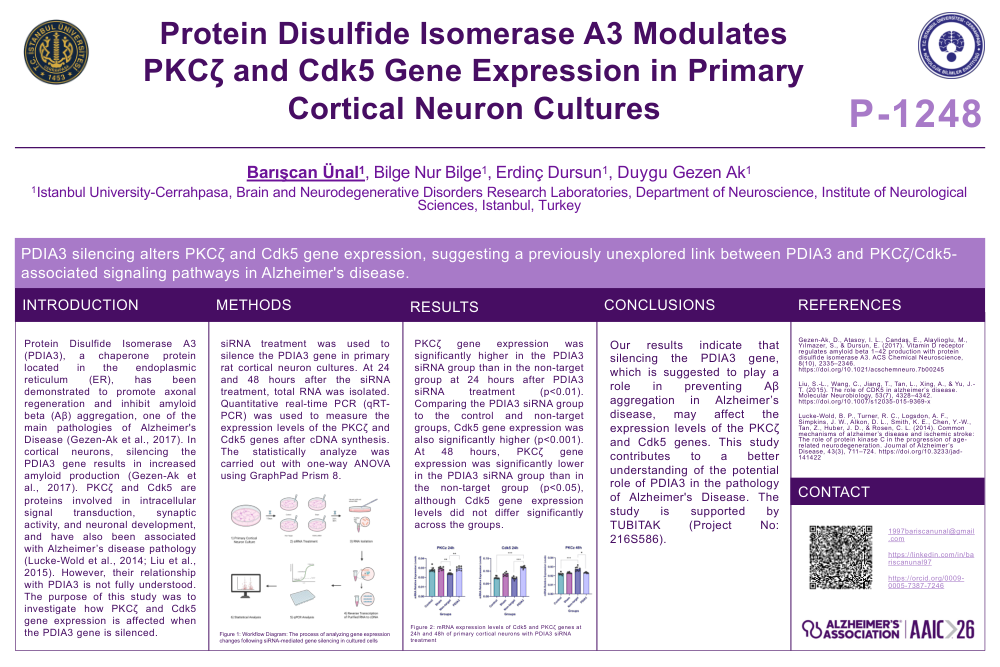
Methods: siRNA treatment was used to silence the PDIA3 gene in primary rat cortical neuron cultures. At 24 and 48 hours after the siRNA treatment, total RNA was isolated. Quantitative real-time PCR (qRT-PCR) was used to measure the expression levels of the PKCζ and Cdk5 genes after cDNA synthesis. The statistically analyze was carried out with one-way ANOVA using GraphPad Prism 8.
Results: PKCζ gene expression was significantly higher in the PDIA3 siRNA group than in the non-target group at 24 hours after PDIA3 siRNA treatment (p<0.01). Comparing the PDIA3 siRNA group to the control and non-target groups, Cdk5 gene expression was also significantly higher (p<0.001). At 48 hours, PKCζ gene expression was significantly lower in the PDIA3 siRNA group than in the non-target group (p<0.05), although Cdk5 gene expression levels did not differ significantly across the groups.
Conclusion: Our results indicate that silencing the PDIA3 gene, which is suggested to play a role in preventing Aβ aggregation in Alzheimer’s disease, may affect the expression levels of the PKCζ and Cdk5 genes. This study contributes to a better understanding of the potential role of PDIA3 in the pathology of Alzheimer's Disease. The study is supported by TUBITAK (Project No: 216S586).
Comments
Email is required but is not shown publicly.
Loading comments...