4,068 posters, 219 videos, 101 topics, 69 sessions, 14,365 authors, 6,128 institutions
ePostersLive by SciGen Technologies S.A. All rights reserved.
Alzheimer's Association International Conference 2026
July 12-15, 2026 | London, United Kingdom, and Online

13440
Prediction Of Cognitive Decline And Diagnostic Outcomes From Multi-modal Alzheimer's Disease Resilience Phenotypes
Poster Presenter
Authors
Emily R. Mahoney, Alaina Durant, Sarah Biber, Walter A. Kukull, Mary Ellen Koran, Paul K. Crane, Shubhabrata Mukherjee, Christos Davatzikos, Sterling Johnson, Elizabeth Mormino, Leslie Gaynor, Derek Archer, Logan Dumitrescu, Timothy J. Hohman
Affiliations
Vanderbilt Memory & Alzheimer's Center, Vanderbilt Health, Nashville, TN, Department of Neurology, Washington University in St. Louis, St. Louis, MO, Department of Radiology, Stanford Hospital, Stanford, CA, Department of Medicine, University of Washington, Seattle, WA, Center for Biomedical Image Computing and Analytics, University of Pennsylvania, Perelman School of Medicine, Philadelphia, PA, Alzheimer’s Disease Research Center, University of Wisconsin School of Medicine and Public Health, Madison, WI, Department of Neurology, Stanford Hospital, Stanford, CA
Part of Topic
Basic Science and Pathogenesis -> Human Neuropathology -> Clinico-pathologic correlations
Background:
The development of amyloid-β plaques and tau tangles in the brain typically results in reduced brain volumes and cognitive impairment in Alzheimer’s disease. However, many individuals with amyloid and tau accumulation in the brain never proceed to experience cognitive decline or an Alzheimer’s disease (AD) diagnosis. Building high-quality metrics of resilience to pathology deposition is critical for studying the mechanisms of such protection. This study leverages multi-modal quantifications of amyloid and tau burden, harmonized cognitive scores, brain imaging, and diagnostic information to generate and evaluate resilience metrics.
Methods:
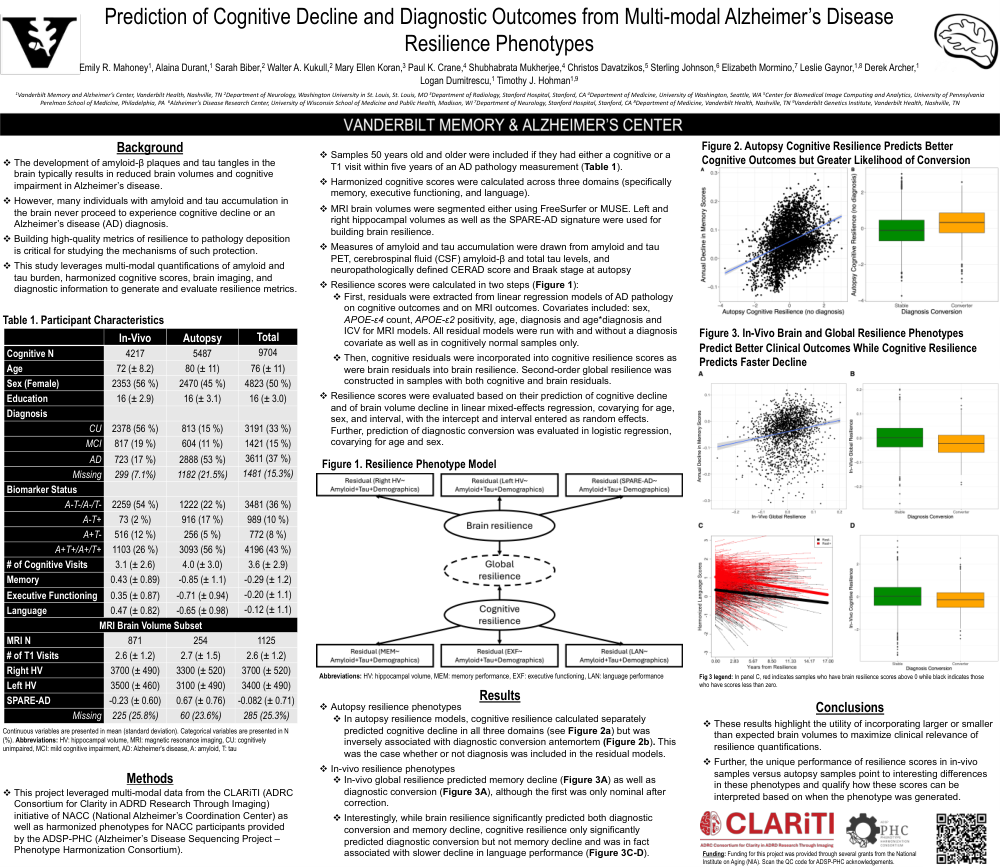
Resilience scores were calculated in two steps (Figure 1): First, residuals were extracted from linear regression models of AD pathology on cognitive outcomes and on MRI outcomes. Covariates included: sex, APOE-ε4 count,APOE-ε2 positivity, age, diagnosis and age*diagnosis and ICV for MRI models. All residual models were run with and without a diagnosis covariate as well as in cognitively normal samples only. Then, cognitive residuals were incorporated into cognitive resilience scores as were brain residuals into brain resilience. Second-order global resilience was constructed in samples with both cognitive and brain residuals.
Comments
Email is required but is not shown publicly.
Loading comments...