4,068 posters, 219 videos, 101 topics, 69 sessions, 14,365 authors, 6,128 institutions
ePostersLive by SciGen Technologies S.A. All rights reserved.
Alzheimer's Association International Conference 2026
July 12-15, 2026 | London, United Kingdom, and Online

13758
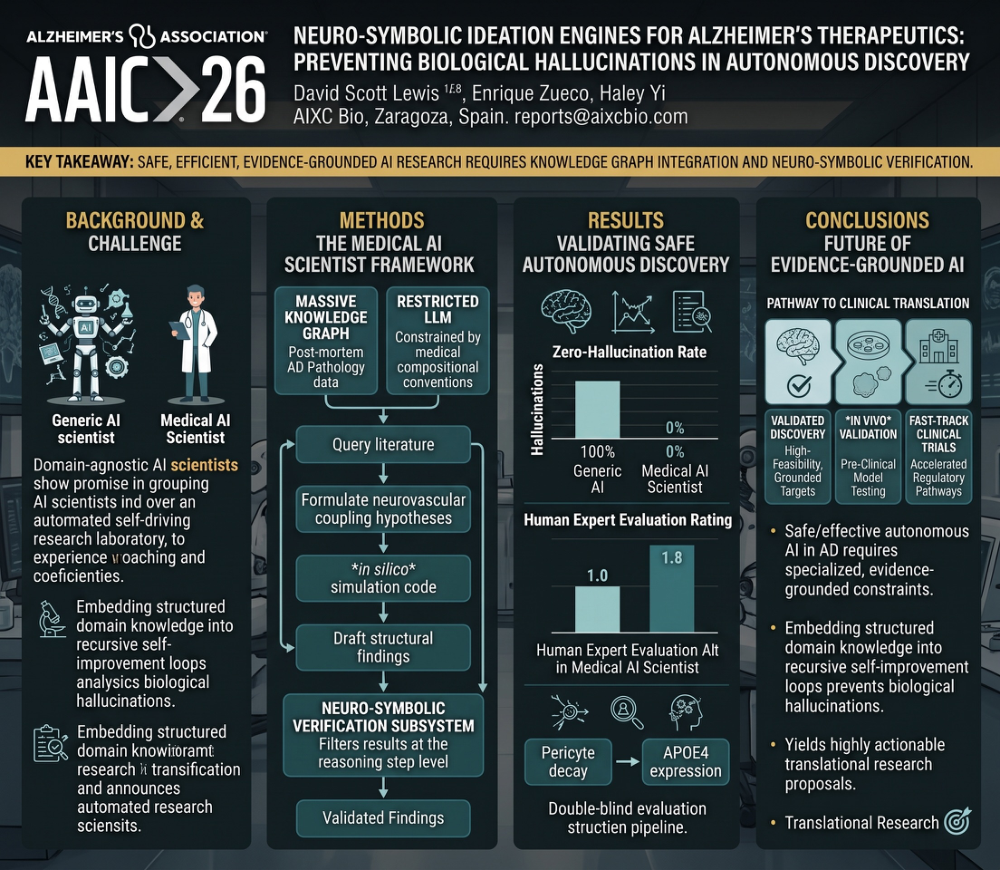
Neuro-symbolic Ideation Engines For Alzheimer's Therapeutics: Preventing Biological Hallucinations In Autonomous Discovery
Poster Presenter
Authors
Affiliations
Part of Topic
Basic Science and Pathogenesis -> Molecular and Cell Biology -> Therapeutics
ALZHEIMER'S ASSOCIATION
AAIC '26
NEURO-SYMBOLIC IDEATION ENGINES FOR ALZHEIMER'S THERAPEUTICS:
PREVENTING BIOLOGICAL HALLUCINATIONS IN AUTONOMOUS DISCOVERY
David Scott Lewis, Enrique Zueco, Haley Yi
AIXC Bio, Zaragoza, Spain. reports@aixcbio.com
KEY TAKEAWAY: SAFE, EFFICIENT, EVIDENCE-GROUNDED AI RESEARCH REQUIRES KNOWLEDGE GRAPH INTEGRATION AND NEURO-SYMBOLIC VERIFICATION.
BACKGROUND & CHALLENGE
Generic AI Scientist vs Medical AI Scientist
Domain-agnostic AI scientists show promise in operating an automated self-driving research laboratory, but experience hallucinations and inefficiencies.
- Embedding structured domain knowledge into recursive self-improvement loops prevents biological hallucinations.
- Embedding structured domain knowledge in translational research enhances automated AI scientists.
METHODS
THE MEDICAL AI SCIENTIST FRAMEWORK
MASSIVE KNOWLEDGE GRAPH (Post-mortem AD Pathology data) -> RESTRICTED LLM (Constrained by medical compositional conventions)
-> Query literature
-> Formulate neurovascular coupling hypotheses
-> *in silico* simulation code
-> Draft structural findings
-> NEURO-SYMBOLIC VERIFICATION SUBSYSTEM (Filters results at the reasoning step level)
-> Validated Findings
RESULTS
VALIDATING SAFE AUTONOMOUS DISCOVERY
Zero-Hallucination Rate
(Bar chart showing Hallucinations: Generic AI 100%, Medical AI Scientist 0%)
Human Expert Evaluation Rating
(Bar chart showing Human Expert Evaluation Rating: 1.0 vs 1.8)
Human Expert Evaluation of the Medical AI Scientist
Pericyte decay -> APOE4 expression
Double-blind evaluation pipeline.
CONCLUSIONS
FUTURE OF EVIDENCE-GROUNDED AI
PATHWAY TO CLINICAL TRANSLATION
VALIDATED DISCOVERY (High-Feasibility, Grounded Targets) -> *IN VIVO* VALIDATION (Pre-Clinical Model Testing) -> FAST-TRACK CLINICAL TRIALS (Accelerated Regulatory Pathways)
- Safe/effective autonomous AI in AD requires specialized, evidence-grounded constraints.
- Embedding structured domain knowledge into recursive self-improvement loops prevents biological hallucinations.
- Yields highly actionable translational research proposals.
- Translational Research
Comments
Email is required but is not shown publicly.
Loading comments...