4,068 posters, 219 videos, 101 topics, 69 sessions, 14,365 authors, 6,128 institutions
ePostersLive by SciGen Technologies S.A. All rights reserved.
Alzheimer's Association International Conference 2026
July 12-15, 2026 | London, United Kingdom, and Online

12887
Multimorbidity Analysis Of The CogNID Study Population
Poster Presenter
Authors
Nodee Chowdhury, Christopher Newby, Lu Yian Tan, Asaad Alasadi, Peter Sellars, Elizabeta Mukaetova-Ladinska, Akram A Hosseini
Affiliations
Nottingham University Hospitals NHS Trust, Neurology, Nottingham University Hospitals NHS Trust, Statistics, University of Nottingham, Nottingham, Old Age Psychiatry, University of Leicester
Part of Topic
Basic Science and Pathogenesis -> Human Neuropathology -> Mixed pathology/comorbidities
INTRODUCTION
The Cognitive and Neuroimaging for Neurodegenerative Disorders (CogNID) database is a prospective cohort of memory clinic patients with mild cognitive impairment (MCI) or early dementia, seen between 2018- 2026.
Of 720 participants, 495 were included in this analysis: MCI without known cause (n=49), Alzheimer’s disease (AD, n=147), other neurodegenerative conditions (Other_ND, including FTD, DLB, VaD, n=135) and subjective cognitive decline (SCD, controls, n=164).
Aim: do modifiable risk factors differ across dementia subtypes and severity, and do risk factor profiles differ between YOD <65 and LOD, ≥65 years.
METHODS
Data were extracted from the CogNID database and analysed using R (version 4.5.2). Missing data were addressed using multiple imputation by chained equations (MICE).
Hierarchical multinomial logistic regression models were fitted to examine associations between modifiable risk factors (HTN, DM, CVD, stroke/TIA, depression, smoking, alcohol use and education) and diagnostic group, with controls as the reference category, and an age stratification added to compare young and late-onset groups.
Ordinal and linear regression examined ACE-III performance and multimorbidity burden was compared by ANOVA & Tukey post-hoc correction.
RESULTS
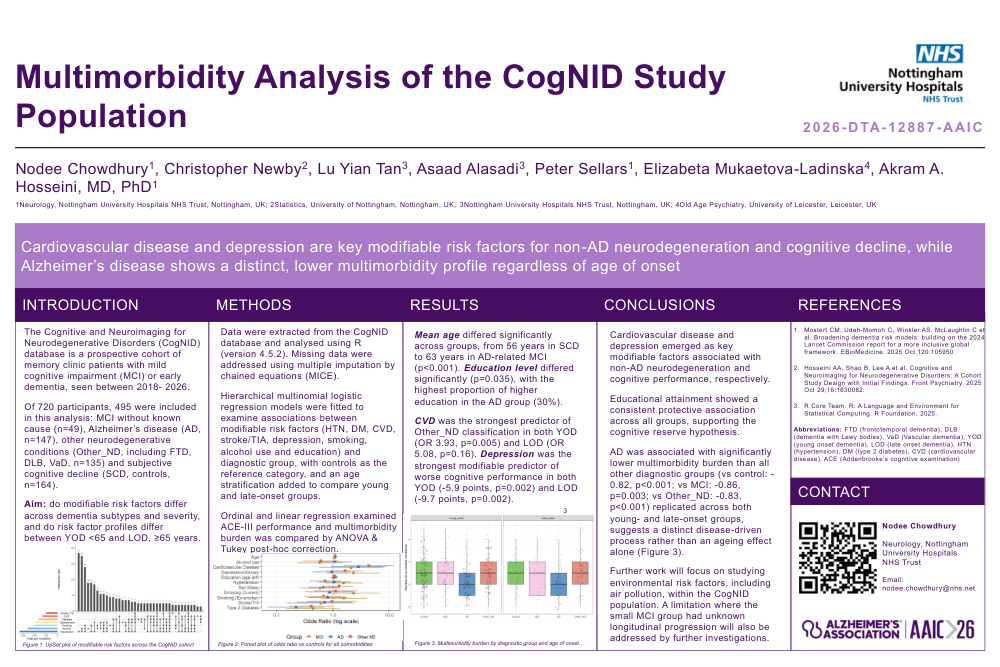
Mean age differed significantly across groups, from 56 years in SCD to 63 years in AD-related MCI (p<0.001). Education level differed significantly (p=0.035), with the highest proportion of higher education in the AD group (30%).
CVD was the strongest predictor of Other_ND classification in both YOD (OR 3.93, p=0.005) and LOD (OR 5.08, p=0.16). Depression was the strongest modifiable predictor of worse cognitive performance in both YOD (-5.9 points, p=0.002) and LOD (-9.7 points, p=0.002).
CONCLUSIONS
Cardiovascular disease and depression emerged as key modifiable factors associated with non-AD neurodegeneration and cognitive performance, respectively.
Educational attainment showed a consistent protective association across all groups, supporting the cognitive reserve hypothesis.
AD was associated with significantly lower multimorbidity burden than all other diagnostic groups (vs control: -0.82, p<0.001; vs MCI: -0.86, p=0.003; vs Other_ND: -0.83, p<0.001) replicated across both young- and late-onset groups, suggests a distinct disease-driven process rather than an ageing effect alone (Figure 3).
Further work will focus on studying environmental risk factors, including air pollution, within the CogNID population. A limitation where the small MCI group had unknown longitudinal progression will also be addressed by further investigations.
REFERENCES
Abbreviations: FTD (frontotemporal dementia), DLB (dementia with Lewy bodies), VaD (Vascular dementia), YOD (young onset dementia), LOD (late onset dementia), HTN (hypertension), DM (type 2 diabetes), CVD (cardiovascular disease), ACE (Addenbrooke’s cognitive examination
Comments
Email is required but is not shown publicly.
Loading comments...