4,068 posters, 219 videos, 101 topics, 69 sessions, 14,365 authors, 6,128 institutions
ePostersLive by SciGen Technologies S.A. All rights reserved.
Alzheimer's Association International Conference 2026
July 12-15, 2026 | London, United Kingdom, and Online

13511
Memento: Modeling Myelin Energy Failure As A Contributor To Selective Vulnerability In Alzheimer's Disease
Poster Presenter
Part of Topic
Basic Science and Pathogenesis -> Human Neuropathology -> Selective vulnerability
TITLE
MEMENTO: Modeling Myelin Energy Failure in Alzheimer's Disease
A coupled ODE model grounded in cable theory and the TIER framework
Tate Lewis · Peter S. Pressman, MD
Layton Aging & Alzheimer's Disease Research Center · Department of Neurology · Oregon Health & Science University
BACKGROUND
White matter damage can begin roughly 10 years before cognitive symptoms appear in aging and Alzheimer's disease (Silbert 2012). The brain regions that develop last are often the first to degenerate (Bartzokis 2011), mapping onto developmental myelination.
The TIER (thermodynamic-informational entropic relationship) framework proposes that the tissue doing the most work wears out fastest, like any system in engineering. While there are many routes to thermodynamic entropic damage, hubs of vulnerability can often be recognized. Myelin increases the efficiency of information integration; when it is damaged, the work of that processing increases, driving further degeneration. When energy supply falls short of demand, the system triggers a self-amplifying cycle.
Maintaining myelin costs more energy than it saves at typical firing rates, a fragile arrangement (Harris and Attwell 2012). When energy supplies dwindle, oligodendrocytes burn their own myelin for fuel (Asadollahi 2024). APOE4 disrupts myelin repair at four separate steps: cholesterol delivery, lipid transport, precursor cell function, and debris clearance (Blanchard 2022).
We integrate this into the Myelin Energy Model of Entropic Neural Tissue Outcomes (MEMENTO).
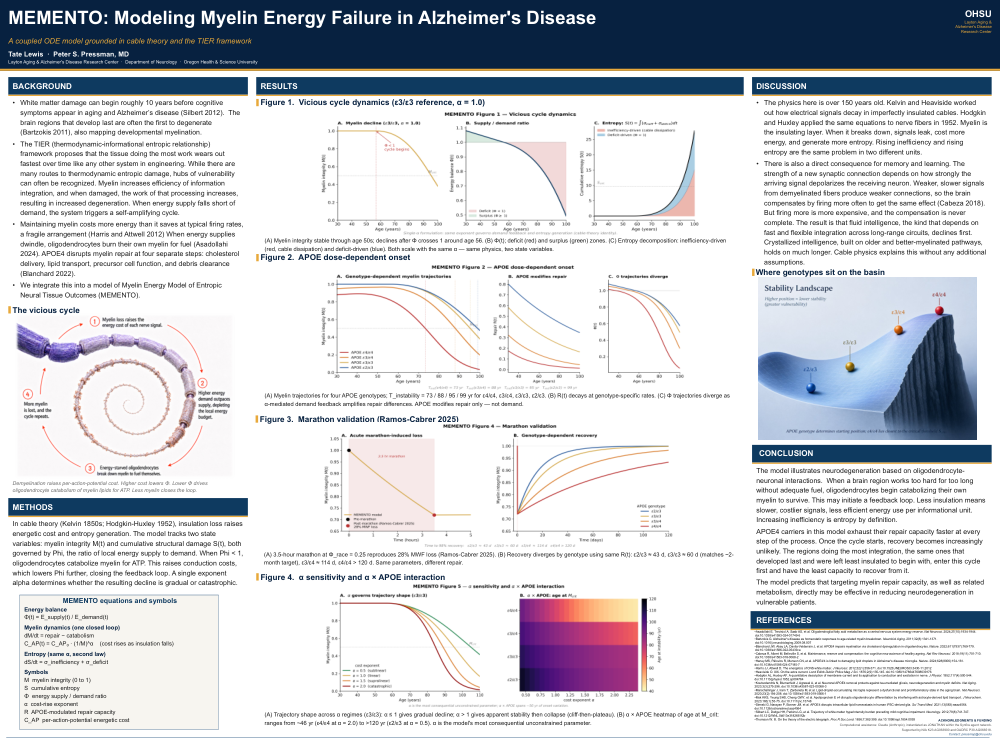
The vicious cycle: Demyelination raises per-action-potential cost. Higher cost lowers Φ. Lower Φ drives oligodendrocyte catabolism of myelin lipids for ATP. Less myelin closes the loop.
METHODS
In cable theory (Kelvin 1850s; Hodgkin-Huxley 1952), insulation loss raises energetic cost and entropy generation. The model tracks two state variables: myelin integrity M(t) and cumulative structural damage S(t), both governed by Phi, the ratio of local energy supply to demand. When Phi < 1, oligodendrocytes catabolize myelin for ATP. This raises conduction costs, which lowers Phi further, closing the feedback loop. A single exponent alpha determines whether the resulting decline is gradual or catastrophic.
RESULTS
Figure 1. Vicious cycle dynamics (ε3/ε3 reference, α = 1.0). (A) Myelin integrity stable through the 50s; declines after Φ crosses 1 around age 56. (B) Φ(t); deficit (red) and surplus (green) zones. (C) Entropy decomposition: inefficiency-driven (red, cable dissipation) and deficit-driven (blue). Both scale with the same α, the same physics across two state variables.
Figure 2. APOE dose-dependent onset. (A) Myelin trajectories for four APOE genotypes; T_instability = 73 / 88 / 95 / 99 yr for ε4/ε4, ε3/ε4, ε3/ε3, ε2/ε3. (B) R(t) decays at genotype-specific rates. (C) Φ trajectories diverge as α-mediated demand feedback amplifies repair differences. APOE modifies repair only, not demand.
Figure 3. Marathon validation (Ramos-Cabrer 2025). (A) A 3.5-hour marathon at Φ_race = 0.25 reproduces 28% MWF loss (Ramos-Cabrer 2025). (B) Recovery diverges by genotype using the same R(t): ε2/ε3 ≈ 43 d, ε3/ε3 ≈ 60 d (matches the ~2-month target), ε3/ε4 ≈ 114 d, ε4/ε4 > 120 d. Same parameters, different repair.
Figure 4. α sensitivity and α × APOE interaction. (A) Trajectory shape across α regimes (ε3/ε3): α ≤ 1 gives gradual decline; α > 1 gives apparent stability then collapse (cliff-then-plateau). (B) α × APOE heatmap of age at M_crit: from ~46 yr (ε4/ε4 at α = 2.0) to >120 yr (ε2/ε3 at α = 0.5). α is the model's most consequential unconstrained parameter.
DISCUSSION
The physics here is over 150 years old. Kelvin and Heaviside worked out how electrical signals decay in imperfectly insulated cables. Hodgkin and Huxley applied the same equations to nerve fibers in 1952. Myelin is the insulating layer. When it breaks down, signals leak, cost more energy, and generate more entropy. Rising inefficiency and rising entropy are the same problem in two different units.
There is also a direct consequence for memory and learning. The strength of a new synaptic connection depends on how strongly the arriving signal depolarizes the receiving neuron. Weaker, slower signals from demyelinated fibers produce weaker connections, so the brain compensates by firing more often to get the same effect (Cabeza 2018). But firing more is more expensive, and the compensation is never complete. The result is that fluid intelligence, the kind that depends on fast and flexible integration across long-range circuits, declines first. Crystallized intelligence, built on older and better-myelinated pathways, holds on much longer. Cable physics explains this without any additional assumptions.
CONCLUSION
The model illustrates neurodegeneration grounded in oligodendrocyte-neuronal interactions. When a brain region works too hard for too long without adequate fuel, oligodendrocytes begin catabolizing their own myelin to survive. This may initiate a feedback loop. Less insulation means slower, costlier signals and less efficient energy use per informational unit. Increasing inefficiency is entropy by definition.
APOE4 carriers in this model exhaust their repair capacity faster at every step. Once the cycle starts, recovery becomes increasingly unlikely. The regions doing the most integration, the same ones that developed last and were left least insulated to begin with, enter this cycle first and have the least capacity to recover from it.
The model predicts that targeting myelin repair capacity, along with related metabolism, directly may reduce neurodegeneration in vulnerable patients.
MEMENTO EQUATIONS AND SYMBOLS
Energy balance: Φ(t) = E_supply(t) / E_demand(t)
Myelin dynamics (one closed loop): dM/dt = repair − catabolism
Cost rises as insulation falls: C_AP(t) = C_AP0 · (1/M)^α
Entropy (same α, second law): dS/dt = σ_inefficiency + σ_deficit
Symbols: M = myelin integrity (0 to 1) · S = cumulative entropy · Φ = energy supply/demand ratio · α = cost-rise exponent · R = APOE-modulated repair capacity · C_AP = per-action-potential energetic cost
REFERENCES
Asadollahi E, Trevisiol A, Saab AS, et al. Oligodendroglial fatty acid metabolism as a central nervous system energy reserve. Nat Neurosci. 2024;27(10):1934-1944.
Bartzokis G. Alzheimer's disease as homeostatic responses to age-related myelin breakdown. Neurobiol Aging. 2011;32(8):1341-1371.
Blanchard JW, Akay LA, Davila-Velderrain J, et al. APOE4 impairs myelination via cholesterol dysregulation in oligodendrocytes. Nature. 2022;611(7937):769-779.
Cabeza R, Albert M, Belleville S, et al. Maintenance, reserve and compensation: the cognitive neuroscience of healthy ageing. Nat Rev Neurosci. 2018;19(11):701-710.
Haney MS, Pálovics R, Munson CN, et al. APOE4/4 is linked to damaging lipid droplets in Alzheimer's disease microglia. Nature. 2024;628(8006):154-161.
Harris JJ, Attwell D. The energetics of CNS white matter. J Neurosci. 2012;32(1):356-371.
Heaviside O. XIX. On the extra current. Lond Edinb Dublin Philos Mag J Sci. 1876;2(9):135-145.
Hodgkin AL, Huxley AF. A quantitative description of membrane current and its application to conduction and excitation in nerve. J Physiol. 1952;117(4):500-544.
Koutsodendris N, Blumenfeld J, Agrawal A, et al. Neuronal APOE4 removal protects against tau-mediated gliosis, neurodegeneration and myelin deficits. Nat Aging. 2023;3(3):275-296.
Marschallinger J, Iram T, Zardeneta M, et al. Lipid-droplet-accumulating microglia represent a dysfunctional and proinflammatory state in the aging brain. Nat Neurosci. 2020;23(2):194-208.
Mok KKS, Yeung SHS, Cheng GWY, et al. Apolipoprotein E ε4 disrupts oligodendrocyte differentiation by interfering with astrocyte-derived lipid transport. J Neurochem. 2023;165(1):55-75.
Ramos-Cabrer P, Cabrera-Zubizarreta A, Padro D, Matute-González M, Rodríguez-Antigüedad A, Matute C. Reversible reduction in brain myelin content upon marathon running. Nat Metab. 2025;7(4):697-703. doi:10.1038/s42255-025-01244-7
Sienski G, Narayan P, Bonner JM, et al. APOE4 disrupts intracellular lipid homeostasis in human iPSC-derived glia. Sci Transl Med. 2021;13(583):eaaz4564.
Silbert LC, Dodge HH, Perkins LG, et al. Trajectory of white matter hyperintensity burden preceding mild cognitive impairment. Neurology. 2012;79(8):741-747.
Thomson W. III. On the theory of the electric telegraph. Proc R Soc Lond. 1856;7:382-399.
ACKNOWLEDGMENTS & FUNDING
Computational assistance: Claude (Anthropic). Supported by NIA K23 AG063900 and OADRC P30 AG066518.
Contact: pressman@ohsu.edu
Comments
Email is required but is not shown publicly.
Loading comments...