4,068 posters, 219 videos, 101 topics, 69 sessions, 14,365 authors, 6,128 institutions
ePostersLive by SciGen Technologies S.A. All rights reserved.
Alzheimer's Association International Conference 2026
July 12-15, 2026 | London, United Kingdom, and Online

13464
Long Runs Of Homozygosity Reveal A Recessive Genetic Component In Alzheimer's Disease
Poster Presenter
Authors
Affiliations
Part of Topic
Basic Science and Pathogenesis -> Genetics -> Genetic factors of Alzheimer’s disease
LONG RUNS OF HOMOZYGOSITY REVEAL A RECESSIVE GENETIC COMPONENT IN ALZHEIMER'S DISEASE
Background Alzheimer's disease (AD) has a well-established genetic component, yet the contribution of recessive mechanisms remains incompletely understood. Runs of homozygosity (ROH) — contiguous stretches of the genome where both alleles are identical — offer a powerful approach to uncover recessive genetic risk, as they may harbor rare deleterious variants in the homozygous state. This study aims to strengthen the evidence for a recessive genetic component in AD through large-scale ROH analyses across multiple European cohorts.
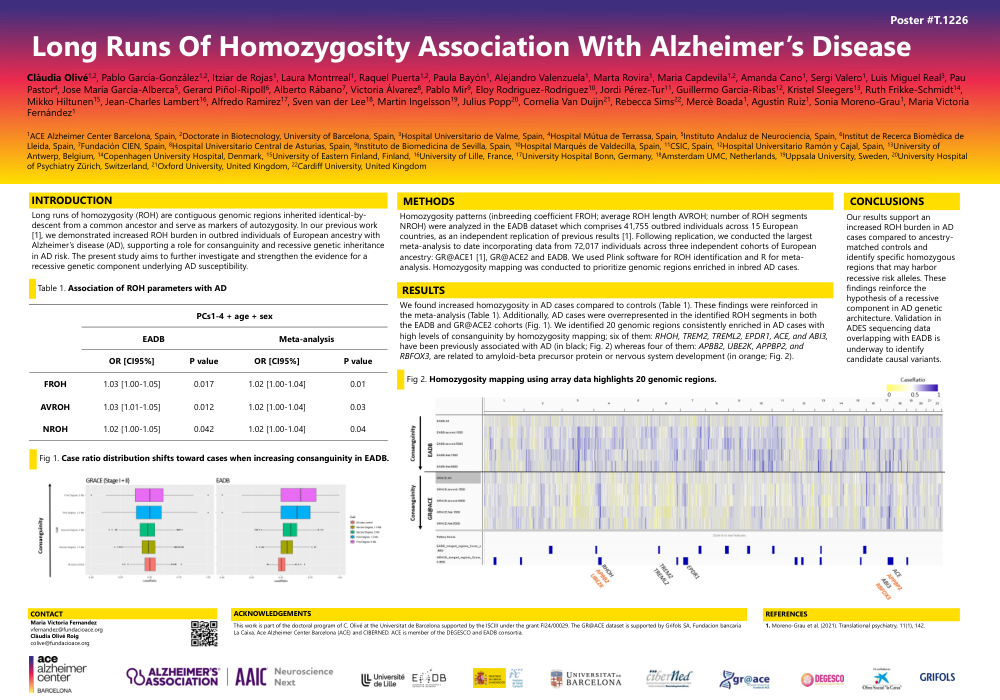
Methods Building on our team's prior discovery of increased ROH burden in AD (Moreno-Grau et al.), we sought to replicate and extend these findings. ROH were analyzed in an independent replication cohort of 41,755 outbred individuals from 15 European countries (19,916 AD cases and 21,839 controls) from the European Alzheimer & Dementia Biobank (EADB). We then conducted the largest ROH meta-analysis to date, incorporating 72,017 individuals (35,421 cases and 36,594 controls) across three independent cohorts of European ancestry: EADB, GR@ACE1, and GR@ACE2. ROH were identified using PLINK software. Homozygosity mapping was performed to prioritize loci enriched in inbred AD cases, nominating recessive candidate regions.
Results We observed a consistent excess of homozygosity in AD cases relative to controls across all ROH metrics: average ROH length (β_AVROH = 1.03, P = 0.003), total ROH length (β_FROH = 1.03, P = 0.002), and number of ROHs (β_NROH = 1.03, P = 0.015). These results were reinforced in the meta-analysis (β_AVROH = 1.05, P = 0.03; β_FROH = 1.05, P = 0.01; β_NROH = 1.04, P = 0.04). AD cases were significantly overrepresented in ROH segments in both EADB (P = 8.47×10⁻²⁹) and GR@ACE2 (P = 4.90×10⁻⁵²). Homozygosity mapping identified 20 enriched genomic regions, six of which — RHOH, TREM2, TREML2, EPDR1, ACE, and ABI3 — overlap with established AD risk loci, and four — APBB2, UBE2K, APPBP2, and RBFOX3 — are implicated in amyloid metabolism or neuronal development.
Discussion These findings confirm a global excess of homozygosity in AD and illuminate the recessive architecture of disease heritability. Identified regions overlap with known AD genes and novel candidates, highlighting ROH mapping as a valuable complement to conventional GWAS for detecting rare recessive variants contributing to AD susceptibility.
Comments
Email is required but is not shown publicly.
Loading comments...