4,068 posters, 219 videos, 101 topics, 69 sessions, 14,365 authors, 6,128 institutions
ePostersLive by SciGen Technologies S.A. All rights reserved.
Alzheimer's Association International Conference 2026
July 12-15, 2026 | London, United Kingdom, and Online

11904
Localised Genetic Architecture Links Alzheimer΄S Disease And Schizophrenia Through Convergent Regulatory Effects
Poster Presenter
Authors
Guillermo Comesana Cimadevila, Alfie Thain, Marie-Joe Dib, Philip R. Taylor, Jeremy Hall, Dervis A. Salih, Nicholas J. Bray, Emily Simmonds, Valentina Escott-Price
Affiliations
UK Dementia Research Institute, Cardiff University, Cardiff, UK; Division of Psychological Medicine and Clinical Neurosciences. School of Medicine, Cardiff University, Cardiff, UK, Division of Psychiatry, University College London, UK, Nascent Studio Ltd, London, UK, UK Dementia Research Institute, Cardiff University, Cardiff, UK; Systems Immunity Research Institute, Cardiff University, Cardiff, UK, Division of Psychological Medicine and Clinical Neurosciences. School of Medicine, Cardiff University, Cardiff, UK, UK Dementia Research Institute, University College London, London, UK, UK Dementia Research Institute, Cardiff University, Cardiff, UK
Part of Topic
Basic Science and Pathogenesis -> Genetics -> Genetics of systems biology
Localised genetic overlap between Alzheimer’s disease and schizophrenia implicates oligodendrocyte-specific regulation of ADAM10 in both disorders
Guillermo Comesana Cimadevila1, 2, Alfie Thain3, Marie-Joe Dib4, Philip R. Taylor1, 5, Jeremy Hall2, Dervis A. Salih6, Nicholas J. Bray2, Emily Simmonds1 & Valentina Escott-Price1, 2†
1UK Dementia Research Institute, Cardiff University, Cardiff, UK, 2Division of Psychological Medicine and Clinical Neurosciences. School of Medicine, Cardiff University, Cardiff, UK, 3Division of Psychiatry, University College London, UK, 4Nascent Studio Ltd, London, UK, 5Systems Immunity Research Institute, Cardiff University, Cardiff, UK, 6UK Dementia Research Institute, University College London, London, UK
Background
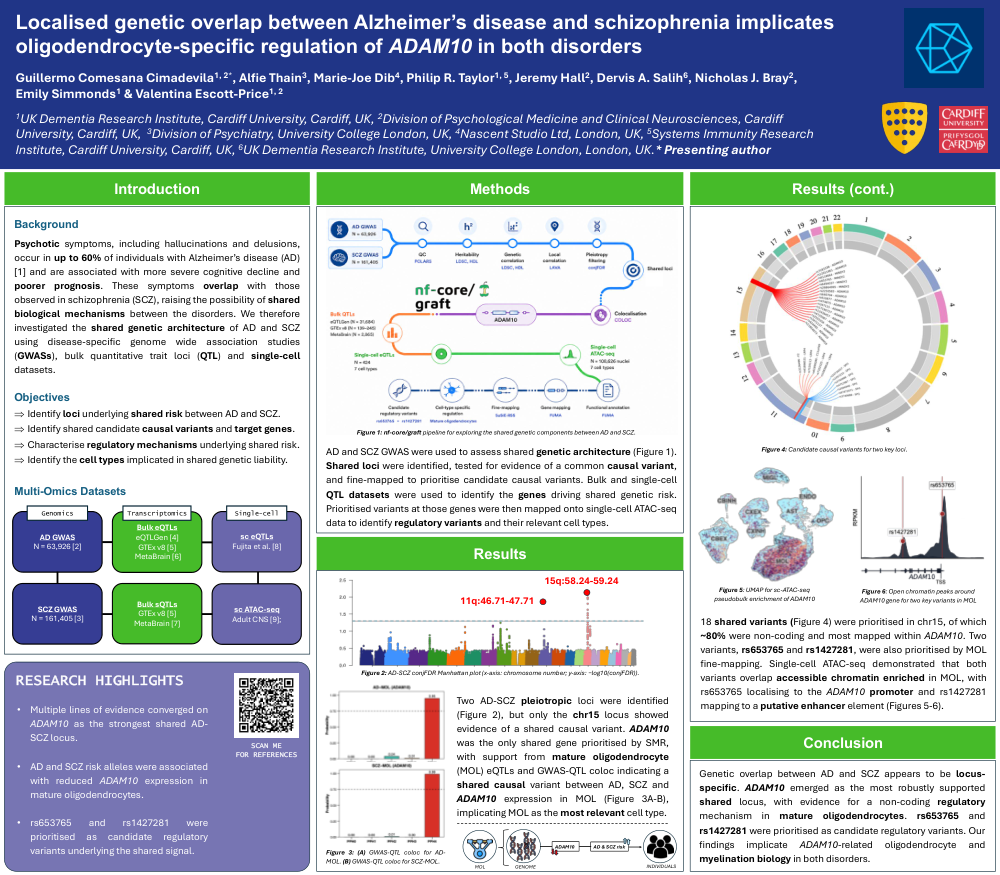
Psychotic symptoms, including hallucinations and delusions, occur in up to 60% of individuals with Alzheimer’s disease (AD) [1] and are associated with more severe cognitive decline and poorer prognosis. These symptoms overlap with those observed in schizophrenia (SCZ), raising the possibility of shared biological mechanisms between the disorders. We therefore investigated the shared genetic architecture of AD and SCZ using disease-specific genome wide association studies (GWASs), bulk quantitative trait loci (QTL) and single-cell datasets.
Objectives
Identify loci underlying shared risk between AD and SCZ.
Identify shared candidate causal variants and target genes.
Characterise regulatory mechanisms underlying shared risk.
Identify the cell types implicated in shared genetic liability.
Methods
AD and SCZ GWAS were used to assess shared genetic architecture (Figure 1). Shared loci were identified, tested for evidence of a common causal variant, and fine-mapped to prioritise candidate causal variants. Bulk and single-cell QTL datasets were used to identify the genes driving shared genetic risk. Prioritised variants at those genes were then mapped onto single-cell ATAC-seq data to identify regulatory variants and their relevant cell types.
Results
Two AD-SCZ pleiotropic loci were identified (Figure 2), but only the chr15 locus showed evidence of a shared causal variant. ADAM10 was the only shared gene prioritised by SMR, with support from mature oligodendrocyte (MOL) eQTLs and GWAS-QTL coloc indicating a shared causal variant between AD, SCZ and ADAM10 expression in MOL (Figure 3A-B), implicating MOL as the most relevant cell type. 18 shared variants (Figure 4) were prioritised in chr15, of which ~80% were non-coding and most mapped within ADAM10. Two variants, rs653765 and rs1427281, were also prioritised by MOL fine-mapping. Single-cell ATAC-seq demonstrated that both variants overlap accessible chromatin enriched in MOL, with rs653765 localising to the ADAM10 promoter and rs1427281 mapping to a putative enhancer element (Figures 5-6).
Conclusion
Genetic overlap between AD and SCZ appears to be locus- specific. ADAM10 emerged as the most robustly supported shared locus, with evidence for a non-coding regulatory mechanism in mature oligodendrocytes. rs653765 and rs1427281 were prioritised as candidate regulatory variants. Our findings implicate ADAM10-related oligodendrocyte and myelination biology in both disorders.
Comments
Email is required but is not shown publicly.
Loading comments...