4,068 posters, 219 videos, 101 topics, 69 sessions, 14,365 authors, 6,128 institutions
ePostersLive by SciGen Technologies S.A. All rights reserved.
Alzheimer's Association International Conference 2026
July 12-15, 2026 | London, United Kingdom, and Online

13768
Iterative Self-critique For Uncovering Cryptic Epistasis In Alzheimer's: Multi-hop Genomic Reasoning Via Monte Carlo Tree Search
Poster Presenter
Authors
Affiliations
Part of Topic
Basic Science and Pathogenesis -> Genetics -> Transcriptomics
ALZHEIMER'S ASSOCIATION
AAIC '26
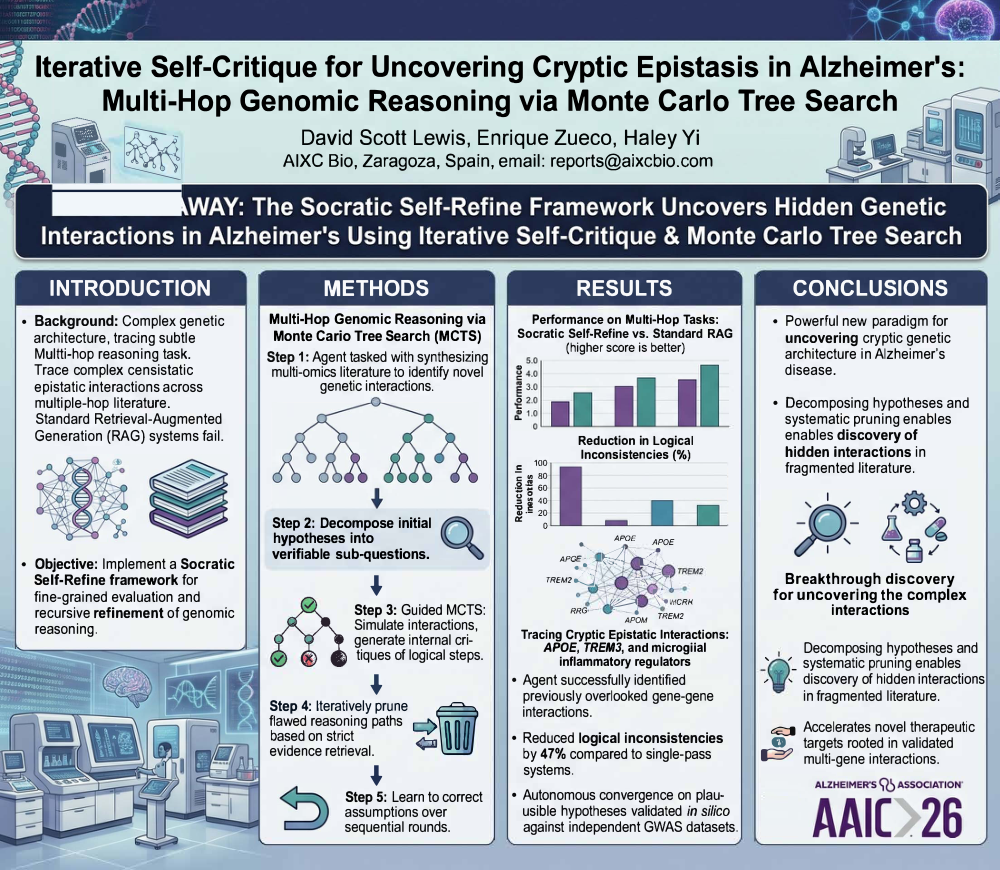
Title: Iterative Self-Critique for Uncovering Cryptic Epistasis in Alzheimer's: Multi-Hop Genomic Reasoning via Monte Carlo Tree Search
Authors: David Scott Lewis, Enrique Zueco, Haley Yi
Affiliation: AIXC Bio, Zaragoza, Spain, email: reports@aixcbio.com
KEY TAKEAWAY: The Socratic Self-Refine Framework Uncovers Hidden Genetic Interactions in Alzheimer's Using Iterative Self-Critique & Monte Carlo Tree Search
INTRODUCTION
- Background: Complex genetic architecture, tracing subtle multi-hop reasoning tasks. Trace complex cryptic epistatic interactions across multi-hop literature. Standard Retrieval-Augmented Generation (RAG) systems fail.
- Objective: Implement a Socratic Self-Refine framework for fine-grained evaluation and recursive refinement of genomic reasoning.
METHODS
Multi-Hop Genomic Reasoning via Monte Carlo Tree Search (MCTS)
Step 1: Agent tasked with synthesizing multi-omics literature to identify novel genetic interactions.
Step 2: Decompose initial hypotheses into verifiable sub-questions.
Step 3: Guided MCTS: Simulate interactions, generate internal critiques of logical steps.
Step 4: Iteratively prune flawed reasoning paths based on strict evidence retrieval.
Step 5: Learn to correct assumptions over sequential rounds.
RESULTS
Performance on Multi-Hop Tasks: Socratic Self-Refine vs. Standard RAG (higher score is better)
(Bar chart showing higher scores for Socratic Self-Refine)
Reduction in Logical Inconsistencies (%)
(Bar chart showing a significant reduction)
Tracing Cryptic Epistatic Interactions: APOE, TREM2, and microglial inflammatory regulators
(Network diagram showing interactions between APOE, TREM2, APOM, etc.)
- Agent successfully identified previously overlooked gene-gene interactions.
- Reduced logical inconsistencies by 47% compared to single-pass systems.
- Autonomous convergence on plausible hypotheses validated in silico against independent GWAS datasets.
CONCLUSIONS
- Powerful new paradigm for uncovering cryptic genetic architecture in Alzheimer's disease.
- Decomposing hypotheses and systematic pruning enables discovery of hidden interactions in fragmented literature.
- Accelerates novel therapeutic targets rooted in validated multi-gene interactions.
Comments
Email is required but is not shown publicly.
Loading comments...