4,068 posters, 219 videos, 101 topics, 69 sessions, 14,365 authors, 6,128 institutions
ePostersLive by SciGen Technologies S.A. All rights reserved.
Alzheimer's Association International Conference 2026
July 12-15, 2026 | London, United Kingdom, and Online

13144
Genetics Of Limbic-predominant Age-related TDP-43 Encephalopathy In The Vantaa 85+ Cohort
Poster Presenter
Authors
Part of Topic
Basic Science and Pathogenesis -> Genetics -> Genetic factors of non-Alzheimer’s disease
Title: Genetic risk loci for limbic-predominant age-related TDP-43 encephalopathy neuropathologic change in the population-based Vantaa 85+ cohort
Authors and affiliations
Elizaveta Mikhailenko1,2, Sara Savola1,2, Mia Kero1,2, Pentti J. Tienari3,4, Liisa Myllykangas1,2, Karri Kaivola3,4
1. Department of Pathology, University of Helsinki, 00014 Helsinki, Finland
2. Department of Pathology, HUS Diagnostic Center, Helsinki University Hospital, 00029 Helsinki, Finland
3. Translational Immunology, Research Programs Unit, University of Helsinki, Helsinki, 00014 Finland
4. Department of Neurology, University of Helsinki and Helsinki University Hospital, 00014 Helsinki, Finland
Introduction
Limbic-predominant age-related TDP-43 encephalopathy neuropathologic change (LATE-NC) is defined by TDP-43 accumulation spreading through the amygdala, hippocampus, and frontal cortex.¹ It affects more than 30% of people aged ≥85 and is independently associated with cognitive decline.²⁻⁴ Despite this high prevalence, its genetic etiology remains largely unknown.
Only one GWAS has targeted a LATE-NC phenotype, identifying TMEM106B and APOE as genome-wide significant (GRN, API5 and LHX1 suggestive).5 Several further candidate loci — including GRN, KAZN, ARHGEF28, UNC13C, WWOX, and TPCN1 — have been reported but seldom replicated.6-10 Whether overall Alzheimer's disease genetic risk influences LATE-NC beyond APOE also remains unresolved.
In the population-based Vantaa 85+ cohort of the oldest old, we asked:
- Do previously reported LATE-NC loci replicate in a single, uniformly assessed neuropathological cohort with a distinct (Finnish) genetic background?
- Is AD genetic risk associated with LATE-NC, or is the link primarily APOE-driven?
Cohort: Vantaa 85+ includes all residents of Vantaa, Finland aged ≥85 in 1991 (n = 601); 304 neuropathologically assessed, 262 were genotyped and analysed (86% female, mean age 92.6 y).
LATE-NC staging : C-terminal anti-TDP-43 immunohistochemistry; regrouped into 4 ordinal levels (Stage 0 → Stage 3; Stage 1c excluded, Stages 1a and 1b combined).
Genotyping: Illumina arrays, SISu v3 imputation (INFO ≥ 0.7, MAF ≥ 0.01); 9 previously reported LATE-NC variants extracted.
AD polygenic risk: validated European AD PRS excluding APOE (PGS000898; 35/39 variants), z-scored across the cohort (n = 504).
Statistics: Fisher's exact test (2×6) →ordinal logistic regression (adjusted for age, sex; AD-PRS model also for APOE ε4 dose + AD pathology defined by NIA-AA ABC criteria); Benjamini–Hochberg correction for FDR.
TMEM106B Alu: Manta on whole-genome sequencing to test LD between rs13237518 and the AluYb8 element.
Results
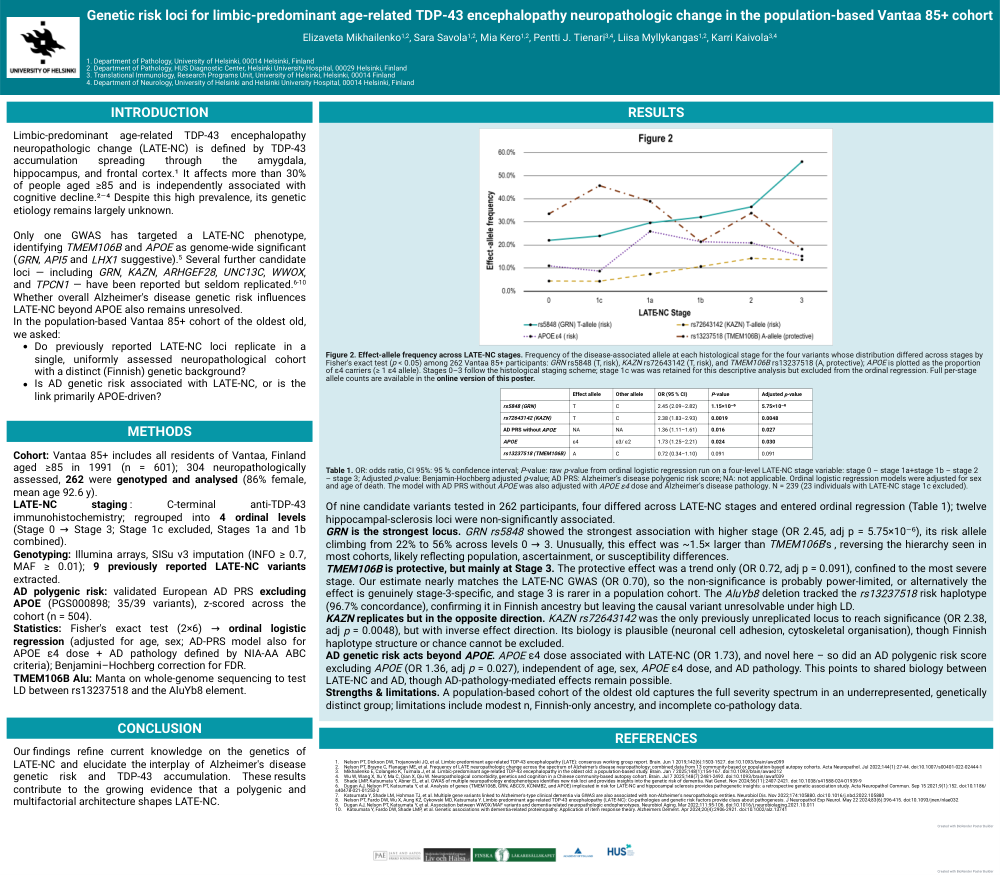
Of nine candidate variants tested in 262 participants, four differed across LATE-NC stages and entered ordinal regression (Table 1); twelve hippocampal-sclerosis loci were non-significantly associated.
GRN is the strongest locus.GRNrs5848 showed the strongest association with higher stage (OR 2.45, adj p = 5.75×10⁻⁶), its risk allele climbing from 22% to 56% across levels 0 → 3. Unusually, this effect was ~1.5× larger than TMEM106B's , reversing the hierarchy seen in most cohorts, likely reflecting population, ascertainment, or susceptibility differences.
TMEM106B is protective, but mainly at Stage 3. The protective effect was a trend only (OR 0.72, adj p = 0.091), confined to the most severe stage. Our estimate nearly matches the LATE-NC GWAS (OR 0.70), so the non-significance is probably power-limited, or alternatively the effect is genuinely stage-3-specific, and stage 3 is rarer in a population cohort. The AluYb8 deletion tracked the rs13237518 risk haplotype (96.7% concordance), confirming it in Finnish ancestry but leaving the causal variant unresolvable under high LD.
KAZN replicates but in the opposite direction. KAZN rs72643142 was the only previously unreplicated locus to reach significance (OR 2.38, adj p = 0.0048), but with inverse effect direction. Its biology is plausible (neuronal cell adhesion, cytoskeletal organisation), though Finnish haplotype structure or chance cannot be excluded.
AD genetic risk acts beyond APOE.APOE ε4 dose associated with LATE-NC (OR 1.73), and novel here – so did an AD polygenic risk score excluding APOE (OR 1.36, adj p = 0.027), independent of age, sex, APOE ε4 dose, and AD pathology. This points to shared biology between LATE-NC and AD, though AD-pathology-mediated effects remain possible.
Strengths & limitations. A population-based cohort of the oldest old captures the full severity spectrum in an underrepresented, genetically distinct group; limitations include modest n, Finnish-only ancestry, and incomplete co-pathology data.
Conclusion
Our findings refine current knowledge on the genetics of LATE-NC and elucidate the interplay of Alzheimer's disease genetic risk and TDP-43 accumulation. These results contribute to the growing evidence that a polygenic and multifactorial architecture shapes LATE-NC.
References
1. Nelson PT, Dickson DW, Trojanowski JQ, et al. Limbic-predominant age-related TDP-43 encephalopathy (LATE): consensus working group report. Brain. Jun 1 2019;142(6):1503-1527. doi:10.1093/brain/awz099
2. Nelson PT, Brayne C, Flanagan ME, et al. Frequency of LATE neuropathologic change across the spectrum of Alzheimer's disease neuropathology: combined data from 13 community-based or population-based autopsy cohorts. Acta Neuropathol. Jul 2022;144(1):27-44. doi:10.1007/s00401-022-02444-1
3. Mikhailenko E, Colangelo K, Tuimala J, et al. Limbic-predominant age-related TDP-43 encephalopathy in the oldest old: a population-based study. Brain. Jan 7 2025;148(1):154-167. doi:10.1093/brain/awae212
4. Wu W, Wang X, Xu Y, Ma C, Qian X, Qiu W. Neuropathological comorbidity, genetics and cognition in a Chinese community-based autopsy cohort. Brain. Jul 7 2025;148(7):2481-2492. doi:10.1093/brain/awaf039
5. Shade LMP, Katsumata Y, Abner EL, et al. GWAS of multiple neuropathology endophenotypes identifies new risk loci and provides insights into the genetic risk of dementia. Nat Genet. Nov 2024;56(11):2407-2421. doi:10.1038/s41588-024-01939-9
6. Dugan AJ, Nelson PT, Katsumata Y, et al. Analysis of genes (TMEM106B, GRN, ABCC9, KCNMB2, and APOE) implicated in risk for LATE-NC and hippocampal sclerosis provides pathogenetic insights: a retrospective genetic association study. Acta Neuropathol Commun. Sep 15 2021;9(1):152. doi:10.1186/s40478-021-01250-2
7. Katsumata Y, Shade LM, Hohman TJ, et al. Multiple gene variants linked to Alzheimer's-type clinical dementia via GWAS are also associated with non-Alzheimer's neuropathologic entities. Neurobiol Dis. Nov 2022;174:105880. doi:10.1016/j.nbd.2022.105880
8. Nelson PT, Fardo DW, Wu X, Aung KZ, Cykowski MD, Katsumata Y. Limbic-predominant age-related TDP-43 encephalopathy (LATE-NC): Co-pathologies and genetic risk factors provide clues about pathogenesis. J Neuropathol Exp Neurol. May 22 2024;83(6):396-415. doi:10.1093/jnen/nlae032
9. Dugan AJ, Nelson PT, Katsumata Y, et al. Association between WWOX/MAF variants and dementia-related neuropathologic endophenotypes. Neurobiol Aging. Mar 2022;111:95-106. doi:10.1016/j.neurobiolaging.2021.10.011
10. Katsumata Y, Fardo DW, Shade LMP, et al. Genetic associations with dementia-related proteinopathy: Application of item response theory. Alzheimers Dement. Apr 2024;20(4):2906-2921. doi:10.1002/alz.13741
Comments
Email is required but is not shown publicly.
Loading comments...