4,068 posters, 219 videos, 101 topics, 69 sessions, 14,365 authors, 6,128 institutions
ePostersLive by SciGen Technologies S.A. All rights reserved.
Alzheimer's Association International Conference 2026
July 12-15, 2026 | London, United Kingdom, and Online

13304
Gadir: Genomics And Digital Neuropathological Phenotyping Of Iberian Brains To Refine The Genetic Architecture Of Dementia
Poster Presenter
Authors
Affiliations
Part of Topic
Basic Science and Pathogenesis -> Genetics -> Genetic factors of Alzheimer’s disease
Video
GADIR: Genomics and Digital Neuropathological Phenotyping of Iberian Brains to Refine the Genetic Architecture of Dementia
Paula Bayon1, Laura Saiz1, María José López1, , Neurological Tissue Banks Working Group (ISCIII Platform for Biomodels and Biobanks, Alberto Rábano1, Victoria Fernández1
1. ACE Alzheimer Center, Barcelona, Spain
2. Reina Sofia Alzheimer Center, CIEN Foundation, ISCIII, Madrid, Spain
Background
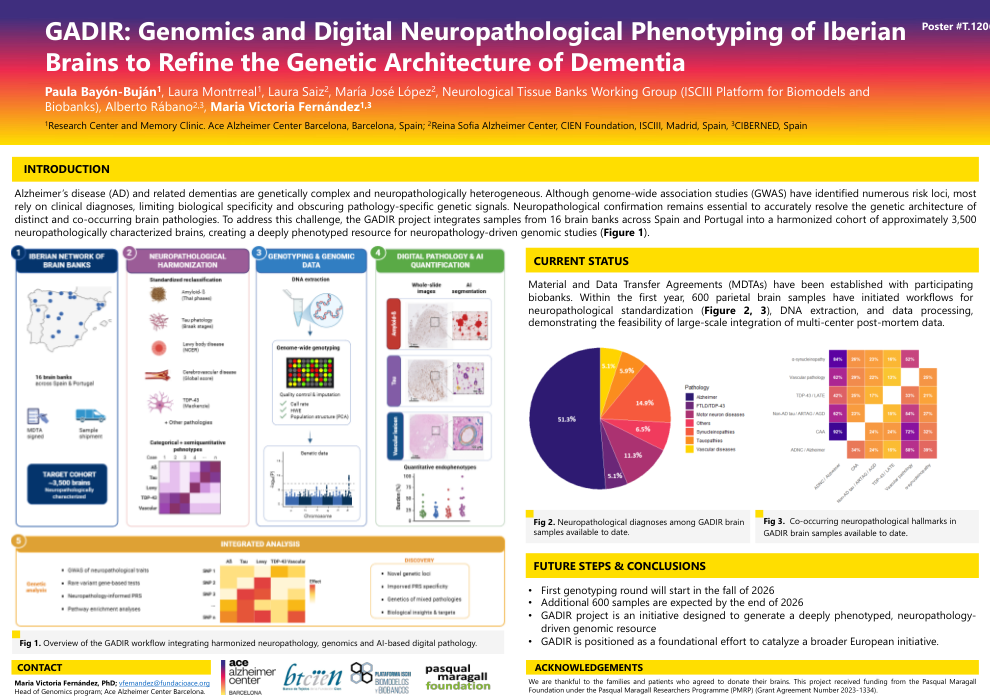
Alzheimer’s disease (AD) and related dementias are genetically complex and neuropathologically heterogeneous. While genome-wide association studies (GWAS) have identified numerous risk loci, most rely on clinical or proxy diagnoses, introducing misclassification and limiting biological specificity. Neuropathological confirmation remains the gold standard for diagnosis and is critical to accurately resolve the genetic architecture of distinct and co-occurring brain pathologies. To address this gap, we present the GADIR project (GenOmics and Digital Neuropathological Phenotyping of Iberian Brains), an initiative designed to generate a deeply phenotyped, neuropathology-driven genomic resource and to serve as a seed for a larger coordinated European effort.
Methods
GADIR integrates samples from 16 brain banks across Spain and Portugal to build a harmonized cohort of ~3,500 neuropathologically characterized brains. The project combines standardized neuropathological reclassification, genome-wide genotyping using a population-optimized array, and advanced bioinformatic analyses including polygenic risk scores (PRS), single-variant, gene-based, and pathway-level approaches. In parallel, a subset of samples undergoes digital pathology with AI-based image analysis to quantify amyloid-β, tau, and vascular burden, enabling the extraction of quantitative endophenotypes. Genomic and digital pathology data will be integrated to identify genetic determinants of specific neuropathological traits and their co-occurrence.
Results
Material and Data Transfer Agreements (MDTAs) have been successfully established with all participating biobanks, enabling coordinated sample and data exchange. Within the first year of the project, approximately 600 brain samples have already been received and incorporated into the harmonization pipeline. Initial workflows for neuropathological standardization, DNA extraction, and data processing have been implemented across sites, demonstrating the feasibility of large-scale integration of multi-center post-mortem data.
Discussion
GADIR represents a scalable framework for neuropathology-driven genomics in dementia. By leveraging deeply phenotyped post-mortem samples, this project aims to refine the interpretation of known risk loci, improve the specificity of PRS, and uncover novel genetic associations linked to defined pathological processes. The focus on an Iberian cohort addresses current population biases in dementia genetics. Importantly, GADIR is positioned as a foundational effort to catalyze a broader European initiative integrating neuropathology, genomics, and digital phenotyping to advance precision medicine in neurodegenerative diseases.
Comments
Email is required but is not shown publicly.
Loading comments...