4,068 posters, 219 videos, 101 topics, 69 sessions, 14,365 authors, 6,128 institutions
ePostersLive by SciGen Technologies S.A. All rights reserved.
Alzheimer's Association International Conference 2026
July 12-15, 2026 | London, United Kingdom, and Online

13825
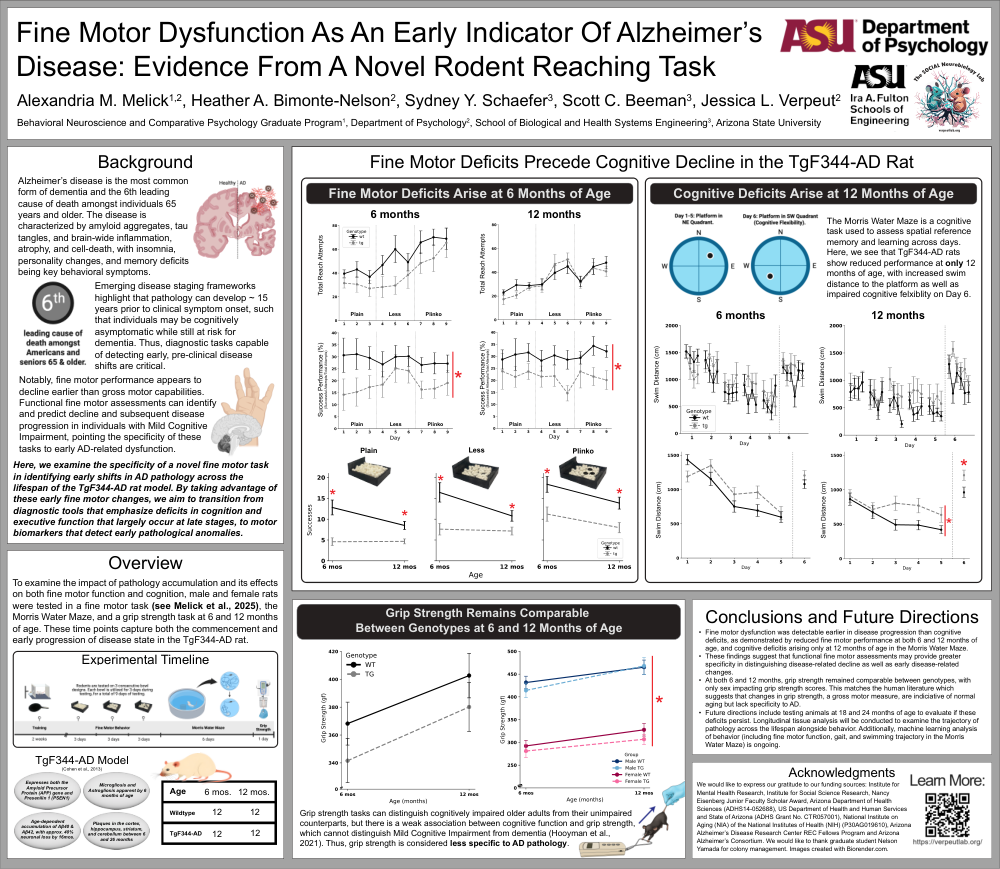
Fine Motor Dysfunction As An Early Indicator Of Alzheimer’S Disease: Evidence From A Novel Rodent Reaching Task
Poster Presenter
Authors
Alexandria Melick, Heather Bimonte-Nelson, Sydney Schaefer, Scott Beeman, Jessica Verpeut
Affiliations
Part of Topic
Basic Science and Pathogenesis -> Genetics -> Genetics of systems biology
Fine motor dysfunction was detectable earlier in disease progression than cognitive deficits, as demonstrated by reduced fine motor performance in the TgF344-AD rats at both 6 and 12 months of age, and cognitive deficitis arising only at 12 months of age in the Morris Water Maze.
These findings suggest that functional fine motor assessments may provide greater specificity in distinguishing disease-related decline as well as early disease-related changes.
At both 6 and 12 months, grip strength remained comparable between genotypes, with only sex impacting grip strength scores. This matches the human literature which suggests that changes in grip strength, a gross motor measure, are indiciative of normal aging but lack specificity to AD.
Future directions include testing animals at 18 and 24 months of age to evaluate if these deficits persist. Longitudinal tissue analysis will be conducted to examine the trajectory of pathology across the lifespan alongside behavior. Additionally, machine learning analysis of behavior (including fine motor function, gait, and swimming trajectory in the Morris Water Maze) is ongoing.
Comments
Email is required but is not shown publicly.
Loading comments...